Top Vídeos

Voy a conducir el primer automóvil del mundo (su réplica), patentado por Benz en 1886.
Para hacer este video Mercedes-Benz me invitó a ir a Stuttgart para ver sus últimos autos, instalaciones de pruebas de choque y experimentar las innovaciones en las que están trabajando.
La física es algo que se aplica directamente a la seguridad de los autos. Los automóviles van rápido, pero a veces también chocan con obstáculos, lo que los detiene repentinamente, sometiendo al vehículo y a los ocupantes a aceleraciones muy altas, que pueden causar lesiones o la muerte. Entonces, la idea principal para mejorar la seguridad del automóvil es reducir estas aceleraciones y hay varias formas de hacerlo. Descúbrelas en este interesante video.
Filmado por Simon Schneider
Editado por Hoplite Creative y Trevor Carlee
------------------------------------------------------------------------
Servicios de doblaje: Unilingo
Traductora: Paula Salomone
Voz de doblaje: Pato Lago, Diego Rivas, Julia Gonzalez Biondini
Ingeniero de sonido: Gastón Adriel Álvarez
Edición y post-producción de video: Juan Caille Tornquist
------------------------------------------------------------------------
#veritasiumenespañol

Una nueva investigación muestra que los camaleones controlan activamente sus nanocristales (cristales fotónicos ) para cambiar su color.
Acompáñenme en este interesante video para ver cómo son capaces de hacerlo.
Esta investigación fue llevada a cabo por Jérémie Teyssier, Suzanne V. Saenko, Dirk van der Marel y Michel C. Milinkovitch en el Departamento de Física Cuántica de la Universidad de Ginebra y en el Laboratorio de Evolución Artificial y Natural (LANE).
El video de la difusión de la melanina es cortesía de Richard Wheeler:
https://www.youtube.com/watch?v=hL0USeWjTHQ
http://www.richardwheeler.net
Agradecimientos especiales a:
Harry, Jo, Daniella y Raquel por ayudarme a producir y filmar este video.
SUSCRÍBETE ahora para ver todos nuestros videos:
http://bit.ly/Suscribirse_Veritasium_en_español
------------------------------------------------------------------------
Servicios de doblaje: Unilingo
Traductora: Paula Salomone
Voz de doblaje: Pato Lago,
Ingeniero de sonido: Gastón Adriel Álvarez
Edición y post-producción de video: Juan Caille Tornquist
------------------------------------------------------------------------
#veritasiumenespañol
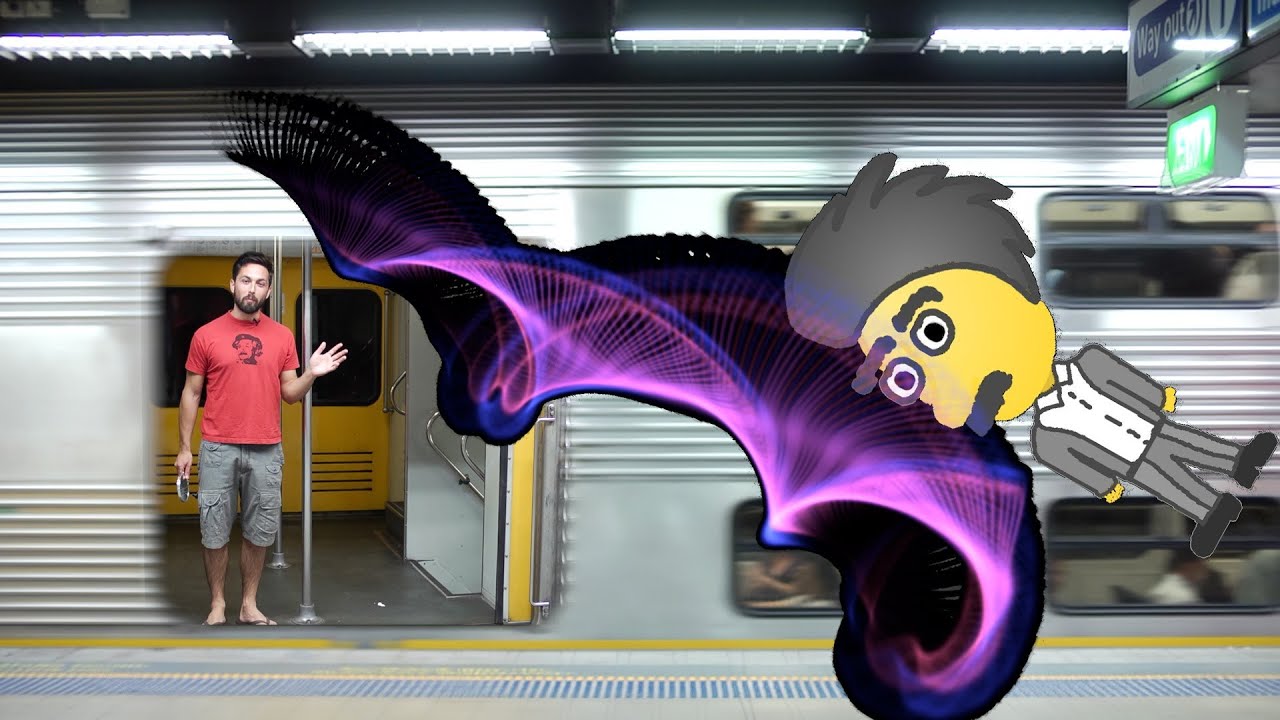
Einstein's classic thought experiment involves sitting on a train travelling at the speed of light. If you hold a mirror in front of your face, will you see your reflection in a mirror? How could light from your face reach the mirror if the mirror is travelling away from you? But it would be a pretty spooky train if you couldn't see your reflection so Einstein felt this solution wasn't realistic. On the other hand if you could see your reflection, it would mean light was travelling at the speed of light inside the train. But that meant the same light observed from outside the train would be going twice the speed of light. This again seems inconsistent. So Einstein resolved that you must see your reflection but that light must travel at the same speed inside and outside the train. The only way this is possible is if space and time are perceived differently by observers inside and outside the train.

We have just seen the first image of a black hole, the supermassive black hole in the galaxy M87 with a mass 6.5 billion times that of our sun. But what is that image really showing us?
This is an awesome paper on the topic by J.P. Luminet:
Image of a spherical black hole with thin accretion disk
Astronomy and Astrophysics, vol. 75, no. 1-2, May 1979, p. 228-235
https://ve42.co/luminet
Using my every day intuition I wondered: will we see the "shadow" of the black hole even if we're looking edge on at the accretion disk? The answer is yes because the black hole warps space-time, so even if we wouldn't normally be able to see the back of the accretion disk, we can in this case because its light is bent up and over the black hole. Similarly we can see light from the bottom of the back of the accretion disk because it's bent under the bottom of the black hole. Plus there are additional images from light that does a half turn around the black hole leading to the inner rings.
What about the black hole "shadow" itself? Well initially I thought it can't be an image of the event horizon because it's so much bigger (2.6 times bigger). But if you trace back the rays, you find that for every point in the shadow, there is a corresponding ray that traces back to the event horizon. So in fact from our one observing location, we see all sides of the event horizon simultaneously! In fact infinitely many of these images, accounting for the virtually infinite number of times a photon can orbit the black hole before falling in. The edge of the shadow is due to the photon sphere - the radius at which light goes around in closed orbits. If a light ray coming in at an oblique angle just skims the photon sphere and then travels on to our telescopes, that is the closest 'impact parameter' possible, and it occurs at sqrt(27)/2*r_s
Huge thanks to:
Prof. Geraint Lewis
University of Sydney https://ve42.co/gfl
Like him, I'm hoping (predicting?) we'll see some moving images of black holes tomorrow
Prof. Rana Adhikari
Caltech https://ve42.co/Rana
Riccardo Antonelli - for excellent images of black holes, simulations and ray-tracing code, check out:
https://ve42.co/rantonels
The Event Horizon Telescope Collaboration
Check out their resources and get your local link for the livestream here: https://ve42.co/EHT
Special thanks to Patreon supporters:
Donal Botkin, Michael Krugman, Ron Neal, Stan Presolski, Terrance Shepherd, Penward Rhyme
Filming by Raquel Nuno
Animation by Maria Raykova

Silicone oil droplets provide a physical realization of pilot wave theories.
Check out Smarter Every Day: http://bit.ly/VeSmarter
Support Veritasium on Patreon: http://bit.ly/VePatreon
Huge thanks to:
Dr. Stephane Perrard, Dr Matthieu Labousse, Pr Emmanuel Fort, Pr Yves Couder and their group site http://dualwalkers.com/
Prof. John Bush: http://math.mit.edu/~bush/
Dr. Daniel Harris
Prof. Stephen Bartlett
Looking Glass Universe: http://bit.ly/LGUVe
Workgroup Bohemian Mechanics: http://www.mathematik.uni-muenchen.de/~bohmmech/
Filmed by Raquel Nuno
Thanks to Patreon supporters:
Nathan Hansen, Bryan Baker, Donal Botkin, Tony Fadell, Saeed Alghamdi
Thanks to Google Making and Science for helping me pursue my #sciencegoals. If you want to try this experiment, instructions are here: link.springer.com/article/10.1007/s12650-016-0383-5
The standard theory of quantum mechanics leaves a bit to be desired. As Richard Feynman put it, "I think I can safely say that no one understands quantum mechanics." This is because observations of experiments have led us to a theory that contradicts common sense. The wave function contains all the information that is knowable about a particle, yet it can only be used to calculate probabilities of where a particle will likely turn up. It can't give us an actual account of where the particle went or where it will be at some later time.
Some have suggested that this theory is incomplete. Maybe something is going on beneath the radar of standard quantum theory and somehow producing the appearance of randomness and uncertainty without actually being random or uncertain. Theories of this sort are called hidden variable theories because they propose entities that aren't observable. One such theory is pilot wave theory, first proposed by de Broglie, but later developed by Bohm. The idea here is that a particle oscillates, creating a wave. It then interacts with the wave and this complex interaction determines its motion.
Experiments using silicone oil droplets on a vibrating bath provide a remarkable physical realization of pilot wave theories. They give us a physical picture of what the quantum world might look like if this is what's going on - and this theory is still deterministic. The particle is never in two places at once and there is no randomness.
Edited by Robert Dahlem
Sound design by A Shell in the Pit
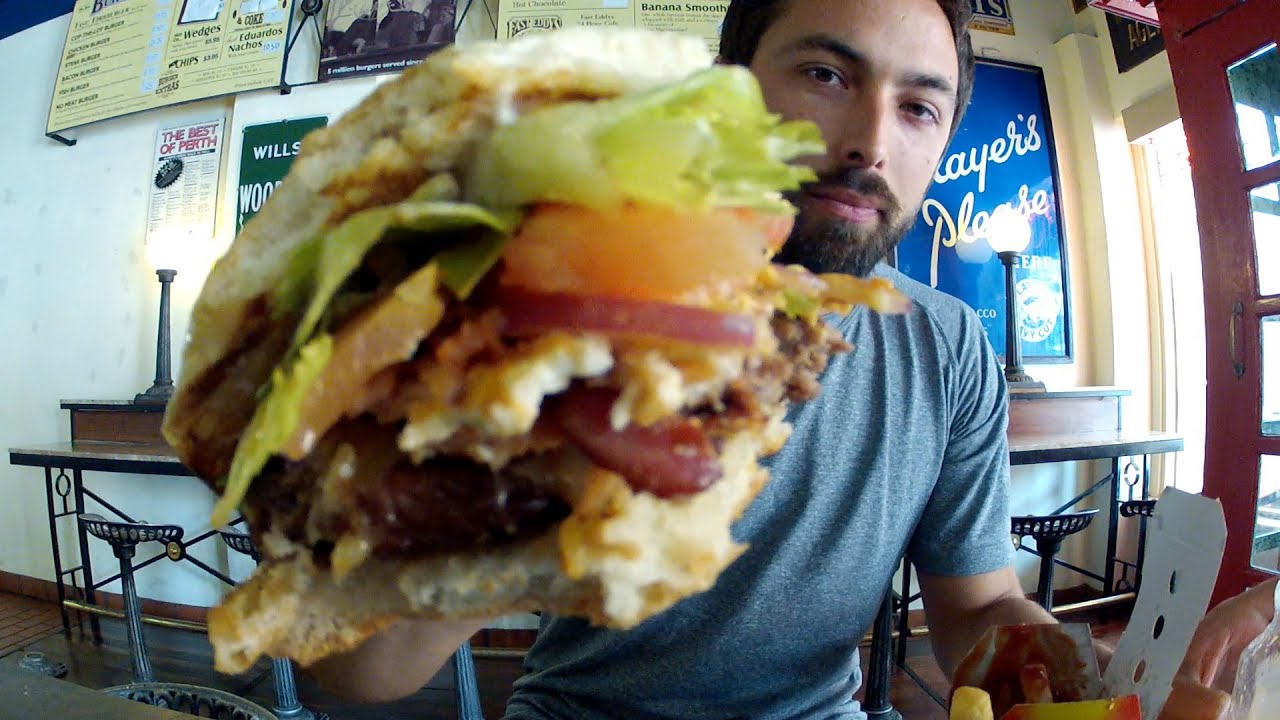
Are you heaviest at night before you go to bed and lightest in the morning? I tried to tease out the factors to figure out what really causes weight gain and loss during the day, and what causes daily weight fluctuations.

Why does time appear to speed up as we get older? Can we slow it down?
Thanks to the National Geographic Channel for sponsoring this video!
The new season of Brain Games starts Sunday, February 14th at 9/8c - http://po.st/90S7Ow
Brain Games is an Emmy-nominated TV series that explores the inner workings of the human mind through experiments and interactive games. Did you know it's estimated that you have more than a dozen senses in addition to the standard five? One of those is a sense of time or chronoception. Tune in to the new season of Brain Games to learn about all of your senses, and more, starting Sunday, February 14 at 9/8c
References:
Ageing and duration judgement:
http://bit.ly/1TRN0cr
Nerve conduction velocity slowing with age:
http://bit.ly/23Wq6oE
Experiments with rats suggest time perception is distributed across brain:
http://bit.ly/1T6IjdO
Time perception with repeated stimuli:
http://bit.ly/1TRNbo5
Energy usage in brain with age:
http://bit.ly/1nXliOU
Time perception in moments of fear / danger:
http://bit.ly/1RoK7Ps
http://1.usa.gov/1TRNa3w
http://bit.ly/1Q8tDvW
Attention’s relation to time perception and recollection of perceived time:
http://bit.ly/20odeD8
http://bit.ly/1TRNfEf

Watch the bullet block experiment first: http://bit.ly/bulletblock
Click for a free audiobook from Audible: http://bit.ly/ZJ5Q6z
An interactive vignette of the bullet block http://ivv.rit.edu/bby/
Can you figure out the spinning disk? http://bit.ly/spinningdisk
Thank you all for the awesome video responses and comments!!
Simulation: http://bit.ly/19SCVnl
Web comic: http://bit.ly/17o8HrR
Wired Blog: http://bit.ly/17o9Dwu
Science Blogs: http://bit.ly/17o9au3
Scientific American: http://bit.ly/19SDoWC
Le's Blog: http://bit.ly/18q1m8a
Video responses from which I borrowed:
http://www.youtube.com/watch?v=hup-l4_Qt_U
http://www.youtube.com/watch?v=uwZ1Mhy0BS0
http://www.youtube.com/watch?v=SgylTbknFdM
Thanks to everyone at RIT and Dickinson College who helped with the making of this video:
Rochester Institute of Technology
Robert Teese, Katelyn Wilkerson, Andrew Gillie, Andrew Stidwill
Dickinson College
This experiment was the brainchild of David Jackson based on a demo at Princeton.
Priscilla Laws, Catrina Hamilton-Drager, Maxine Willis
High-speed camera support:
Charles Zwemer and Bria Antoine
Music: Temper Trap "Love Lost (Instrumental)" and Lights & Motion "Epilogue" licensed from CueSongs.com

I am working on some big new projects I'm excited to share with you!
So this video is a little different from most of the others. The channel is an element of truth, after all, not an element of science. This is my truth. It may not be everyone's but that's ok too.
Clips included were from:
Chernobyl and Pripyat - drone shots from shooting Uranium
Obsidian dome, California
Panum Crater
El Capitan
The Pyramids of Giza
Toronto buildings
The Holocaust Memorial in Berlin
Abu Simbel temple at Aswan, Egypt
Sydney Harbour
Milky way time-lapse from the badlands of South Australia
Sunset over Warrnambool, Victoria
Big Bang animation courtesy of NASA
Sunrise over Bondi
Water off New Caledonia
Great white sharks in the Neptune Islands, South Australia
Crosswalk at Town Hall Sydney
EDUtubers at the YouTube EDU summit in San Francisco
Concert in Sydney
Jetpacking in Western Sydney
Vi's triangles at Perimeter Institute, Waterloo Canada
Aurora Borealis north of Fairbanks Alaska
Sagrada Familia, Barcelona, Spain
Hiking with MinutePhysics in Washington State
Music Licensed from cuesongs.com "The Secret Tower" by Nicholas O

The definitive answer about the direction water swirls in two hemispheres
Sync the videos yourself: http://toiletswirl.com
For the record Destin and I repeated the experiment 3-4 times each in each hemisphere and got the same results every time.
The idea that water going down a drain or flushed down a toilet swirls in opposite directions in the Northern and Southern Hemispheres has a long history. But few have ever done the experiment. Destin from Smarter Every Day and I performed identical experiments in the Northern and Southern hemispheres. What we found is the direction of water swirl in a toilet, sink, or bathtub is determined by other sources of angular momentum. However if the body of water is big enough, e.g. a kiddy pool, and left still for long enough (at least 24 hours), then the Coriolis effect is observable with water swirling counterclockwise in the Northern hemisphere and clockwise in the Southern hemisphere.
Veritasium on Instagram: http://instagram.com/veritasium
Patreon Support Link: http://www.patreon.com/veritasium
Twitter: http://twitter.com/veritasium
http://www.facebook.com/veritasium
Smarter Every Day Instagram: http://instagram.com/smartereveryday
Patreon Support Link: http://www.patreon.com/smartereveryday
Twitter: http://twitter.com/smartereveryday
www.facebook.com/SmarterEveryDay
Gordon McGladdery did all of the sound design for the video. We used two songs from other artists (licensed of course). Derek split the first one up so it fades from video to video, and Gordon split the instruments up on the second one. There are violins on one video and percussion on the other for example. It's really neat.
The neat earth animation at the beginning and the synchronizing timer was made by http://eisenfeuer.com/. He also made still images of the earth from the top and the bottom.
Thanks to Vanessa for filming in Sydney: http://youtube.com/braincraftvideo
MORE INFO:
There was a study performed at MIT years ago (http://web.mit.edu/hml/ncfmf/09VOR.pdf) that explained the physics involved. We repeated some of these demonstrations, but on opposite sides of the globe…and in a way that can be easily understood.
This site is a great resource on the Coriolis effect and ways people have gotten it wrong:
http://www.ems.psu.edu/~fraser/Bad/Ba...

When a tube spins with an X and an O labelled at either end, why do we see only one letter during the rotation?

The sun has been producing light for about five billion years but where does all its energy come from? The most common idea is that the sun is burning gas - like a giant fireball in the sky. If this were true, the sun would have gone out long ago. So how is the sun actually fuelling itself? It is converting its own mass into energy. By combining protons (the nucleus of hydrogen) into helium, it squeezes some mass into energy - 4.3 billion kg per second. It is Einstein's famous E=mc^2 which gives us the quantitative relationship between mass and energy, where c is the speed of light.

Panem finds power in the radiance of the sun, and the water which rains down upon us! District 5’s Chief Energy Researcher Derek Muller takes CapitolTV on a tour of our nation's cutting edge renewable technologies, and demonstrates one of the largest ‘Kelvin’s Thunderstorm’ experiments ever built to date… all for a brighter and more efficient Panem.
Sanctioned by the Capitol Ministry of Information, DISTRICT VOICES was made with friends from Google - http://artcopycode.com/campaign/lionsgate
For more of Panem’s finest programming, and to register for updates, visit http://CapitolTV.pn
#CapitolTV - #DistrictVoices
The Hunger Games: Mockingjay Part 1 – In theaters November 21
http://TheHungerGamesExplorer.com
#Mockingjay
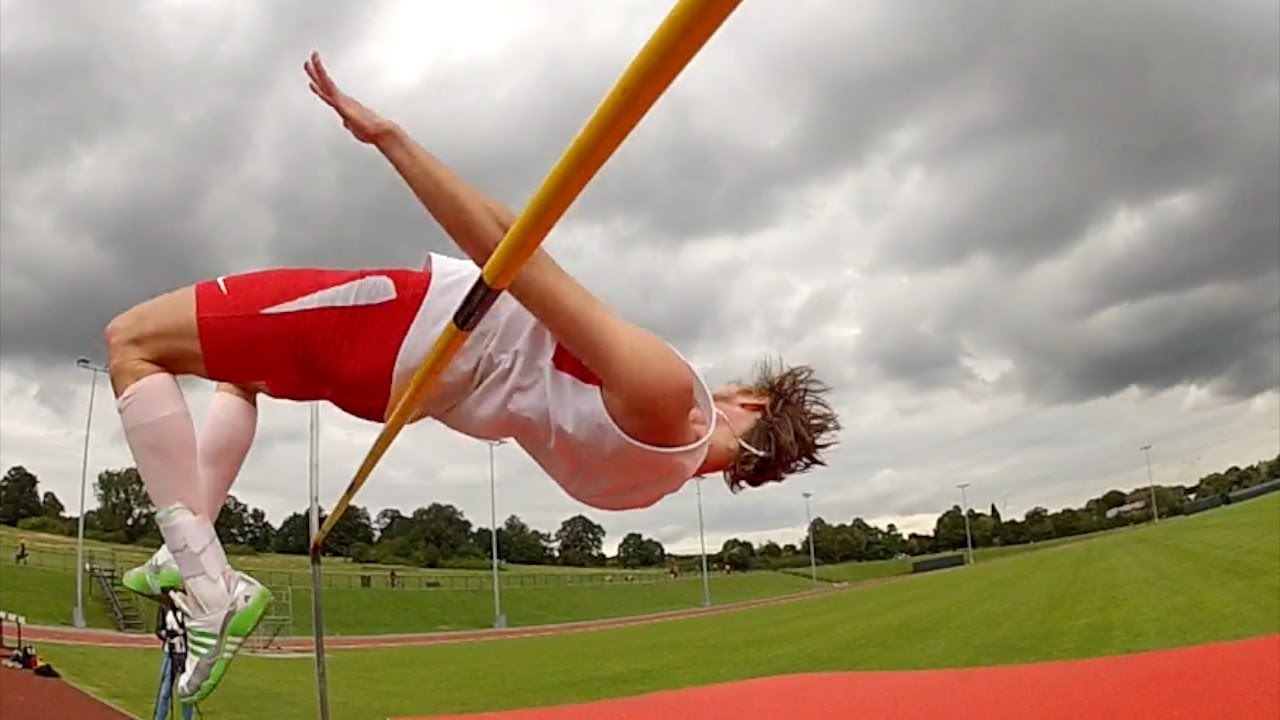
The strange thing about high jump is that the technique changed dramatically after 1968, when Dick Fosbury used his trademark flop to win the gold medal at the Olympics in Mexico City.
Previously the scissors and straddle had been the most common jumping technique, but after the introduction of safer landing matts, the new unorthodox Fosbury Flop became the jump of choice. There are good physical reasons for this - the style allows the jumper to pass over the bar while his or her centre of mass actually passes below the bar.
Huge thanks to Elly (Appchat http://bit.ly/NxAMlX ) for filming, editing, and music!
numberphile http://bit.ly/numberphile
efit30 http://bit.ly/O4CMme
appchat http://bit.ly/NxAMlX
erikaanear http://bit.ly/MdyUzQ
whoisjimmy http://bit.ly/LtFzpW
minutephysics http://bit.ly/Muh6CC
1veritasium http://bit.ly/MrupzL

Scientists have JUST published this new observation. On January 4th, 2017 they detected the merger of two black holes 3 billion light-years away. This marks the furthest detection they've been able to make and increases confidence that these events will be seen with increasing frequency as the LIGO interferometers become more sensitive to low amplitude gravitational waves (as sources of noise are eliminated).
Special thanks to:
Prof. Rana Adhikari
Prof. David Reitze
Resources by:
Binary Neutron Star merger: Relastro @ ITP - Goethe University, Frankfurt https://www.youtube.com/watch?v=nOTXC4FG9gU
Numerical simulation of black hole merger:
S. Ossokine/A. Buonanno/T. Dietrich (MPI for Gravitational Physics)/R. Haas (NCSA)/SXS project
Artist's impression of merger and chart: LIGO/Caltech/MIT/Sonoma State (Aurore Simonnet)
Simulation of black hole merger: SXS Collaboration
Special thanks to Patreon Supporters:
Tony Fadell, Donal Botkin, Jeff Straathof, Zach Mueller, Ron Neal, Nathan Hansen
Support Veritasium on Patreon: http://ve42.co/patreon
Sound Recording by Raquel Nuno

Chaos theory means deterministic systems can be unpredictable. Thanks to LastPass for sponsoring this video. Click here to start using LastPass: https://ve42.co/VeLP
Animations by Prof. Robert Ghrist: https://ve42.co/Ghrist
Want to know more about chaos theory and non-linear dynamical systems? Check out: https://ve42.co/chaos-math
Butterfly footage courtesy of Phil Torres and The Jungle Diaries: https://ve42.co/monarch
Solar system, 3-body and printout animations by Jonny Hyman
Some animations made with Universe Sandbox: https://universesandbox.com/
Special thanks to Prof. Mason Porter at UCLA who I interviewed for this video.
I have long wanted to make a video about chaos, ever since reading James Gleick's fantastic book, Chaos. I hope this video gives an idea of phase space - a picture of dynamical systems in which each point completely represents the state of the system. For a pendulum, phase space is only 2-dimensional and you can get orbits (in the case of an undamped pendulum) or an inward spiral (in the case of a pendulum with friction). For the Lorenz equations we need three dimensions to show the phase space. The attractor you find for these equations is said to be strange and chaotic because there is no loop, only infinite curves that never intersect. This explains why the motion is so unpredictable - two different initial conditions that are very close together can end up arbitrarily far apart.
Music from https://epidemicsound.com "The Longest Rest" "A Sound Foundation" "Seaweed"
My PhD: http://www.physics.usyd.edu.au..../super/theses/PhD(Mu
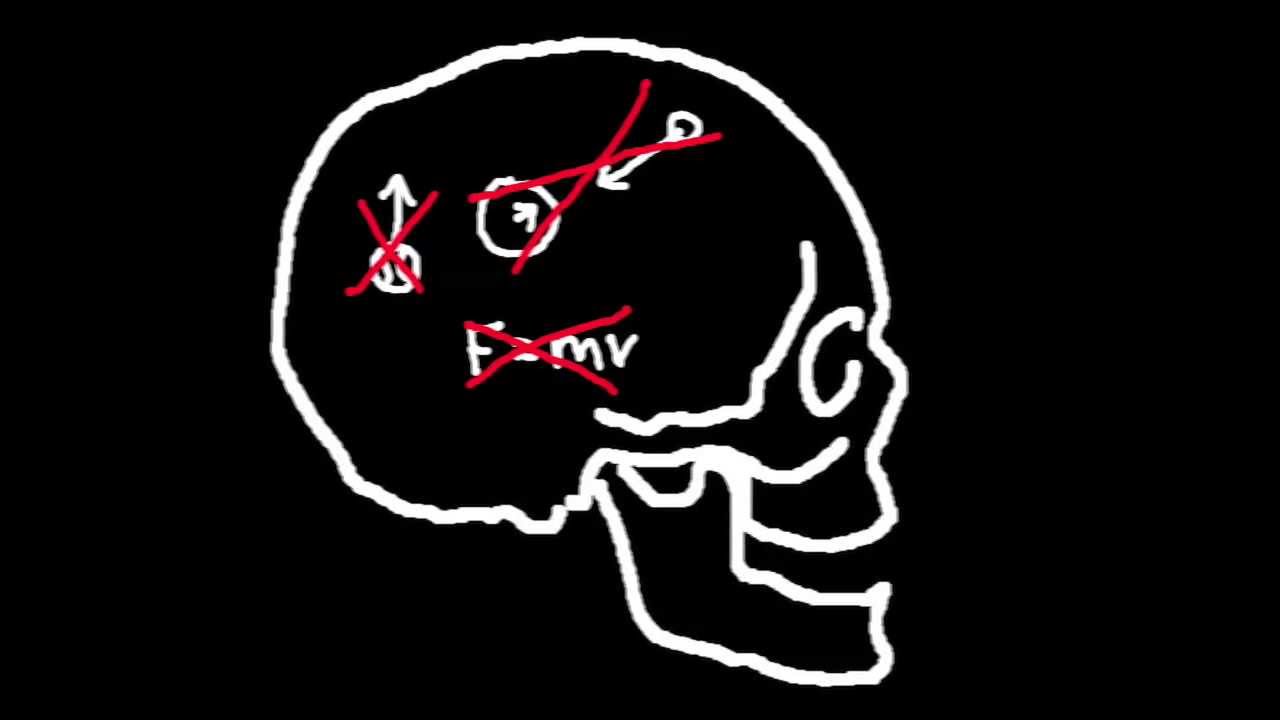
It is a common view that "if only someone could break this down and explain it clearly enough, more students would understand." Khan Academy is a great example of this approach with its clear, concise videos on science. However it is debatable whether they really work. Research has shown that these types of videos may be positively received by students. They feel like they are learning and become more confident in their answers, but tests reveal they haven't learned anything. The apparent reason for the discrepancy is misconceptions. Students have existing ideas about scientific phenomena before viewing a video. If the video presents scientific concepts in a clear, well illustrated way, students believe they are learning but they do not engage with the media on a deep enough level to realize that what was is presented differs from their prior knowledge. There is hope, however. Presenting students' common misconceptions in a video alongside the scientific concepts has been shown to increase learning by increasing the amount of mental effort students expend while watching it.

If you drop a heavy object and a light object simultaneously, which one will reach the ground first? A lot of people will say the heavy object, but what about those who know both will land at the same time? What do they think? Some believe both objects have the same gravitational pull on them and/or both fall to the ground with the same constant speed. Neither of these things is true, however. The force is greater on the heavy object and both objects accelerate at the same rate as they approach the earth, i.e. they both speed up but at the same rate.

How Schlieren imaging works in color, black and white and slow-mo.
Get a free audiobook with a 30 day free trial at http://www.audible.com/veritasium
Special thanks to Patreon supporters:
Tony Fadell, Donal Botkin, Curational, Jeff Straathof, Zach Mueller, Ron Neal, Nathan Hansen, Corvi
Support Veritasium on Patreon: http://ve42.co/patreon
Filming by Raquel Nuno
Sound Effects by A Shell in the Pit

Droplets levitate on a bath of liquid nitrogen and are spontaneously self-propelled. Thanks Audible! Start a 30-day trial and your first audiobook is free. Go to https://audible.com/VERITASIUM or text VERITASIUM to 500500.
Special thanks to Dr. Anaïs Gauthier
Physics of Fluids: https://pof.tnw.utwente.nl/
Self-propulsion of inverse Leidenfrost drops on a cryogenic bath
Anaïs Gauthier, Christian Diddens, Rémi Proville, Detlef Lohse, and Devaraj van der Meer
PNAS January 22, 2019 116 (4) 1174-1179; published ahead of print January 22, 2019
https://www.pnas.org/content/116/4/1174
For a detailed description of the setup:
http://www.lps.ens.fr/~adda/pa....piers/Langmuir2016.p
And self-propulsion is also seen: http://www.lps.ens.fr/~adda/pa....piers/InvLeidenfrost
Other recent (hot) Leidenfrost experiments that might be interesting:
* Leidenfrost wheels: https://www.youtube.com/watch?v=glRGl-eYuXo
* Leidenfrost maze: https://www.youtube.com/watch?time_continue=174&v=vPZ7sx3EwUY
* Leidenfrost explosions: https://www.youtube.com/watch?v=z0sp3AjgUy4
Special thanks to Patreon supporters:
Donal Botkin, James M Nicholson, Michael Krugman, Nathan Hansen, Ron Neal, Stan Presolski, Terrance Shepherd
Thanks to Prof. Kevin McKeegan at UCLA for the liquid nitrogen
Filming by Raquel Nuno
Additional animations by Alan Chamberlain
