Top Vídeos

Om Nom along with his best friend Om Nelle are now entering the magical world of learning where every day they learn something new about shapes, colors, numbers and more! Come along kids and join your ever favorite #OmNom in this new and exclusive #cartoon collection of #LearningWithOmNom!
Don’t forget to subscribe: https://www.youtube.com/channel/UCvMF...
To watch more of our videos click on the following links:
The Om Nom Finger Family:
https://www.youtube.com/watch?v=8wec3...
Learn Colors with Soccer Balls Xylophone:
https://www.youtube.com/watch?v=Ax-EA...
Learn Numbers and Colors with Underwater Sea Animals:
https://www.youtube.com/watch?v=pe-sz...
Om Nom Arts and Crafts:
https://www.youtube.com/watch?v=x4Lb3...

http://www.sciencefriday.com/cider
How do you turn apples into a delicious hard cider? Just ask Alejandro del Peral, a cidermaker from upstate New York. It takes blending suitable apples, adding the right yeast, and experimenting with sourness to get the cider exactly right. As he puts it, the process is "about 50 percent chemistry, and the other 50 percent is art."
Produced by Luke Groskin
Music by Audio Network
Special Thanks to Chau Tu and Nine Pin Cider
http://www.sciencefriday.com
Like many spice junkies, Dr. Marco Tizzano once believed he could develop a tolerance to the burning, painful sensations generated by eating chilis. But as a chef and researcher in chemosensory sensations, he now knows better. Dr. Tizzano explains how capsaicin creates a chemical cascade inside your body and why emotions might make chili lovers think they can handle the heat.

Tour the unique artifacts, including a yeti scalp and 4-tusked elephant, collected by Explorers Club members during research expeditions over the last century. Executive Director Will Roseman reveals the remarkable science and stories of the collection at the Club Headquarters in New York City.

Thought to the be inspiration of "sea serpent" stories, the monstrously-long Oarfish provokes wonder in nearly all that witness it. Yet despite our fascination, little is known about this fish, its lifecycle and how it navigates its deep-sea environment. With help of a frozen specimen, CalState Assistant Professor Misty Paig-Tran provides us with a biomechanist insights into this real-life "sea monster's" unusual physiology.
Produced by Luke Groskin
Filmed by Christian Baker, Luke Groskin, CalState - Fullerton Music by Audio Network
Additional Stills and Video by UnCruise Adventures, Mark Benfield NOAA, and Juan, Pablo Maturana, Corrine Bourbellion, Thomas Kohler
http://www.sciencefriday.com
This video is part of Science Friday's #CephalopodWeek 2015! Join the cephaloparty starting Friday, June 19th. http://cephalopodweek.tumblr.com
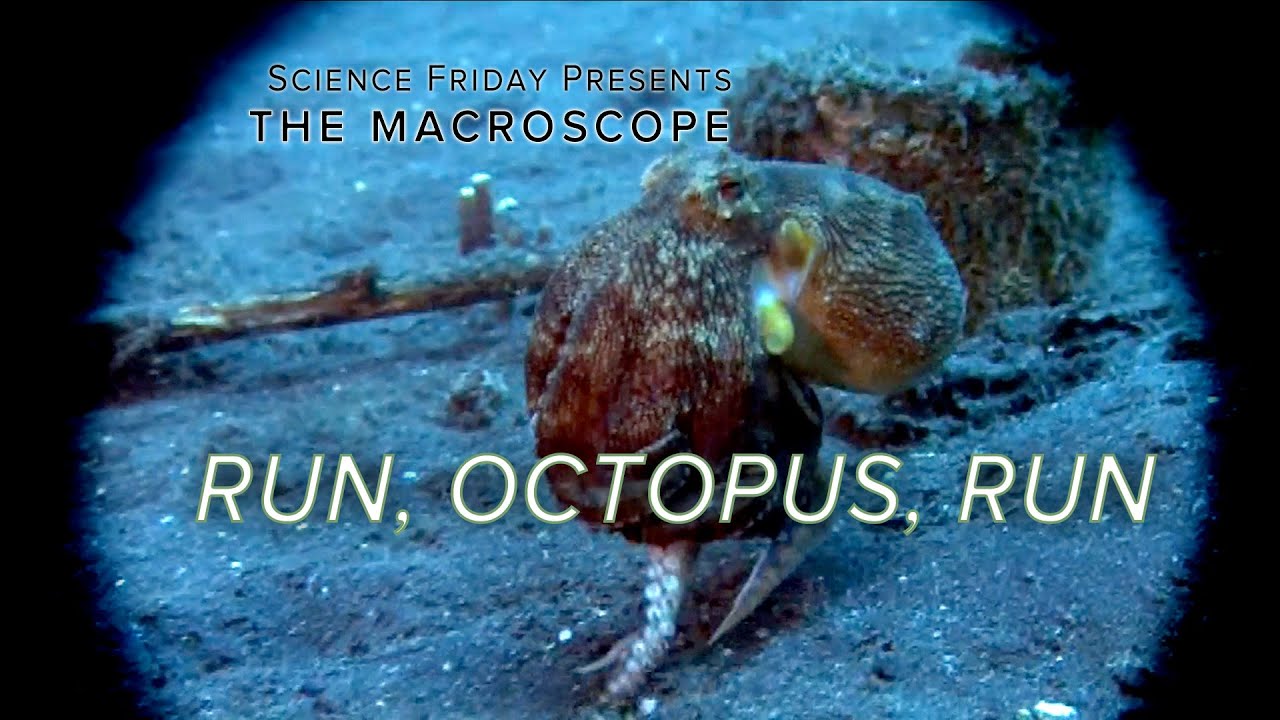
Crawling, swimming, squeezing, jetting—the range of movement available to an octopus is impressive. Yet some species occasionally choose to stand up on two arms and "run" backwards. Chrissy Huffard, a Senior Researcher at the Monterey Bay Aquarium Research Institute, explains the pros and cons of this seemingly silly behavior and why an octopus might find looking foolish useful.

There are lots of wild things in Brooklyn, NY, but did you know about the wild parrots? Several communities of Quaker Parrots (Myiopsitta monachus), believed to hail from the mountains of South America, are nesting in the New York area. So we asked Steve Baldwin, the creator of http://BrooklynParrots.com, to point out the parrots. He gives free group tours about once a month, if you're in the area....

http://www.sciencefriday.com
By looking at a face for less than a second, we can judge someone’s age, gender, race, emotional state and even their trustworthiness. High-speed scanning and perception experiments by social neurologist Dr. Jon Freeman have revealed our brain’s ability to generate character assessments in less than blink of an eye. These first impressions can linger in our brains and influence our real-world interactions.
Produced by Luke Groskin
Music by Audio Network
MRI Stand-in by Sarah Lewin
Footage ands Stills Provided by Dr. Jon Freeman, Shutterstock, Warren Goldswain, Glasgow Unfamiliar Face Database, Bruce Gionet (C.C. 3.0), Nina Paley (C.C. 3.0), Kim Cramer (C.C. 3.0), “Brain Optic Nerve Impulses,” Produced by Purdue University Calumet senior engineering students supervised by Professors Bin Chen, Ph.D, and Ge Jin Ph.D, with support of the university’s Center for Innovation through Visualization and Simulation. Full video is available at: http://webs.purduecal.edu/civs/brain-visualization

What high-tech materials are required to make a robotic hand that can pick up almost anything? Coffee grounds and a latex balloon. The design comes from a team of researchers including Heinrich Jaeger of The University of Chicago and John Amend, who is now trying to sell these grippers through Empire Robotics. But you can make your own version at home with some simple materials. The only tricky-to-find object you'll need is a vacuum pump (I got mine from here: https://www.sparkfun.com/products/10398, where you can also find an excellent instructional video).

http://www.sciencefriday.com
Just as humans utilize roads and freeways to move cars and resources around our cities, fungus utilize fluid networks to move nutrients and nuclei through their cells. Dr. Marcus Roper of UCLA explains how these networks function with remarkable efficiency and prevent microscopic traffic jams.
Produced by Christian Baker
Music by Audio Network
Additional Footage Courtesy of Marcus Roper and UCLA

For most people, getting stuck in a traffic jam on the New Jersey Turnpike is a grueling lesson in futility. But if you're Simon Garnier of the New Jersey Institute of Technology, you often view it as an opportunity to examine our collective behavior and ponder how we became so inefficient compared to other species. Having studied the expansive food trails of army ants and the seemingly mindless exploration of slime mold, Garnier hopes to model the systems of their behavior in order to understand how and why relatively simple organisms organize themselves so dynamically.
Produced by Luke Groskin
Music by Audio Network
Additional Stills and Video Provided by:
Sean McCann, Matthew Lutz, Simon Garnier, Aladin Casino (C.C. 3.0), Phy Chip (C.C. 2.0), Un Poco Del Choco (C.C. 3.0),
Jeff Gerber PD (C.C. 3.0), Vimeo User Implicate Order (C.C. 3.0), Murray Gans (C.C. 3.0)
S.P Sullivan (C.C. 3.0)

http://www.sciencefriday.com
For over 70 years, no one had seen the oblong rocksnail. Declared extinct in 2000, the species was considered to be another native Alabaman mollusk gone and forgotten. But one day in the spring of 2011, biology grad student Nathan Whelan picked up a tiny rock and got a big surprise.
Produced by Luke Groskin
Music by Audio Network
Additional Stills and Photos by Shutterstock, Thomas Tarpley, Alabama Department of Conservation and Natural Resources, Alabama Aquatic Biodiversity Center, Nathan Whelan, Boris Datnow, Alabama Power, Annals of Lyceum, Wild Side TV, Paul Johnson, Masood Lohar, Bermuda Conservation Services, Jefferson County Environmental Services

http://www.sciencefriday.com
Medieval stained glass reveals a lot about life in the Middle Ages, but keeping these artistic works from falling apart is a detailed process. Hanne Roemich from New York University's Conservation Center and Brooklyn-based conservator Mary Clerkin Higgins discuss the science behind glass conservation, and how these centuries-old relics are protected from the natural elements so we can enjoy them for years to come!
Produced by Katie Free and Neel V. Patel
Music by Kevin Macloed via incompetech.com

http://www.sciencefriday.com
Did you know that most mammals, from a house cat to an elephant, take roughly the same amount of time to urinate? Researchers at Georgia Tech collected data, streamed via online video and in real life, and discovered that a combination of physiology and gravity enable this feat of fluid dynamics.

*** Please support our video productions - http://www.patreon.com/scifri ***
For writer Michael Pollan, the contents of his refrigerator is often on the forefront of his mind: "I do think about food a lot, and if I'm distracted it's with thoughts of what's in the fridge." In the latest installment of our Desktop Diaries video series, we'll take you into the home office (and garden) of the famous food and nature author to see how edible ornamentations can sometimes provide inspiration.
Produced by Luke Groskin
Filmed by Christian Baker
Produced by Luke Groskin
Filmed by Christian Baker
Music by Claude Debussey as performed by Teppei Yamada-Scriba

Learn more and find out how you can take part at wnyc.org/streets.
Find out about this National Institute of Environmental Health Sciences Study here :
Avoiding belligerent bus drivers or unwitting tourists popping out of taxis are just a few of the more obvious risks of riding a bike through city streets.Yet there could be another inconspicuous and nearly unavoidable danger that could take a toll on your health: air pollution. Identifying how hazardous exercise can be in an urban environment filled with noxious particles in the air is the goal of a new study by Columbia University researchers Steven Chillrud and Darby Jack. Using biometric sensors, a wearable pollution monitor, and GPS, the study will detail participants' exposure to toxins as they cycle through city streets.
Produced by Luke Groskin
Music by Audio Network
Additional Stills and Video Provided by Zev Ross Spatial Analysis, Jen Connor, Recios Media Crew (C.C. 3.0), NACTO (C.C. 3.0), Vimeo User GCM (C.C. 3.0) , WNYC , Michael Phillips (C.C. 3.0), Darby Jack, Brewbooks EPA, Edison-Hannigan Lab

http://www.patreon.com/scifri - Please Help Support Our Video Productions!
Produced by Luke Groskin
By shrinking an entire museum into a 6 foot tall modular design, MICRO hopes that these tiny exhibits can go in all sorts of public areas, like shopping malls, waiting rooms, airports, and parks where they can integrate science and learning into people's day-to-day lives.
Edited by Sarah Galloway
Music by Audio Network
Additional Footage Provided by People’s Television and Science Sandbox, an initiative of the Simons Foundation
Special Thanks to Charles Philipp, Ruby Murray, and Amanda Schochet

*** Please support our video productions - http://www.patreon.com/scifri ***
MORE CEPHALOPOD VIDEOS - https://www.youtube.com/playli....st?list=PLB2w1JNHV4H
Deep below the sea surface, giant squid fight off predatory sperm whales--stirring legendary tales of epic battles. Yet for all it's infamy, discovering how many of these enormous cephalopods are lurking in the ocean has remained impossible...until now. Using simple arithmetic, Elizabeth Shea, Curator of Mollusks at the Delaware Museum of Natural History, along with colleagues at the Smithsonian Institution try to solve the mystery – with unfathomable results!
Produced by Luke Groskin
Music by Audio Network
Intro Giant Squid Footage by Akinobu Kimura
Additional Stills and Video by
Clyde and Ingrid Roper, Don Hurlbert/Smithsonian Institution, Getty/Oxford Scientific, J.J. King (C.C. BY 3.0), Liz Shea, Mike Goren (C.C. BY 3.0), NOAA Okeanos Explorer Program, Oceana Canada, Pond5, Shutterstock, Tsunemi Kubodera and Kyoichi Mori, Discovery / NHK
Special Thanks to Danna Staaf whose blog post inspired the video.

http://www.sciencefriday.com
What's the right way to hard-boil eggs?Just don't boil them! Jeff Potter, author of Cooking for Geeks, explains how steaming eggs, even massive ostrich eggs, makes them easier to peel.

*** Please support our video productions - http://www.patreon.com/scifri ***
MORE CEPHALOPOD VIDEOS - https://www.youtube.com/playli....st?list=PLB2w1JNHV4H
It's small. It's striped. It's looking for love. Meet the lesser Pacific striped octopus. Full-time biologist—part-time cephalopod matchmaker, Richard Ross invites us into his secret home lab where he studies the mating rituals of these tiny cephalopods.
Produced by Christian Baker
Music by Audio Network
Additional footage courtesy of Richard Ross