Top Vídeos

Tracklist below.
Online purchase or streaming (Spotify, iTunes, Amazon Music, Deezer, Google Play): https://brilliant-classics.lnk.to/DebussyPianoDuo
More Information: https://www.brilliantclassics.....com/articles/d/debus
Brilliant Classics Spotify: https://open.spotify.com/user/....brilliantclassics?si
Brilliant Classics Facebook: https://www.facebook.com/brilliantclassics
If it is true that the end of Romanticism coincided with the invention of electric light, then we can date this to 1880 – the year in which Thomas Alva Edison patented the light bulb. At around this time, a brilliant student at the Paris Conservatoire, Claude Debussy, decided to embark upon a composing career that would soon ‘illuminate’ the history of music.
Debussy’s output is roughly divided into three periods, each of which is represented by one of the three discs in this set. Focusing solely on his works for piano duo, the collection effectively represents a vantage point from which to analyse his stylistic development, since it touches on both Debussy's piano and orchestral writing simultaneously: as well as original keyboard works (Lindaraja is one example, the composer's first work inspired by Spain), there are piano pieces arranged for orchestra, vice-versa compositions (Prélude a l'après-midi d'un faune, for instance) and music that was clearly intended for the orchestra or for specific ensembles (one example is Le triomphe de Bacchus, for which the orchestration was never completed).
Performing these works are two of Italy's most celebrated pianists, Massimiliano Damerini and Marco Rapetti. Their accomplished readings highlight the unique relationship that exists between piano and orchestra – the former can be seen as a monochromatic version of the latter, with the latter essentially describing the former in polychromatic terms – and, at the same time, draw the listener's attention towards an important area of 19th-century music-making: namely piano transcriptions’ vital role in making operatic and symphonic repertoire available to all.
00:00:00 Symphonie: Allegro
00:09:54 Andante cantabile
00:18:27 Diane: Ouverture
00:25:20 Le triomphe de Bacchus: Suite d’Orchestre: I. Divertissement
00:28:59 Le triomphe de Bacchus: Suite d’Orchestre: II. Andante
00:32:29 Le triomphe de Bacchus: Suite d’Orchestre: IV. Marche et Bacchanale: (fragment A)
00:33:39 Le triomphe de Bacchus: Suite d’Orchestre: IV. Marche et Bacchanale: (fragment B)
00:38:17 Intermezzo
00:42:49 Première Suite d’Orchestre: I. Fête
00:48:49 Première Suite d’Orchestre: II. Ballet
00:53:22 Première Suite d’Orchestre: III. Rêve
01:01:47 Première Suite d’Orchestre: IV. Cortège et Bacchanale
01:10:47 Divertissement
01:22:46 L’Enfant prodigue: Scène lyrique, three excerpts: I. Prélude
01:25:21 L’Enfant prodigue: Scène lyrique, three excerpts: II. Cortège - III. Air de danse
01:29:36 Printemps: Suite symphonique: I. Très modéré
01:39:54 Printemps: Suite symphonique: II. Modéré
01:47:45 Petite Suite: I. En bateau
01:51:26 Petite Suite: II. Cortège
01:54:56 Petite Suite: III. Menuet
01:58:16 Petite Suite: IV. Ballet
02:01:38 Marche écossaise sur un Thème populaire: ‘The Earl of Ross March’
02:09:09 Prélude à l’après-midi d’un Faune
02:19:36 Lindaraja
02:25:54 La Mer: Trois Esquisses symphoniques: I. De l’Aube à midi sur la Mer
02:34:40 La Mer: Trois Esquisses symphoniques: II. Jeux de vagues
02:42:17 La Mer: Trois Esquisses symphoniques: III. Dialogue du Vent et de la Mer
02:50:25 Danses: I. Danse sacrée
02:55:23 Danses: II. Danse profane
03:00:33 Six Épigraphes antiques: I. Pour invoquer Pan, dieu du Vent d’été
03:03:00 Six Épigraphes antiques: II. Pour un Tombeau sans Nom
03:06:55 Six Épigraphes antiques: III. Pour que la Nuit soit propice
03:09:18 Six Épigraphes antiques: IV. Pour la Danseuse aux crotales
03:11:53 Six Épigraphes antiques: V. Pour l’Égyptienne
03:15:03 Six Épigraphes antiques: VI. Pour remercier la Pluie au matin
03:17:15 En blanc et noir: I. Avec emportement
03:21:42 En blanc et noir: II. Lent, sombre
03:29:22 En blanc et noir: III. Scherzando

Online purchase or streaming (Spotify, iTunes, Amazon Music, Deezer, Google Play): https://brilliant-classics.lnk.....to/RachmaninoffAndP
More Information: https://www.brilliantclassics.....com/articles/r/rachm
Brilliant Classics Spotify: https://open.spotify.com/user/....brilliantclassics?si
Brilliant Classics Facebook: https://www.facebook.com/brilliantclassics
Composers: Alexander Glazunov, Piotr Ilyich Tchaikovsky, Sergei Prokofiev, Sergei Rachmaninoff
Artists: Alexander Russakovsky (cello), Amber Shay Nicholson (piano)
Bringing together works for cello and piano by some of the greatest composers in Russian music history, the set begins with Rachmaninoff’s Cello Sonata – a landmark piece for the composer and whose highlights include a lyrical opening movement and the furiousness of an apparent snowstorm in the second-movement Scherzo. The Pas d’action from Tchaikovsky’s ballet Sleeping Beauty, which follows, depicts the moment where Prince Désiré, wandering alone in the forest, is approached by the Lilac Fairy who shows him a vision of the beautiful princess Aurora, and this is followed by Glazunov’s Sérénade espagnole – the first of the composer’s ‘Spanish’ works, one which employs a ringing tone reminiscent of a Spanish guitar or lute. Bringing the collection to an end is Prokofiev’s Cello Sonata. This piece, beginning with a distinctly serious tone, metamorphoses into a triumphant carnival-like finale, complete with the festive bells that are so symbolic of Russian music.
Cellist Alexander Russakovsky enjoys an international reputation as a performer and teacher. He has given masterclasses as far afield as Latin America and Taiwan, and in recent years has won first prize at the Angela and Maurice M. Clairmont Competition in Tel Aviv and the Performing Arts Foundation Competition in Santa Barbara. Pianist Amber Shay Nicholson won the 2001 Rachmaninoff Concerto No.3 competition at the Eastman School of Music; she is also a former member of the piano faculty of the University of Southern Mississippi.
00:00:00 Cello Sonata in G Minor, Op. 19: I. Lento – Allegro moderato
00:12:29 Cello Sonata in G Minor, Op. 19: II. Allegro scherzando
00:19:22 Cello Sonata in G Minor, Op. 19: III. Andante
00:25:07 Cello Sonata in G Minor, Op. 19: IV. Allegro mosso
00:36:16 Sleeping Beauty, Op. 66, Act 2: No. 15, Pas d’action. Andante cantabile (Arr .Albert Kleineke)
00:40:40 Pieces for Cello and Orchestra, Op.20: II. Sérénade Espagnole
00:43:30 Cello Sonata in C Major, Op. 119: I. Andante grave
00:55:12 Cello Sonata in C Major, Op. 119: II. Moderato
01:00:11 Cello Sonata in C Major, Op. 119: III. Allegro ma non troppo
Tracklist below.
Online purchase or streaming (Spotify, iTunes, Amazon Music, Deezer, Google Play): https://brilliant-classics.lnk.....to/FieldCompletePia
More Information: https://www.brilliantclassics.....com/articles/f/field
Brilliant Classics Spotify: https://open.spotify.com/user/....brilliantclassics?si
Brilliant Classics Facebook: https://www.facebook.com/brilliantclassics
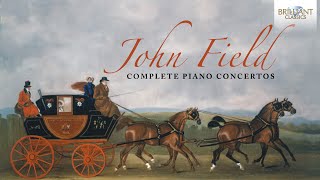
John Field, inventor of the Nocturne. That is all most people know about this remarkable and influential Irish composer. Born in 1782 in Dublin, he became one of the most celebrated pianist-composers of the early-Romantic age. Admired by his contemporaries Hummel, Moscheles and Kalkbrenner, he also drew praise from Chopin (upon whose music he exerted a huge influence) and Schumann.
Composer: John Field
Artist: Paolo Restani (piano)
00:00:00 Piano Concerto No.1 in E flat H27: I. Allegro
00:09:49 Piano Concerto No.1 in E flat H27: II. Air écossais: Adagio non troppo
00:16:47 Piano Concerto No.1 in E flat H27: III. Rondo Finale: Allegro vivace
00:22:03 Piano Concerto No.2 in A flat H31: IV. Allegro moderato
00:42:49 Piano Concerto No.2 in A flat H31: V. Poco adagio
00:46:40 Piano Concerto No.2 in A flat H31: VI. Rondo: Moderato innocente
00:59:07 Piano Concerto No.3 in E flat H32: I. Allegro moderato
01:17:40 Piano Concerto No.3 in E flat H32: II. Nocturne No.2 in C Minor, H25: Moderato e molto espressivo
01:22:47 Piano Concerto No.3 in E flat H32: III. Rondo: Tempo di Polacca
01:37:12 Piano Concerto No.4 in E flat H28: I. Allegro moderato
01:55:49 Piano Concerto No.4 in E flat H28: II. Siciliano: Un poco adagio
01:59:09 Piano Concerto No.4 in E flat H28: III. Rondo: Allegretto
02:12:05 Piano Concerto No.5 in C H39 ‘L’Incendie par l’Orage’: I. Allegro [moderato]
02:30:44 Piano Concerto No.5 in C H39 ‘L’Incendie par l’Orage’: II. Adagio
02:32:52 Piano Concerto No.5 in C H39 ‘L’Incendie par l’Orage’: III. Rondo: Allegro
02:41:21 Piano Concerto No.6 in C H49: I. Tempo di marcia: Allegro moderato
03:01:57 Piano Concerto No.6 in C H49: II. Larghetto
03:08:14 Piano Concerto No.6 in C H49: III. Rondo: Moderato
03:14:43 Piano Concerto No.7 in C Minor H58: I. Allegro moderato [maestoso] – Lento – Tempo I
03:33:40 Piano Concerto No.7 in C Minor H58: II. Rondo: Allegro moderato

Tracklist below.
Online purchase or streaming (Spotify, iTunes, Amazon Music, Deezer, Google Play): https://brilliant-classics.lnk.to/DutchDelight
More Information: https://www.brilliantclassics.....com/articles/d/dutch
Brilliant Classics Spotify: https://open.spotify.com/user/....brilliantclassics?si
Brilliant Classics Facebook: https://www.facebook.com/brilliantclassics
Composers: Cornelis Schuyt, Jan Pieterszoon Sweelinck
Artist: Matthias Havinga
This attractive collection brings together organ music from the Dutch Golden Age; a period of great prosperity and power for the Republic of the Netherlands. During this era culture blossomed, with art, particularly painting and music, reaching a hitherto unknown level of refinement as exemplified in the works of Rembrandt and Sweelinck, among others.
Cities of the Republic were centers of power, and the position of city organist was one of great prestige, as he was essentially responsible for coordinating local musical culture. His musical adaptability led him to compose in all manner of forms, as can be heard on this release – which effectively offers a postcard from the Dutch Golden Age through its variety of compositions: psalm arrangements, fantasias, dances and secular songs. As arguably the greatest Dutch composer of all time, Jan Pieterszoon Sweelinck’s music is a particularly prominent feature of the disc. Of his contrasting variation sets, many were based on secular songs (whose subjects range widely): More Palatino is a bawdy drinking song and Mein junges Leben hat ein End a melancholic melody in the ‘vanitas’ style, linking closely to popular themes in paintings of the time. Of the musical psalm settings for the organ, which were used to accompany the singing of a massed congregation and also performed during public “concerts” while people wandered through the church in great numbers, Anthoni van Noordt’s setting of Psalm 24 is particularly notable, beginning soberly, featuring an adventurous, expressive second variation, and ending grandly with the melody in the pedal. The Faber/Blank organ of the Jacobuskerk,
Zeerijp, is well suited to the repertoire; dating from 1651, it was reconstructed to its original condition in 1979. In the hands of Matthias Havinga, who has won prizes at various international organ competitions and performed extensively in many European countries and in the USA, it is essential in recreating the sound world of the music as closely as possible.
This beautiful programme, recorded in 2014, brings us back to the Golden Age of the Netherlands, the 16th and 17th century, in which cultural life blossomed thanks to the economical prosperity brought by the overseas trade. Wealthy merchants commissioned works by artists like Rembrandt, Vermeer, Ruischdael and others. Also musical life flourished, and musicians from all over Europe came to hear and study with Jan Pieterszoon Sweelinck. Organist Matthias Havinga selected a beautiful bouquet of works by Dutch composers: Sweelinck, Van Noordt, Schuyt, Havingha (an ancient ancestor of the artist..?) and others.
00:00:00 Fantasia chromatica in D Minor à 4 SwWV 258
00:08:37 Almande Gratie [More Palatino] SwWV 318 [4 variations]
00:13:02 6 Variations on “Mein junges Leben hat ein End” in A Minor, SwWV 324
00:20:13 XLIX. Wilhelmus – XIV. Almande prynce
00:22:15 Psalm 118 “Dancket den Heer seer hoogh’ ghepresen”
00:25:00 Tabulatuur-boeck van psalmen en fantasyen: Psalm XXIV. Verse 1 à 4, pedaliter
00:27:24 Tabulatuur-boeck van psalmen en fantasyen: Psalm XXIV. Verse 2 à 4
00:29:47 Tabulatuur-boeck van psalmen en fantasyen: Psalm XXIV. Verse 3 à 4, in de Bas
00:32:49 Ballo del Granduca in G Major, SwWV 319
00:37:52 LVI. Daphne [3 verses]
00:43:47 Psalm 36 SwWV 311 “Des boosdoenders wille seer quaet”: Variatio
00:46:41 Psalm 36 SwWV 311 “Des boosdoenders wille seer quaet”: Secunda Variatio
00:49:51 Psalm 36 SwWV 311 “Des boosdoenders wille seer quaet”: Tertia Variatio
00:53:31 IV. De frans galliard
00:54:22 XXXVI. Serbande
00:56:08 XIII. Almande Brun Smeedelyn
00:57:33 Malle Sijmen in D Major, SwWV 323
00:59:12 12 Pavans and Galliards, and 2 Canzonas: Padovana
01:03:34 12 Pavans and Galliards, and 2 Canzonas: Gagliarda
01:05:21 Ouverture Octava: Vivace
01:09:56 Fantasia in G Minor à 3 SwWV 271

Online purchase or streaming (Spotify, iTunes, Amazon Music, Deezer, Google Play):
https://brilliant-classics.lnk.....to/BoccheriniOp11-1
Physical purchase:
http://www.brilliantclassics.c....om/articles/b/bocche
Composer: Luigi Boccherini
Artists: La Magnifica Communità, Enrico Casazza (violin and concert master)
A much-underrated composer, Luigi Boccherini (1743-1805) was one of the leading composers of the late 18th century, a friend and colleague of both Haydn and Mozart, and a formidable cello virtuoso. His reputation was such that he was nicknamed ‘Mrs Haydn’ – not in a pejorative sense, the appellation was due to his music sounding Haydnesque, but with a sensual, feminine grace rather than the Sturm und Drang of his Austrian friend’s music.
Although his cello concerti and some of his symphonies remain in the repertoire, it is his chamber music that his reputation today rests, especially the quintets. Boccherini championed this genre, and it was his example that inspired Mozart to compose his quintets.
This release contains the string quintets Op. 10 - Op. 13. Great performances by La Magnifica Communità, lead by violinist Enrico Casazza
The tracklist can be found in the comments section below!

Online purchase or streaming (Spotify, iTunes, Amazon Music, Deezer, Google Play): https://brilliant-classics.lnk.to/Moszkowski
More Information: https://www.brilliantclassics.....com/articles/m/moszk
Brilliant Classics Spotify: https://open.spotify.com/user/....brilliantclassics?si
Brilliant Classics Facebook: https://www.facebook.com/brilliantclassics
Composer: Moritz Moszkowski
Artists: Domenico Monaco/Michele Solimando (piano 4 hands)
This collection of duets by Moritz Moszkowski, a German pianist and composer of Polish descent, astonishes in its range and variety. From the spirited Polish Folk Dances, via the elegant Deutsche Reigen or the virtuoso Tarantelle from the Klavierstücke, to the distinctive and exotic sound of the Spanish Dances for which Moszkowski was best known, every disc in the set reveals a new aspect of the composer’s craft. The influences are varied too, as the composer tips his hat to musical traditions from a range of countries including Hungary, Russia, Spain, his native Germany, and the Poland of his ancestors. This interest in styles characteristic of different countries is most clearly showcased in his Aus aller Herren Ländern (From Foreign Parts), a set that is both engaging and – of course – full of variety.
Italian pianists Domenico Monaco and Michele Solimando appear here for the first time on Brilliant Classics. Both have received many prestigious awards, including prizes in international competitions such as ‘P. Badura Skoda’ at Villa Seca (Spain), and enjoy busy performing careers alongside their regular teaching.
00:00:00 5 Spanische Tänze, Op. 12: I. Allegro brioso
00:01:48 5 Spanische Tänze, Op. 12: II. Moderato
00:06:05 5 Spanische Tänze, Op. 12: III. Con moto
00:08:37 5 Spanische Tänze, Op. 12: IV.. Allegro comodo
00:11:29 5 Spanische Tänze, Op. 12: V. Bolero. Con spirito
00:14:06 Album Espagnol, Op. 21: I. Allegro moderato
00:17:21 Album Espagnol, Op. 21: II. Vivace assai
00:19:31 Album Espagnol, Op. 21: III. Con moto
00:23:30 Album Espagnol, Op. 21: IV. Moderato e grazioso
00:27:06 4 Polnische Volkstänze, Op. 55: I. Mazurka: Allegro
00:30:52 4 Polnische Volkstänze, Op. 55: II. Mazurka: Allegro un poco moderato
00:34:16 4 Polnische Volkstänze, Op. 55: III. Polonaise: Allegretto con moto
00:40:08 4 Polnische Volkstänze, Op. 55: IV. Krakowiak: Allegro con spirito
00:43:21 3 Neue Spanische Tänze, Op. 65: I. Allegro ma non troppo
00:47:40 3 Neue Spanische Tänze, Op. 65: II. Andante con moto
00:52:28 3 Neue Spanische Tänze, Op. 65: III. Habanera: Allegretto
00:57:17 5 Walzer, Op. 8: I. Allegro moderato
01:00:14 5 Walzer, Op. 8: II. Pesante e lugubre
01:02:58 5 Walzer, Op. 8: III. Allegro grazioso
01:06:25 5 Walzer, Op. 8: IV. Vivace assai
01:08:21 5 Walzer, Op. 8: V. Pomposo ed energico, ma non troppo allegro
01:12:25 5 Deutsche Reigen, Op. 25: I. Moderato
01:16:06 5 Deutsche Reigen, Op. 25: II. Allegretto con moto
01:17:40 5 Deutsche Reigen, Op. 25: III. Moderato e grazioso
01:21:18 5 Deutsche Reigen, Op. 25: IV. Allegro animato
01:26:35 5 Deutsche Reigen, Op. 25: V. Allegro con brio
01:31:08 4 Klavierstücke, Op. 33: I. Kinder Marsch. Allegro
01:34:27 4 Klavierstücke, Op. 33: II. Humoreske. Allegretto
01:37:53 4 Klavierstücke, Op. 33: III. Tarantelle. Allegro molto
01:42:36 4 Klavierstücke, Op. 33: IV. Spinnerlied. Vivo
01:45:41 Le maître et l’élève, Op. 96: I. Prologue. Allegro brioso
01:47:30 Le maître et l’élève, Op. 96: II. Moment musical. Molto moderato
01:48:55 Le maître et l’élève, Op. 96: III. Mélodie. Allegro moderato
01:50:45 Le maître et l’élève, Op. 96: IV. Air de Ballet. Andante con moto
01:52:32 Le maître et l’élève, Op. 96: V. Arabesque. Allegretto animato
01:54:33 Le maître et l’élève, Op. 96: VI. Berceuse. Andante
01:56:50 Le maître et l’élève, Op. 96: VII. Valse. Tempo moderato
01:58:54 Le maître et l’élève, Op. 96: VIII. Tarantelle. Molto vivace
01:59:55 3 Stücke, Op. 11: I. Polonaise. Brioso ed energico
02:04:08 3 Stücke, Op. 11: II. Walzer. Allegretto grazioso
02:10:41 3 Stücke, Op. 11: III. Ungarischer Tanz. Allegro con fuoco
02:13:21 Aus aller Herren Ländern, Op. 23: I. Russia. Allegretto
02:15:43 Aus aller Herren Ländern, Op. 23: II. Germany. Andante
02:20:31 Aus aller Herren Ländern, Op. 23: III. Spain. Molto vivace
02:22:22 Aus aller Herren Ländern, Op. 23: IV. Poland. Allegro con fuoco
02:28:19 Aus aller Herren Ländern, Op. 23: V. Italy. Presto
02:32:38 Aus aller Herren Ländern, Op. 23: VI. Hungary. Molto allegro
02:35:51 Cortège et gavotte, Op.43: I. Cortège. Allegro ma non troppo
02:41:09 Cortège et gavotte, Op.43: II. Gavotte. Moderato
02:46:03 Kaleidoskop, Op. 74: I. Molto allegro e con fuoco
02:47:29 Kaleidoskop, Op. 74: II. Presto
02:48:37 Kaleidoskop, Op. 74: III. Andante
02:51:25 Kaleidoskop, Op. 74: IV. Allegro moderato e grazioso
02:54:28 Kaleidoskop, Op. 74: V. Allegro con spirito
02:57:14 Kaleidoskop, Op. 74: VI. Mesto
03:01:01 Kaleidoskop, Op. 74: VII. Tempo di Valse
Tracklist below.
iTunes: https://itunes.apple.com/album..../bach-brandenburg-co
Physical sale: http://brilliantclassics.com/a....rticles/j/js-bach-br
Spotify: https://open.spotify.com/album..../5GaZjZs77eeR5KxisXm
Bach’s set of six Brandenburg concertos remains among his most attractive works. Recorded by Muscia Amphion, a specialized Dutch period instrument ensemble led by harpsichordist Pieter-Jan Belder.
Musica Amphion delivers highly energetic performances. The musicians are joined by several of the most prominent early music specialists such as Wilbert Hazelzet on flute and Daniel Brüggen on the recorder.
00:00:00 Concerto No. 1 in F Major, BWV 1046: Without tempo indication
00:03:54 Concerto No. 1 in F Major, BWV 1046: Adagio
00:07:28 Concerto No. 1 in F Major, BWV 1046: Allegro
00:11:34 Concerto No. 1 in F Major, BWV 1046: Menuet - Trio I - Polonaise- Trio II
00:19:39 Concerto No. 2 in F Major, BWV 1047: Without tempo indication
00:24:27 Concerto No. 2 in F Major, BWV 1047: Andante
00:27:42 Concerto No. 2 in F Major, BWV 1047: Allegro assai
00:30:26 Concerto No. 3 in G Major, BWV 1048: Without tempo indication
00:35:45 Concerto No. 3 in G Major, BWV 1048: Adagio
00:36:06 Concerto No. 3 in G Major, BWV 1048: Allegro
00:40:51 Concerto No. 4 in G Major, BWV 1049: Allegro
00:47:33 Concerto No. 4 in G Major, BWV 1049: Andante
00:51:04 Concerto No. 4 in G Major, BWV 1049: Presto
00:55:39 Concerto No. 5 in D Major, BWV 1050: Allegro
01:05:26 Concerto No. 5 in D Major, BWV 1050: Affettuoso
01:11:08 Concerto No. 5 in D Major, BWV 1050: Allegro
01:16:20 Concerto No. 6 in B-Flat Major, BWV 1051: Without tempo indication
01:22:17 Concerto No. 6 in B-Flat Major, BWV 1051: Adagio ma non tanto
01:27:00 Concerto No. 6 in B-Flat Major, BWV 1051: Allegro
Artist:
Musica Amphion
Pieter-Jan Belder harpsichord and concert master with
Wilbert Hazelzet (flute)
Daniel Brüggen (recorder)

Download & Streams:
https://VA.lnk.to/Top40FavouriteClassicalMelodies
Physical Sale: http://brilliantclassics.com/a....rticles/t/top-40-fav
Follow us also on Spotify:
https://brilliant-classics.lnk.to/Spotify
A TOP 40 of the most popular classical melodies. The very best tracks of the moment. Also great for Relaxation music, work or studying.
00:00:00 Vivaldi - Violin Concerto in E Major, RV 269, "Spring": I. Allegro
00:03:30 Camille Saint-Saëns - The Carnival of the Animals: XIII. The Swan
00:06:27 Mozart - Sonata No. 11 in A Major, K. 331: III. Rondo alla turca
00:09:55 Chopin - Waltzes, Op. 64: No. 1, Waltz in D-Flat Major "Minute Waltz"
00:11:37 Mozart - Eine kleine Nachtmusik, K. 525: I. Allegro
00:16:52 Gabriel Fauré - Sicilienne, Op. 78
00:20:16 Claude Debussy - Childrens Corner, L. 113: No. 6, Golliwog's Cake-walk
00:22:57 Franz liszt - Liebestraum, S. 541: No. 3, Oh Lieb, so lang du lieben kannst
00:27:29 Johannes Brahms - 16 Waltzes, Op. 39: No. 15, Waltz in A-Flat Major "Lullaby"
00:29:06 Beethoven - Piano Sonata No. 8 in C Minor, Op. 13, "Pathetique": I. Adagio cantabile
00:33:48 Robert Schumann - Kinderszenen, Op. 15: No. 7, Traumerei in F Major
00:36:56 Mozart - Piano Concerto No. 23 in A Major, K. 488: II. Adagio
00:43:12 Nicolló Paganini - Cantabile e Valser, Op. 19: I. Cantabile quasi adagio
00:46:40 Franz liszt - Consolations, S. 172: III. Lento placido in D-Flat Major
00:49:43 Charles-valentin Alkan - 6 French Songs, Op. 65: No. 6, Barcarolle
00:53:25 J.S. Bach - Brandenburg Concerto No. 4 in G Major, BWV 1049: II. Andante
00:56:58 Beethoven - Bagatelle in A Minor, WoO 59 "Für Elise"
00:59:48 Edvard Grieg - Lyric Pieces, Op. 43: No. 6, To Spring
01:02:15 Telemann - Ouverture-Suite in E Minor, TWV 55: No. 6, Air. Un peu vivement
01:06:38 Gabriel Fauré - Berceuse, Op. 16
01:10:04 Vivaldi - Flute Concerto No. 3 in D Major, RV 428 "Il gardellino": I. Allegro
01:14:06 Mussorgsky - Pictures at an Exhibition: Promenade II, No. 2, The Old Castle
01:19:11 Beethoven - Piano Sonata in C-Sharp Major, Op. 27 No. 2 "Moonlight": I. Adagio sostenuto
01:24:49 Claude Debussy - Suite Bergamasque, L. 75: III. Clair de Lune
01:29:44 Erik Satie - 3 Gymnopédies: No. 1, Lent et douloureux in D Major
01:33:23 Mozart - Piano Concerto in C Major, K. 467: II. Andante "Elvira Madigan"
01:40:13 Franz liszt - 2 Concert-Studies, S. 145: No. 1, Waldesrauschen. Vivace
01:44:17 Tchaikovsky - The Seasons, Op. 37a: No. 10, October. Autumn Song in D Minor. Andante doloroso e molto cantabile
01:47:41 Anatoly Lyadov - 2 Morceaux, Op. 9: No. 1, Valse
01:50:43 Felix Mendessohn - Lieder ohne Worte, Op. 19b: No. 6, Venetian Gondola Song. Andante sostenuto
01:52:14 Claude Debussy - 2 Arabesques, L. 66: No. 1, Première Arabesque in E Major
01:56:22 Chopin - Nocturnes, Op. 9: No. 2, Nocturne in E-Flat Major
02:00:40 Edvard Grieg - Lyric Pieces, Op. 54: No. 3, March of the Dwarfs
02:03:32 Gabriel Fauré - Requiem, Op. 48: XII. In Paradisum
02:06:45 J.S. Bach - Jesu, meine Freude, BWV 227
02:09:45 Erik Satie - Gnossiennes: No. 5, Moderato
02:12:31 Tchaikovsky - The Seasons, Op. 37a: No. 3, March. Song of the Lark in G Minor. Andantino espressivo
02:14:12 Johannes Brahms - Symphony No. 3, Op. 90: III. Poco allegretto in C Minor
02:20:12 Franz Schubert - 6 Moments musicaux, D. 780: No. 3, Allegro moderato
02:22:16 Chopin - Preludes, Op. 28: No. 15, Prelude in D-Flat Major "Raindrop"
Tracklist below.
Online purchase or streaming (Spotify, iTunes, Amazon Music, Deezer, Google Play): https://brilliant-classics.lnk.....to/TchaikovskyCompl
More Information: https://www.brilliantclassics.....com/articles/t/tchai
Brilliant Classics Spotify: https://open.spotify.com/user/....brilliantclassics?si
Brilliant Classics Facebook: https://www.facebook.com/brilliantclassics
00:00:00 Swan Lake, Op. 20, Pt. 1: I. Introduction. Moderato assai
00:03:07 Swan Lake, Op. 20, Pt. 1: II. Scène. Allegro giusto
00:06:09 Swan Lake, Op. 20, Pt. 1: III. Valse. Tempo di valse
00:13:26 Swan Lake, Op. 20, Pt. 1: IV. Scène: Entrance of Pages. Allegro moderato
00:17:34 Swan Lake, Op. 20, Pt. 1: V. Pas de trois. Intrada (Allegro moderato)
00:20:26 Swan Lake, Op. 20, Pt. 1: V. Pas de trois. Andante sostenuto
00:24:18 Swan Lake, Op. 20, Pt. 1: V. Pas de trois. Allegro semplice – Presto
00:25:32 Swan Lake, Op. 20, Pt. 1: V. Pas de trois. Prince (Moderato)
00:26:52 Swan Lake, Op. 20, Pt. 1: V. Pas de trois. Allegro
00:28:00 Swan Lake, Op. 20, Pt. 1: V. Pas de trois. Coda (Allegro vivace)
00:29:50 Swan Lake, Op. 20, Pt. 1: VI. Pas de deux. Intrada (Tempo di valse)
00:31:35 Swan Lake, Op. 20, Pt. 1: VI. Pas de deux. Andante
00:37:12 Swan Lake, Op. 20, Pt. 1: VI. Pas de deux. Tempo di valse
00:38:57 Swan Lake, Op. 20, Pt. 1: VI. Pas de deux. Intrada (Tempo di valse)
00:40:57 Swan Lake, Op. 20, Pt. 1: VI. Pas de deux. Pas d’action (Andantino quasi moderato - Allegro)
00:43:50 Swan Lake, Op. 20, Pt. 1: VII. Scène. Dusk falls
00:44:46 Swan Lake, Op. 20, Pt. 1: VIII. Danse des coupes (Polonaise)
00:50:28 Swan Lake, Op. 20, Pt. 1: IX. Finale. Swan Theme (Andante)
00:53:15 Swan Lake, Op. 20, Pt. 2: I. Scène. Swan Theme (Moderato)
00:59:46 Swan Lake, Op. 20, Pt. 2: II. Scène. Allegro moderato - Moderato - Allegro vivo
01:03:37 Swan Lake, Op. 20, Pt. 2: III. Danses des cygnes
01:05:34 Swan Lake, Op. 20, Pt. 2: IV. Danses des petits cygnes
01:07:02 Swan Lake, Op. 20, Pt. 2: V. Pas d’action. Second Dance of the Queen (Andante)
01:15:06 Swan Lake, Op. 20, Pt. 2: VI. Tempo di valse
01:16:47 Swan Lake, Op. 20, Pt. 2: VII. Coda. Allegro vivace
01:18:28 Swan Lake, Op. 20, Pt. 2: VIII. Scène finale. Swan theme (Moderato)
01:21:36 Swan Lake, Op. 20, Pt. 3: I. Scène. Danse de fançailles (Allegro giusto)
01:24:23 Swan Lake, Op. 20, Pt. 3: II. Scène. La sortie des invités et la valse
01:29:17 Swan Lake, Op. 20, Pt. 3: III. Scène. Allegro - Allegro giusto
01:31:03 Swan Lake, Op. 20, Pt. 3: IV. Pas de six. Intrada (Moderato assai)
01:33:00 Swan Lake, Op. 20, Pt. 3: IV. Pas de six. Variation 1 (Allegro)
01:34:07 Swan Lake, Op. 20, Pt. 3: IV. Pas de six. Variation 2 (Andante con moto)
01:37:27 Swan Lake, Op. 20, Pt. 3: IV. Pas de six. Variation 3 (Moderato)
01:38:14 Swan Lake, Op. 20, Pt. 3: IV. Pas de six. Variation 4 (Allegro)
01:39:18 Swan Lake, Op. 20, Pt. 3: IV. Pas de six. Variation 5 (Moderato - Allegro semplice) - Coda (Allegro molto vivace)
01:42:54 Swan Lake, Op. 20, Pt. 3: V. Dance hongroise. Czárdás
01:46:40 Swan Lake, Op. 20, Pt. 3: VI. Danse russe
01:51:21 Swan Lake, Op. 20, Pt. 3: VII. Danse espagnole
01:53:49 Swan Lake, Op. 20, Pt. 3: VIII. Danse napolitaine
01:56:23 Swan Lake, Op. 20, Pt. 3: IX. Mazurka
02:00:28 Swan Lake, Op. 20, Pt. 3: X. Scène. Allegro - Valse - Allegro vivo
02:04:20 Swan Lake, Op. 20, Pt. 4: I. Entr’acte. Moderato
02:06:53 Swan Lake, Op. 20, Pt. 4: II. Scène. Allegro non troppo
02:09:42 Swan Lake, Op. 20, Pt. 4: III. Danses des petits cygnes. Moderato
02:15:04 Swan Lake, Op. 20, Pt. 4: IV. Scène. Allegro agitato
02:18:22 Swan Lake, Op. 20, Pt. 4: V. Scène finale. Andante
Artist:
Royal Philharmonic Orchestra
Nicolae Moldoveanu
Barry Wordsworth
David Maninov (conductors)

Online purchase or streaming (Spotify, iTunes, Amazon Music, Deezer, Google Play): https://brilliant-classics.lnk.....to/TelemannViolinSo
Physical purchase: http://www.brilliantclassics.c....om/articles/t/telema
Facebook page: https://www.facebook.com/brilliantclassics/
Composer: Georg Philipp Telemann
Artists: Valerio Losito baroque (violin), Federico Del Sordo (harpsichord)
Brilliant Classics presents the release of a new recording which delves further into the protean output of that most prolific of composers, Georg Philipp Telemann. In the year that he is remembered with particular enthusiasm, 250 years after his death in Hamburg, the breadth of his achievement can be appreciated more than ever, not least thanks to recent recordings of the recorder sonatas (BC95247), concertos and suites for flute (BC95147), double concertos with recorder (BC95249), oboe concertos (BC95379), and a reissue of the classic account of the complete Tafelmusik (BC92177), which is the modern counterpart to the Bruggen recording that brought Telemann’s name to so many listeners half a century ago.
Much of this music concentrates on the composer’s fondness for wind instruments. Now Valerio Losito brings our attention to the accompanied sonatas. Rather as with Bach, when we think of Telemann and the violin, it is the unaccompanied music that first springs to mind, for the free and unbridled imagination and the evident pleasure it gives to violinists who perform and record the 12 fantasias. However (like Bach), Telemann produced a set of six sonatas for violin accompanied by harpsichord, with or without a separate basso continuo, and first published in 1715.
The sonatas were effectively his opus 1, published in 1715 at the comparatively late age of 24, and dedicated to the violin-playing Duke of Saxe-Weimar, from whom Telemann evidently wished to curry favour to judge from his long and obsequious preface. In just six sonatas may be found a remarkable diversity of elements: the Italianate style and Corelli-like fugues of Sonatas 1 and 5, echoes of Polish and ‘gypsy’ folk music in Sonatas 3 and 4, melodious arias reminiscent of Handel in sonata 3, and dance movements in the French style in Sonatas 2 and 6. Telemann’s genius allowed him to condense and reconcile in one volume parallel worlds that would appear to be mutually incompatible.
00:00:00 Sonata No. 1 in G Minor, TWV 41:g1: I. Adagio
00:01:50 Sonata No. 1 in G Minor, TWV 41:g1: II. Allegro
00:04:40 Sonata No. 1 in G Minor, TWV 41:g1: III. Adagio
00:05:53 Sonata No. 1 in G Minor, TWV 41:g1: IV. Vivace
00:08:57 Sonata No. 2 in D Major, TWV 41:D1: I. Allemanda, largo
00:12:56 Sonata No. 2 in D Major, TWV 41:D1: II. Corrente, vivace
00:16:15 Sonata No. 2 in D Major, TWV 41:D1: III. Sarabanda
00:17:53 Sonata No. 2 in D Major, TWV 41:D1: IV. Gique
00:20:41 Sonata No. 3 in B Minor, TWV 41:h1: I. Cantabile
00:23:15 Sonata No. 3 in B Minor, TWV 41:h1: II. Allegro assai
00:25:40 Sonata No. 3 in B Minor, TWV 41:h1: III. Andante
00:27:32 Sonata No. 3 in B Minor, TWV 41:h1: IV. Vivace
00:30:33 Sonata No. 4 in G Major, TWV 41:G1: I. Largo
00:31:51 Sonata No. 3 in B Minor, TWV 41:h1: II. Allegro
00:34:14 Sonata No. 3 in B Minor, TWV 41:h1: III. Adagio
00:37:08 Sonata No. 3 in B Minor, TWV 41:h1: IV. Allegro
00:39:40 Sonata No. 5 in A Minor, TWV 41:a1: I. Allemanda, largo
00:42:24 Sonata No. 3 in B Minor, TWV 41:h1: II. Corrente, vivace
00:44:27 Sonata No. 3 in B Minor, TWV 41:h1: III. Sarabanda
00:46:02 Sonata No. 3 in B Minor, TWV 41:h1: IV. Giga
00:48:30 Sonata No. 6 in A Major, TWV A1: I. Allemanda, largo
00:51:39 Sonata No. 6 in A Major, TWV A1: II. Corrente, allegro
00:54:05 Sonata No. 6 in A Major, TWV A1: III. Sarabanda
00:55:57 Sonata No. 6 in A Major, TWV A1: IV. Giga

Download & streams:
https://brilliant-classics.lnk.to/Campagnoli6Flute
Physical purchase:
https://www.brilliantclassics.....com/articles/c/campa
Brilliant Classics Spotify:
https://brilliant-classics.lnk.to/Spotify
Brilliant Classics Facebook:
https://www.facebook.com/brilliantclassics
Bartolomeo Campagnoli (1751-1827) was a violinist by training, who worked in the courts and capitals of Baroque-era Europe, with posts in Rome, Dresden and then (from 1979 to 1818) in Leipzig, where he was leader of the venerable Gewandhaus orchestra.
Thus most of his own compositions are for strings, focused on his own instrument, and often with pedagogical or commercial aims in mind, such as the 41 Capricci for solo viola and the 7 Divertimenti for solo violin. There is also an extensive Method – in 132 separate lessons! – which was first published by Ricordi in 1797, and reprinted and translated many times.
It was around this time that he wrote the six delightful, serenade-like works on this album, scored for flute and string trio. Often the flute engages in vivacious dialogue with the upper voice of the trio, within the tradition of similar works by Tartini, Rolla and Mercadante. The predominant mood is light, the expression airy and untroubled. The exception to this is the Fourth Sonata in E minor – the only minor-key quartet of the set, and the only one cast in three movements, with a central Andante grazioso of a suave gravity that would not have disgraced the young Mozart.
Composer: Bartolomeo Campagnoli
Artist: Gabriele Formenti (flute)
Maurizio Schiavo (violin)
Il Demetrio
00:00:00 Flute Quartet No. 1 in D Major: I. Allegro
00:06:08 Flute Quartet No. 1 in D Major: II. Presto
00:09:47 Flute Quartet No. 2 in C Major: I. Allegro
00:15:58 Flute Quartet No. 2 in C Major: II. Romance. Andante
00:19:30 Flute Quartet No. 2 in C Major: III. Rondo
00:22:49 Flute Quartet No. 3 in G Major: I. Allegro
00:29:41 Flute Quartet No. 3 in G Major: II. Allegro con variazioni
00:36:35 Flute Quartet No. 4 in E Minor: I. Allegro espressivo
00:42:24 Flute Quartet No. 4 in E Minor: II. Andante grazioso
00:45:16 Flute Quartet No. 4 in E Minor: III. Allegro assai
00:49:45 Flute Quartet No. 5 in F Major: I. Allegro
00:55:55 Flute Quartet No. 5 in F Major: II. Rondo grazioso
00:59:39 Flute Quartet No. 6 in B-Flat Major: I. Allegro
01:06:31 Flute Quartet No. 6 in B-Flat Major: II. Rondo

Download & Streaming: https://brilliant-classics.lnk.....to/CorelliCompleteE
Physical Sale: https://www.brilliantclassics.....com/articles/c/corel
Facebook: https://www.facebook.com/brilliantclassics
Brilliant Classics Spotify : https://brilliant-classics.lnk.to/Spotify
It may seem surprising: can 10 discs really contain all of Arcangelo Corelli’s output? They can, and do, but the surprise is merited, for the influence and reputation of these works far outstrips their quantity (and how often can one say that of a Barock composer!). On display here is the apogee of Barock form as displayed in the genres of Solo Sonatas, Trio Sonatas and Concerti Grossi, full of sparkling virtuosity and an intimate knowledge and love of the violin and its potential as a solo instrument.
The influence was felt most immediately in Rome, where he was based for his adult life, but publication of these collections soon earned him a name across Europe, as much as his prowess as a solo violinist did; for this was the golden age of the composer as creator, when composition went hand in hand with performance. Of course there is plenty more music Corelli composed which hasn’t survived, or at least not on manuscripts with his name on them, for Corelli as an impresario frequently staged oratorios to which he would have contributed sinfonias and instrumental numbers.
What survives is never less than highly polished; often bold, and continually inventive, as is more than evident in these performances from a welcome and uniform perspective by a leading Dutch period-instrument ensemble. And it’s unique; there is no other Corelli box on the market, nor has such a project ever been attempted before or since.
Tracklist
00:00:00 Violin Sonatas OP.5 NOS 1 – 11
01:48:54 ‘La folia’
01:59:49 Concerti Grossi OP. 6 NOS 1 – 12
04:10:30 SInfonia WoO1 (to the oratorio Santa Beatrice d’Este)
04:18:55 Sonata A Quattro WoO2

Online purchase or streaming (Spotify, iTunes, Amazon Music, Deezer, Google Play): https://brilliant-classics.lnk.to/Vocalise
More Information: https://www.brilliantclassics.....com/articles/v/vocal
Brilliant Classics Facebook: https://www.facebook.com/brilliantclassics
Spotify Playlists:
Brilliant Classics Spotify: https://brilliant-classics.lnk.to/Spotify
The best of Liszt: https://brilliant-classics.lnk.to/Playliszt
The best of Bach: https://brilliant-classics.lnk.....to/BestOfBachPlayli
Most popular piano music: https://brilliant-classics.lnk.to/MostPopularPiano
Beautiful classical Music: https://brilliant-classics.lnk.....to/BeautifulClassic
Classical music for dinnertime: https://brilliant-classics.lnk.....to/ClassicalMusicfo
Composers: Alessandro Longo, Felix Mendelssohn, Robert Schumann
Artists: Massimo Data (bassoon), Piero Barbareschi (piano)
The chamber literature for bassoon is not as rich and varied as the instrument deserves. Despite its widely recognised beauty of timbre and expressive potentialities, used and celebrated in solos from many significant orchestral and operatic compositions, a fitting chamber literature in the 19th and 20th centuries, especially in duo with the piano, is conspicuously absent. The pieces recorded on this CD are an attempt to demonstrate how this repertoire may be expanded and built upon, both by using original compositions for bassoon and piano and by transcribing significant pieces by Romantic and 20th-century authors originally intended for other expressive instruments.
The pieces themselves range from atmospheric 19th-century compositions such as Schumann’s Drei Romanzen Op.98, in which the bassoon takes on a distinctly vocal quality, to beautiful and at times melancholic 20th-century pieces, including Piazzolla’s Oblivion, in which the flexibility of the instrument’s timbre truly comes to the fore. Bridging these two groups is the ‘title track’ by Rachmaninoff, the implications of whose name are certainly done justice in this set, for the bassoon truly ‘finds its own voice’ here.
Bassoonist Massimo Data has played as principal bassoonist for several orchestras in Italy and beyond, and has given masterclasses across the world. He is accompanied by pianist Piero Barbareschi, who collaborates on chamber music duos with a wide variety of instrumentalists and plays a broad repertoire of music ranging from the 17th century to the present day.
The Bassoon, the bass member of the woodwind family, is a surprisingly versatile, agile, and expressive instrument. Its expression ranges from the joyful and even comic, sonorous, melancholic to the mournful. Regretfully classical composers wrote little of substance for the solo bassoon, therefore this new recording presents a selection of delightful arrangements of classical evergreens: Schumann’s Fantasiestücke Op. 73 (itself written for clarinet or cello), a Mendelssohn Lied ohne Worte, Rachmaninoff’s Vocalise, an original piece by Gabriel Pierné, a heartbreaking Pavane by Ravel, and two raucous Piazzolla tangos.
00:00:00 Lied ohne Worte in E Major, Op. 19 No. 1
00:03:48 Fantasiestücke, Op. 73: I. Zart und mit Ausdruck
00:06:58 Fantasiestücke, Op. 73: II. Lebhaft, leicht
00:10:57 Fantasiestücke, Op. 73: III. Rasch und mit Feuer
00:15:29 Suite for Bassoon and Piano: I. Andante con variazioni
00:20:08 Suite for Bassoon and Piano: II. Romanza
00:25:06 Suite for Bassoon and Piano: III. Vivace
00:28:41 14 Romances, Op. 34: No. 14, Vocalise
00:34:25 Drei Romanzen, Op. 98: I. Nicht schnell
00:37:42 Drei Romanzen, Op. 98: II. Einfach, innig
00:41:39 Drei Romanzen, Op. 98: III. Nicht schnell
00:45:45 Enrico IV: Oblivion
00:48:45 Solo de concert, Op. 35
00:54:42 Pavane pour une infante défunte in G Major, M. 19
00:59:03 Libertango
Download & Streams:
https://brilliant-classics.lnk.....to/BoccheriniString
Physical purchase:
https://www.brilliantclassics.....com/articles/b/bocch
Brilliant classics Spotify:
https://brilliant-classics.lnk.to/Spotify
Brilliant classics Facebook:
https://www.facebook.com/brilliantclassics
Composer: Luigi Boccherini
Artists: La Magnifica Comunitá, Enrico Casazza (violin and concert master)
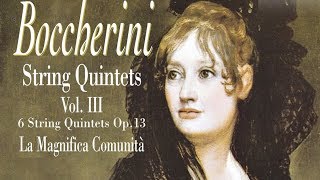
The third part of the Boccherini string quintets performed by La Magnifica Communitá, containing the 6 quintets Op. 13 written in 1772. Delightful classical music which has been an example to many of Boccherini’s younger colleagues. He was one of the first to write for string quintet and the five parts are beautifully balanced.
The musicians of La Magnifica Communitá research their interpretations thoroughly. They perform Boccherini’s music in a pleasantly whole-hearted way, being both down to earth and airy.
00:00:00 Quintetto I In E Flat Major G. 277 : Maestoso
00:05:42 Quintetto I In E Flat Major G. 277 : Larghetto Con Espressione
00:09:27 Quintetto I In E Flat Major G. 277 : Minuetto: Allegro
00:13:35 Quintetto I In E Flat Major G. 277 : Presto
00:19:56 Quintetto Ii In C Major G. 279 : Allegro Maestoso
00:28:23 Quintetto Ii In C Major G. 279 : Larghetto
00:31:48 Quintetto Ii In C Major G. 279 : Presto
00:35:22 Quintetto Iii In F Major G. 279 : Prestissimo
00:41:58 Quintetto Iii In F Major G. 279 : Largo
00:47:49 Quintetto Iii In F Major G. 279 : Tempo Di Minuetto, Trio
00:51:17 Quintetto Iii In F Major G. 279 : Presto
00:55:37 Quintetto Iv In D Minor G. 280 : Allegro
01:04:39 Quintetto Iv In D Minor G. 280 : Andante Sostenuto
01:10:45 Quintetto Iv In D Minor G. 280 : Fuga (allegro Giusto)
01:14:52 Quintetto Iv In D Minor G. 280 : Andantino
01:20:34 Quintetto Iv In D Minor G. 280 : Allegro Giusto
01:25:54 Quintetto Iv In D Minor G. 280 : Presto Assai
01:29:47 Quintetto Vi In E Major G. 282 : Andante Sostenuto
01:33:02 Quintetto Vi In E Major G. 282 : Allegro Con Spirito
01:38:56 Quintetto Vi In E Major G. 282 : Minuetto
01:42:12 Quintetto Vi In E Major G. 282 : Rondeau, Allegro

Composers: Johann Sebastian Bach
Artists: The Choir of King’s College Cambridge, Brandenburg (Consort), Roy Goodman (consort leader), Stephen Cleobury (conductor)
Online purchase or streaming (Spotify, iTunes, Amazon Music, Deezer, Google Play): https://brilliant-classics.lnk.....to/BachMatthauspass
More Information: https://www.brilliantclassics.....com/articles/j/js-ba
Brilliant Classics Spotify: https://open.spotify.com/user/....brilliantclassics?si
Booklet: http://www.brilliantclassics.c....om/media/499093/9412
Brilliant Classics Facebook: https://www.facebook.com/brilliantclassics
Subscribe here: https://www.youtube.com/user/B....rilliantClassics?sub
Bach composed his St Matthew Passion in 1727. Only two of his five Passion settings have survived - the St Matthew and the St John. The St Mark survives in a realisation after the manuscript was destroyed in a bombing raid in the Second World War. Of the other two works there is no trace. The work was premiered in Leipzig where Bach was kapellmeister at the Thomaskirche. Revised several times by the composer, it was often performed during his lifetime, but not heard outside Leipzig until 1829 when Mendelssohn performed an edited and modified version in Berlin. Today we take a dim view of the 19th century tampering with a work like the St Matthew Passion. However, Mendelssohn's pioneering work in bringing the music of Bach to a wider public was responsible for the reappraisal of the composer, and the restoration of masterpieces such as the St Matthew Passion to the repertoire.
Matthäus-Passion, BWV 244 no. 1 until no. 68 Tracklist can be found in the comment section!

Tracklist Below:
Download via iTunes: https://itunes.apple.com/album..../telemann-music-for-
Buy CD: http://brilliantclassics.com/a....rticles/t/telemann-m
Spotify: https://open.spotify.com/album..../1Mp0q1MDZVAS5LSl7xO
Telemann wrote so much and so well for the flute with the understanding of one who knew the instrument from the inside. ‘How my heart beats,’ he wrote, ‘when I see the walls and corners of the room covered with musical instruments… Excellent instrumentalists have made me want to improve my performance on my instruments. I would have done so if an inner fire had spurred me beyond the keyboard, the violin and the flute, to learn the oboe, the chalumeau, the viola da gamba, or indeed the double bass and the bass trombone.’
In line with their earlier work on Vivaldi for Brilliant Classics (BC95078), Hanspeter Oggier and the Ensemble Fratres have now chosen to address the delectable feast of Telemann’s wonderfully joyous music. Meticulous in his work, alert and inventive, Telemann was a great colourist whose coherence and open mindedness enabled him to address the widest audience. The particular appeal of this collection is that the flute parts are taken by the pan-flute, which lend a rustic, sometimes insouciant colour to pairs of suites and concertos. In Telemann the prevalence of curiosity over perfectionism suggests the desire to produce works that were straightforward and accessible to all. There is no hint of superficiality in this approach, however: he sensitively assimilated both Italian and French musical languages as well as certain traditional Polish stylistic elements. These and other ingredients he accepted as simple, pliable mother tongues, without trying to adapt them to his native German idiom.
In the Baroque it was by no means uncommon for composers to freely transcribe and arrange their own works or works by others for a different instruments. Therefore, any present day attempt of alternative instrumentation should be viewed with respect and curiosity: the result counts. And what result we encounter on this new recording of Flute Concertos by Telemann transcribed for the Pan Flute! By turns dramatic and furious, sweet and beguiling: the pan flute has infinite colouristic qualities to do full justice to these master works. The pan flute in its present form originates from 17th century Rumania, mostly used as a folk music instrument. However the use of the pan flute in “classical” Baroque music is by no means an abomination. The improvisatory character, the organic way of tone production which is regulated by the intensity of the breath of the player suit the Baroque music particularly well! Exhilarating performances by Master Pan flutist Hanspeter Oggier and his Ensemble Fratres. They already recorded successfully flute concertos by Vivaldi for Brilliant Classics (BC95078). Extensive liner notes on the music and the instrument included.
00:00:00 Ouverture-Suite in A Minor, TWV 55:a2: I. Ouverture
00:10:37 Ouverture-Suite in A Minor, TWV 55:a2: II. Les plaisirs
00:14:09 Ouverture-Suite in A Minor, TWV 55:a2: III. Air à l’Italien
00:21:03 Ouverture-Suite in A Minor, TWV 55:a2: IV. Menuett I-II
00:24:55 Ouverture-Suite in A Minor, TWV 55:a2: V. Rejouissance
00:27:24 Ouverture-Suite in A Minor, TWV 55:a2: VI. Passepied I-II
00:28:59 Ouverture-Suite in A Minor, TWV 55:a2: VII. Polonoise
00:32:59 Flute Concerto in D Major, TWV 51:D2: I. Moderato
00:35:33 Flute Concerto in D Major, TWV 51:D2: II. Allegro
00:39:47 Flute Concerto in D Major, TWV 51:D2: III. Largo
00:43:22 Flute Concerto in D Major, TWV 51:D2: IV. Vivace
00:46:26 Ouverture-Suite in G Major, TWV 55:G2: I. Ouverture
00:51:34 Ouverture-Suite in G Major, TWV 55:G2: II. Courante
00:53:46 Ouverture-Suite in G Major, TWV 55:G2: III. Gavotte en rondeau
00:54:52 Ouverture-Suite in G Major, TWV 55:G2: IV. Branle
00:55:49 Ouverture-Suite in G Major, TWV 55:G2: V. Sarabande
00:57:37 Ouverture-Suite in G Major, TWV 55:G2: VI. Fantaisie
00:58:48 Ouverture-Suite in G Major, TWV 55:G2: VII. Menuet I-II
01:02:28 Ouverture-Suite in G Major, TWV 55:G2: VIII. Rossignol
01:04:25 Flute Concerto in G Major, TWV 51:G2: I. Andante
01:07:08 Flute Concerto in G Major, TWV 51:G2: II. Vivace
01:09:43 Flute Concerto in G Major, TWV 51:G2: III. Adagio
01:11:50 Flute Concerto in G Major, TWV 51:G2: IV. Allegro
Artist:
Hanspeter Oggier pan flute
Ensemble Fratres

Download & Streams:
https://brilliant-classics.lnk.....to/BocheriniStringT
Physical sale:
https://www.brilliantclassics.....com/articles/b/bocch
Brilliant Classics Spotify:
https://brilliant-classics.lnk.to/Spotify
Brilliant Classics Facebook:
https://www.facebook.com/brilliantclassics
Firstly, this album represents a welcome return to the studio, and the recording catalogues, of the Russian violinist Mark Lubotsky. In English-speaking countries, Lubotsky is renowned as the soloist on Britten’s Decca recording of the Violin Concerto: a performance of idiomatic sweep which fully bears out the composer’s claim that ‘this is the performance I have been waiting for.’ He worked with all the great Russian conductors of his generation such as Kondrashin, Svetlanov and Rozhdestvensky. Throughout his career he has played and advocated the music of our time: most notably that of his fellow student at the Moscow Conservatoire, Alfred Schnittke, who dedicated both the Second Violin Concerto and three violin sonatas to him.
However, this focus on new music should not overshadow Lubotsky’s mastery of the classical repertoire. This particular disposition of the ‘Lubotsky Trio’ features the Swedish violinist Katarina Andreasson, though Lubotsky and the cellist Olga Dowbusch-Lubotsky have also played and recorded Taneyev in the more traditional string trio line-up with the violists Ferdinand Erblich and Vladimir Botchkovsky, and also as a piano trio, where they have been partnered by Schnittke’s widow Irina.
The String Trios Op.6 were published in 1769. After his Opp. 1 and 4 sets, they represent Boccherini’s third attempt in as many years to take forward the genre of the Baroque trio sonata. He went on to write another four sets of string trios, all of which are better known and more frequently encountered on record than Op.6, which makes this new recording all the more desirable for the connoisseur of Classical-era chamber music.
No less than the later sets, the Op.6 trios are characterized by a richness of melodic language, virtuosic brilliance and elegance, which nevertheless contains moments of high expression such as the chromatic Adagio which opens the G minor Trio, No.5 in the set. The sound of the two violins and cello in its fullness often approaches to that of the string quartet. Listening to these masterpieces, it is impossible not to notice the indubitable impact of his music on the great Viennese classics, first of all on Mozart.
Luigi Boccherini was one of the most famous cellists of his day, travelling Europe as a touring virtuoso. On his return to his native Lucca he founded the first professional string quartet in history.
Boccherini’s output for string ensembles is vast: he wrote more than 120 string quartets, 100 string quintets (with two cellos) and 48 string trios.
The string trios Op. 6 are for 2 violins and cello, highly expressive music full of rich classical melodies, elegance and instrumental brilliance.
Excellent performances by the Lubotsky Trio, with the eminent Russian violinist Mark Lubotsky, a pupil of David Oistrakh, as primarius.
Composer: Luigi Boccherini
Artist: Lubotsky Trio
00:00:00 String Trio No. 4 in F Major, G. 92: I. Allegro molto
00:05:06 String Trio No. 4 in F Major, G. 92: II. Lento con espressione
00:11:00 String Trio No. 4 in F Major, G. 92: III. Tempo di minuetto
00:15:56 String Trio No. 2 in E-Flat Major, G. 90: I. Allegro maestoso
00:20:21 String Trio No. 2 in E-Flat Major, G. 90: II. Andante grazioso
00:24:30 String Trio No. 2 in E-Flat Major, G. 90: III. Allegro molto
00:28:03 String Trio No. 5 in G Minor, G. 93: I. Adagio
00:31:26 String Trio No. 5 in G Minor, G. 93: II. Rondo allegro
00:34:41 String Trio No. 5 in G Minor, G. 93: III. Tempo di minuetto
00:37:06 String Trio No. 6 in C Major, G. 94: I. Allegro assai
00:43:40 String Trio No. 6 in C Major, G. 94: II. Larghetto
00:50:19 String Trio No. 6 in C Major, G. 94: III. Presto

The liturgy and events of Holy Week lie behind some of the most inspired and powerful works in the entire repertoire. By now churches are sombre and bare, statues having been covered up, the altars set to be stripped after the Maundy Thursday service – and so much of the music is correspondingly meditative and sombre. Conversely, faced with depicting the events of the Passion story itself, Bach produced some of the most movingly dramatic music ever written; monuments of the repertoire, Bach’s Passions seem a good place to start.
Stabat Mater Dolorosa is considered one of the seven greatest Latin hymns of all time. It is based upon the prophecy of Simeon that a sword was to pierce the heart of His mother, Mary (Lk 2:35). The hymn originated in the 13th century during the peak of Franciscan devotion to the crucified Jesus and has been attributed to Pope Innocent III (d. 1216), St. Bonaventure, or more commonly, Jacopone da Todi (1230-1306), who is considered by most to be the real author. The hymn is often associated with the Stations of the Cross. In 1727 it was prescribed as a Sequence for the Mass of the Seven Sorrows of Mary (September 15) where it is still used today. In addition to this Mass, the hymn is also used for the Office of the Readings, Lauds, and Vespers for this memorial. There is a mirror image to this hymn, Stabat Mater speciosa, which echoes the joy of the Blessed Virgin Mary at the birth of Jesus.
There can be few more evocative words in music than ‘passion’. As well as its familiar English definition, in a musical context it also suggests the commemoration of that most emotive Christian story, the journey of Jesus to the cross. The word has also come to be all but synonymous in music with its two greatest exemplars: the St. John and St. Matthew Passions of Johann Sebastian Bach.
The Tracks are from the following Albums:
Pergolesi: Stabat Mater
Online purchase or streaming (Spotify, iTunes, Amazon Music, Deezer, Google Play): https://brilliant-classics.lnk.....to/PergolesiStabatM
More Information: https://www.brilliantclassics.....com/articles/p/pergo
Bononcini: Stabat Mater
Online purchase or streaming (Spotify, iTunes, Amazon Music, Deezer, Google Play): https://brilliant-classics.lnk.....to/BononciniStabatM
More Information: https://www.brilliantclassics.....com/articles/b/bonon
Boccherini: Stabat Mater, String Quartet Op.41/1
Online purchase or streaming (Spotify, iTunes, Amazon Music, Deezer, Google Play): https://brilliant-classics.lnk.....to/BoccheriniStabat
More Information: https://www.brilliantclassics.....com/articles/b/bocch
J.S. Bach: Matthäus Passion
Online purchase or streaming (Spotify, iTunes, Amazon Music, Deezer, Google Play): https://brilliant-classics.lnk.....to/BachMatthauspass
More Information: https://www.brilliantclassics.....com/articles/j/js-ba
J.S. Bach: Johannes Passion (2)
Online purchase or streaming (Spotify, iTunes, Amazon Music, Deezer, Google Play): https://brilliant-classics.lnk.to/BachPassion
More Information: https://www.brilliantclassics.....com/articles/j/js-ba
Weep & Rejoice, Music for the Holy Week:
Online purchase or streaming (Spotify, iTunes, Amazon Music, Deezer, Google Play): https://brilliant-classics.lnk.....to/MusicForTheHolyW
More information: https://www.brilliantclassics.....com/articles/w/weep-
Pasquini: Passion Cantatas
Download via iTunes: https://itunes.apple.com/album..../pasquini-passion-ca
Physical sale: http://www.brilliantclassics.c....om/articles/p/pasqui
Listen via Spotify: https://play.spotify.com/searc....h/label%3A%22Brillia
Telemann: Passions-Oratorium
Online purchase or streaming (Spotify, iTunes, Amazon Music, Deezer, Google Play): https://brilliant-classics.lnk.....to/TelemannPassions
More Information: https://www.brilliantclassics.....com/articles/t/telem
J.S. Bach: Oster-Oratorium / Easter Oratorio
Online purchase or streaming (Spotify, iTunes, Amazon Music, Deezer, Google Play): https://brilliant-classics.lnk.....to/JSBachOsterOrato
More information: http://www.brilliantclassics.c....om/articles/j/js-bac

Tracklist below.
Online purchase or streaming (Spotify, iTunes, Amazon Music, Deezer, Google Play): https://brilliant-classics.lnk.to/MascagniMessa
More Information:
Brilliant Classics Spotify: https://open.spotify.com/user/....brilliantclassics?si
Brilliant Classics Facebook: https://www.facebook.com/brilliantclassics
Artist: Ensemble Seicentonovecento, Flavio Colusso (conductor)
Today Mascagni is best remembered for his verismo opera Cavalleria rusticana, a work which firmly belongs in many of the greatest opera houses’ core repertory, but his Messa di Gloria – which predates this composition by a matter of months and from which many of Cavalleria’s themes in fact derive – was also greatly lauded in its day. Mascagni’s interest in church music can be traced back to the days of his gifted adolescence: by the age of 13 he has written a Kyrie; at the age of 16 he refers in a letter to his involvement in composing a Mass (together with his friend Barbini); and during his student days in Milan he composed a motet as well as a great deal of music for the Messa per la festa di Maria SS. del Rosario. First performed in the Apulian town of Cerginola and conducted by the composer himself, a contemporary account of the Messa di Gloria described it as ‘a very powerful and original work, full of beauty, inspired by the requirements of modern taste’. In 1891 Mascagni repeated the peformance to an audience of 6000, as part of the celebrations marking the sixth centenary of Orvieto’s famous cathedral; such was the reception that the magazine Teatro illustrato declared the occasion ‘an event for the art of music in Italy’. Anyone expecting to hear a chorale, a fugue or even a simple fugato anywhere in the piece would have been disappointed, however, and doubts were raised regarding the religious nature of the work.
Instead, as the composer himself wrote, the Messa di Gloria can be described as a ‘prayer. The Mass is a prayer, all love and all passion!’ Here it is performed with aplomb by Ensemble Seicentonovento, an internationally renowned vocal-instrumental group that has recorded widely and appeared with such notable singers as José Carreras and Patrizia Pace. Iorio Zennaro and Pietro Spagnoli contribute well-executed arias to the mix as the respective tenor and bass soloists.
00:00:00 Messa di Gloria: Kyrie (Tenor, Bass, Chorus)
00:05:18 Messa di Gloria: Gloria (Tenor, Bass, Chorus)
00:07:00 Messa di Gloria: Gloria. Laudamus (Tenor, Chorus)
00:11:25 Messa di Gloria: Gloria. Gratias (Bass)
00:16:30 Messa di Gloria: Gloria. Domine Deus (Tenor, Bass)
00:18:48 Messa di Gloria: Gloria. Qui tollis (Tenor)
00:23:11 Messa di Gloria: Gloria. Qui sedes (Bass)
00:27:30 Messa di Gloria: Gloria. Quoniam (Tenor, Bass, Chorus)
00:28:42 Messa di Gloria: Gloria. Cum Sancto Spiritu (Tenor, Bass, Chorus)
00:29:51 Messa di Gloria: Credo (Chorus)
00:31:32 Messa di Gloria: Credo. Et incarnatus (Tenor, Chorus)
00:35:07 Messa di Gloria: Credo. Et resurrexit (Tenor, Bass, Chorus)
00:38:12 Messa di Gloria: Sanctus (Tenor, Chorus)
00:40:21 Messa di Gloria: Sanctus. Elevazione
00:44:08 Messa di Gloria: Sanctus. Benedictus (Bass)
00:47:15 Messa di Gloria: Sanctus. Hosanna (Chorus)
00:47:53 Messa di Gloria: Agnus Dei (Tenor, Bass, Chorus)

Online purchase or streaming (Spotify, iTunes, Amazon Music, Deezer, Google Play): https://brilliant-classics.lnk.....to/Sor20StudiesForG
More Information: https://www.brilliantclassics.....com/articles/s/sor-2
Brilliant Classics Facebook: https://www.facebook.com/brilliantclassics
Spotify Playlists:
Brilliant Classics Spotify: https://brilliant-classics.lnk.to/Spotify
The best of Liszt: https://brilliant-classics.lnk.to/Playliszt
The best of Bach: https://brilliant-classics.lnk.....to/BestOfBachPlayli
Most popular piano music: https://brilliant-classics.lnk.to/MostPopularPiano
Beautiful classical Music: https://brilliant-classics.lnk.....to/BeautifulClassic
Classical music for dinnertime: https://brilliant-classics.lnk.....to/ClassicalMusicfo
The first complete recording based on the new Curci edition of the famous 20 Studies of the Spanish composer Fernando Sor (1778 - 1839) selected by Andrés Segovia and edited by Angelo Gilardino. Completely revisited in the timbres and colors of high value music for six strings belonging to the classical repertoire and of great interest to students and professionals.
A complete and innovative reading, carried out thanks to 'urtext' version, the latter the result of a comparison of minunzioso sources. It follows a synoptic reading of the two versions from which emerge in a transparent way the nature of the work of Segovia and creative teaching of a classical author that he read and interpreted in the light of his aesthetics and his ideal.
Composer: Fernando Sor
Artist: Cristiano Porqueddu (guitar)
00:00:00 Studio Op.6 n.8 (I)
00:02:29 Esercizio Op.35 n.13 (II)
00:03:23 Studio Op.6 n.2 (III)
00:04:44 Studio Op.6 n.1 (IV)
00:06:08 Esercizio Op.35 n.22 (V)
00:09:03 Esercizio Op.35 n.17 (VI)
00:10:48 Lezione Op.31 n.21 (VII)
00:12:54 Lezione Op.31 n.16 (VIII)
00:15:12 Lezione Op.31 n.20 (IX)
00:16:17 Lezione Op.31 n.19 (X)
00:18:02 Studio Op.6 n.3 (XI)
00:19:40 Studio Op.6 n.6 (XII)
00:21:26 Studio Op.6 n.9 (XIII)
00:24:40 Studio Op.6 n.12 (XIV)
00:30:57 Esercizio Op.35 n.16 (XV)
00:32:42 Studio Op.29 n.3 (XVI)
00:35:07 Studio Op.6 n.11 (XVII)
00:38:51 Studio Op.29 n.22 (XVIII)
00:43:34 Studio Op.29 n.13 (XIX)
00:48:20 Studio Op.29 n.17 (XX)