Top Vídeos

You can directly support Crash Course at https://www.patreon.com/crashcourse Subscribe for as little as $0 to keep up with everything we're doing. Free is nice, but if you can afford to pay a little every month, it really helps us to continue producing this content.
In which John Green teaches you about American involvement in World War I, which at the time was called the Great War. They didn't know there was going to be a second one, though they probably should have guessed, 'cause this one didn't wrap up very neatly. So, the United States stayed out of World War I at first, because Americans were in an isolationist mood in the early 20th century. That didn't last though, as the affronts piled up and drew the US into the war. Spoiler alert: the Lusitania was sunk two years before we joined the war, so that wasn't the sole cause for our jumping in. It was part of it though, as was the Zimmerman telegram, unrestricted submarine warfare, and our affinity for the Brits. You'll learn the war's effects on the home front, some of Woodrow Wilson's XIV Points, and just how the war ended up expanding the power of the government in Americans' lives.
Subbable message!!!: Jared Richardson says, "All true love is beautiful. Support your LGBT community."
Hey teachers and students - Check out CommonLit's free collection of reading passages and curriculum resources to learn more about the events of this episode. The complex secret alliances of Europe led to World War I: https://www.commonlit.org/text....s/a-mad-dash-to-disa
It took several years before Americans joined the war: https://www.commonlit.org/text....s/to-the-front-lines
After the war, President Woodrow Wilson wanted to prevent a future World War, and promoted creating a League of Nations, established following the Treaty of Versailles: https://www.commonlit.org/text....s/the-treaty-of-vers
Follow Us!
@thecrashcourse
@realjohngreen
@crashcoursestan
@raoulmeyer
@thoughtbubbler
@br8ybrunch
On today’s episode...CATS. Also: Hank talks about some philosophy stuff, like a few of the key concepts philosophers use when discussing belief and knowledge, such as what defines an assertion and a proposition, and that belief is a kind of propositional attitude. Hank also discusses forms of justification and the traditional definition of knowledge, which Edmund Gettier just totally messed with, using his Gettier cases.
Many thanks to Index the cat for his patience in the filming of this episode.
--
PBS Digital Studios wants to get to know you better! If you have 10 minutes, we'd really appreciate it AND you'll be entered for a chance to win a t-shirt! https://www.surveymonkey.com/r/pbsds2016
--
Images and video via VideoBlocks or Wikimedia Commons, licensed under Creative Commons by 4.0: https://creativecommons.org/licenses/by/4.0/
“Ancient Aliens” copyright 2010 The History Channel
Classroom image via Public Domain Images http://www.public-domain-image.com/
--
Produced in collaboration with PBS Digital Studios: http://youtube.com/pbsdigitalstudios
Crash Course Philosophy is sponsored by Squarespace.
http://www.squarespace.com/crashcourse
--
Want to find Crash Course elsewhere on the internet?
Facebook - http://www.facebook.com/YouTubeCrashC...
Twitter - http://www.twitter.com/TheCrashCourse
Tumblr - http://thecrashcourse.tumblr.com
Support CrashCourse on Patreon: http://www.patreon.com/crashcourse
CC Kids: http://www.youtube.com/crashcoursekids

Want more videos about psychology every Monday and Thursday? Check out our sister channel SciShow Psych at https://www.youtube.com/scishowpsych!
So how do we apply the scientific method to psychological research? Lots of ways, but today Hank talks about case studies, naturalistic observation, surveys and interviews, and experimentation. Also he covers different kinds of bias in experimentation and how research practices help us avoid them.
--
Table of Contents
The Scientific Method 2:06
Case Studies 3:05
Naturalistic Observation 3:48
Surveys and Interviews 4:15
Experimentation 6:35
Proper Research Practices 8:40
--
Want to find Crash Course elsewhere on the internet?
Facebook - http://www.facebook.com/YouTubeCrashCourse
Twitter - http://www.twitter.com/TheCrashCourse
Tumblr - http://thecrashcourse.tumblr.com
Support CrashCourse on Subbable: http://subbable.com/crashcourse
Want more videos about psychology every Monday and Thursday? Check out our sister channel SciShow Psych at https://www.youtube.com/scishowpsych!
How would you measure a personality? What, exactly, is the self? Well, as you've come to expect, it's not that easy to nail down an answer for those questions. Whether you're into blood, bile, earth, wind, fire, or those Buzzfeed questionnaires, there are LOTS of ways to get at who we are and why.
--
Table of Contents
Trait & Social-Cognitive Personality 01:35:01
Measuring Personality 02:57:03
Who or What is the Self? 09:16:14
How Self Esteem Works 09:42:04
--
Want to find Crash Course elsewhere on the internet?
Facebook - http://www.facebook.com/YouTubeCrashCourse
Twitter - http://www.twitter.com/TheCrashCourse
Tumblr - http://thecrashcourse.tumblr.com
Support CrashCourse on Subbable: http://subbable.com/crashcourse

In which John Green teaches you about population. So, how many people can reasonably live on the Earth? Thomas Malthus got it totally wrong in the 19th century, but for some reason, he keeps coming up when we talk about population. In 1800, the human population of the Earth passed 1 billion, and Thomas Malthus posited that growth had hit its ceiling, and the population would level off and stop growing. He was totally right. Just kidding, he was totally wrong! There are like 7 billion people on the planet now! John will teach a little about how Malthus made his calculations, and explain how Malthus came up with the wrong answer. As is often the case, it has to do with making projections based on faulty assumptions. Man, people do that a lot.
You can directly support Crash Course at https://www.patreon.com/crashcourse Subscribe for as little as $0 to keep up with everything we're doing. Free is nice, but if you can afford to pay a little every month, it really helps us to continue producing this content.

You can directly support Crash Course at https://www.patreon.com/crashcourse Subscribe for as little as $0 to keep up with everything we're doing. Free is nice, but if you can afford to pay a little every month, it really helps us to continue producing this content.
In which John Green teaches you about the tumultuous 2000's in the United States of America, mainly the 2000's that coincide with the presidency of George W Bush. From the controversial election in 2000, to the events of 9/11 and Bush's prosecution of the War on Terror, the George W. Bush presidency was an eventful one. John will teach you about Bush's domestic policies like tax cutting, education reform, and he'll get into the wars in Afghanistan and Iraq. The event that came to pass during Bush's presidency are still very much effecting the United States and the world today, so listen up!
Hey teachers and students - Check out CommonLit's free collection of reading passages and curriculum resources to learn more about the events of this episode. Much of President Bush's term was defined by the events following the terror attack on September 11, including his support for the Patriot Act: https://www.commonlit.org/text....s/president-bush-on-
President Bush also sought to prevent discord with Muslim Americans following the 9/11 attacks in his Islam is Peace” Speech: https://www.commonlit.org/text....s/president-bush-s-i

This week Craig Benzine talks about the importance of elections. But he isn’t going to focus on presidential elections, but instead those of the strongest part of our government: congressional elections. Craig will talk about the frequency of elections in the Senate and House, typical characteristics of a candidate, and the motivating factors our congresspeople follow to get re-elected.
Produced in collaboration with PBS Digital Studios: http://youtube.com/pbsdigitalstudios
Support is provided by Voqal: http://www.voqal.org
Want to find Crash Course elsewhere on the internet?
Facebook - http://www.facebook.com/YouTubeCrashCourse
Twitter - http://www.twitter.com/TheCrashCourse
Tumblr - http://thecrashcourse.tumblr.com
Instagram - http://instagram.com/thecrashcourse
So, today we’re talking about African Pantheons. Now, you might say, that’s ridiculous. Africa isn’t a single place with a single pantheon, and we’d be fools to try and cover all that in an eleven minute video. You’d be right. Instead we’re going to focus on Yoruba religion from west Africa, and the Orishas that populate Yoruba stories. The many, many Orishas cover all aspects of life, and can be pretty specialized. We’re going to focus on a dozen or so.
Crash Course is on Patreon! You can support us directly by signing up at http://www.patreon.com/crashcourse
Thanks to the following Patrons for their generous monthly contributions that help keep Crash Course free for everyone forever:
Mark, Les Aker, Bob Kunz, Mark Austin, William McGraw, Jeffrey Thompson, Ruth Perez, Jason A Saslow, Eric Prestemon, Malcolm Callis, Steve Marshall, Advait Shinde, Rachel Bright, Ian Dundore, Tim Curwick, Ken Penttinen, Dominic Dos Santos, Caleb Weeks, Frantic Gonzalez, Kathrin Janßen, Nathan Taylor, Yana Leonor, Andrei Krishkevich, Brian Thomas Gossett, Chris Peters, Kathy & Tim Philip, Mayumi Maeda, Eric Kitchen, SR Foxley, Tom Trval, Andrea Bareis, Moritz Schmidt, Jessica Wode, Daniel Baulig, Jirat
--
Want to find Crash Course elsewhere on the internet?
Facebook - http://www.facebook.com/YouTubeCrashCourse
Twitter - http://www.twitter.com/TheCrashCourse
Tumblr - http://thecrashcourse.tumblr.com
Support Crash Course on Patreon: http://patreon.com/crashcourse
CC Kids: http://www.youtube.com/crashcoursekids
So today Craig is going to talk about where our political opinions come from. Of course, most people’s politics are grounded in their ideologies, but there are also other external influences such as the government itself, interest groups, and the media. So we're going to talk about how these influencers factor into the overall public opinion and how their roles have changed over time. Now this stuff may seem like common sense, but it’s important to know where our opinions come from, especially when you consider how quickly the media landscape is changing.
Produced in collaboration with PBS Digital Studios: http://youtube.com/pbsdigitalstudios
Support is provided by Voqal: http://www.voqal.org
All attributed images are licensed under Creative Commons by Attribution 4.0
https://creativecommons.org/licenses/...
Want to find Crash Course elsewhere on the internet?
Facebook - http://www.facebook.com/YouTubeCrashC...
Twitter - http://www.twitter.com/TheCrashCourse
Tumblr - http://thecrashcourse.tumblr.com
Support Crash Course on Patreon: http://patreon.com/crashcourse
CC Kids: http://www.youtube.com/crashcoursekids
Crash Course World History is now available on DVD! Visit http://store.dftba.com/product....s/crashcourse-world- to buy a set for your home or classroom.
You can directly support Crash Course at http://www.patreon.com/crashcourse Subscribe for as little as $0 to keep up with everything we're doing. Free is nice, but if you can afford to pay a little every month, it really helps us to continue producing this content.
John Green teaches you about the so-called Dark Ages, which it turns out weren't as uniformly dark as you may have been led to believe. While Europe was indeed having some issues, many other parts of the world were thriving and relatively enlightened. John covers European Feudalism, the cultural blossoming of the Islamic world, and the scientific and artistic advances in China, all during these "Dark Ages." Along the way, John will raise questions about the validity of Europe's status as a continent, reveal the best and worst years of his life, and frankly state that science and religion were once able to coexist.
Follow us!
@thecrashcourse
@realjohngreen
@raoulmeyer
@crashcoursestan
@saysdanica
@thoughtbubbler
Like us! http://www.facebook.com/youtubecrashcourse
Follow us again! http://thecrashcourse.tumblr.com Support CrashCourse on Patreon: http://patreon.com/crashcourse
There's a new Crash Course poster with all your favorite World History characters! Czech it: http://store.dftba.com/product....s/crashcourse-charac
In which John Green teaches you about the Mughal Empire, which ruled large swaths of the Indian Sub-Continent from 1526 to (technically) 1857. While John teaches you about this long-lived Muslim empire, he'll also look at the idea of historical reputation and how we view people from history. Namely, he'll look at the reputations of Mughal emperors Akbar I and Aurangzeb. Traditionally, Akbar I is considered the emperor that made the Mughal Empire great, and Aurangzeb gets the blame for running the whole thing into the ground and setting it up for decline. Is that really how it was, though? It turns out, it's complicated.
You can directly support Crash Course at https://www.patreon.com/crashcourse Subscribe for as little as $0 to keep up with everything we're doing. Free is nice, but if you can afford to pay a little every month, it really helps us to continue producing this content.
So today Craig is going to look at political ideology in America. We're going to focus on liberals and conservatives and talk about the influencers of both of these viewpoints. Now, it's important to remember that political ideologies don't always perfectly correspond with political parties, and this correspondence becomes less and less likely over time. So, sure we can say that Democrats tend to be liberal and Republicans tend to be conservative, but we're not going to be talking about political parties in this episode. It's also important to note, that there are going to be a lot of generalizations here, as most peoples' ideologies fall on a spectrum, but we're going to try our best *crosses fingers* to summarize the most commonly held viewpoints for each of these positions as they are used pretty frequently in discussions of American politics.
Produced in collaboration with PBS Digital Studios: http://youtube.com/pbsdigitalstudios
Support is provided by Voqal: http://www.voqal.org
All attributed images are licensed under Creative Commons by Attribution 4.0
https://creativecommons.org/licenses/...
Want to find Crash Course elsewhere on the internet?
Facebook - http://www.facebook.com/YouTubeCrashC...
Twitter - http://www.twitter.com/TheCrashCourse
Tumblr - http://thecrashcourse.tumblr.com
Support Crash Course on Patreon: http://patreon.com/crashcourse
CC Kids: http://www.youtube.com/crashcoursekids

So today we're going to look at the rather thorny issue of the media and its role in politics. Wether you're talking about older forms of media like newspapers and radio or newer forms like television and the Internet, all media serves the same purpose - to provide information to the public. So we're going to discuss their strengths and weaknesses and examine how both content creators and consumers play a role in the information that is told. It could be argued that because the media only relays information it isn't actually important to the American political system, but when you look more closely at what and how this information affects voters as well as their elected officials, we can more clearly see its importance as a political institution.
Produced in collaboration with PBS Digital Studios: http://youtube.com/pbsdigitalstudios
Support is provided by Voqal: http://www.voqal.org
All attributed images are licensed under Creative Commons by Attribution 4.0
https://creativecommons.org/licenses/...
Want to find Crash Course elsewhere on the internet?
Facebook - http://www.facebook.com/YouTubeCrashC...
Twitter - http://www.twitter.com/TheCrashCourse
Tumblr - http://thecrashcourse.tumblr.com
Support Crash Course on Patreon: http://patreon.com/crashcourse
CC Kids: http://www.youtube.com/crashcoursekids
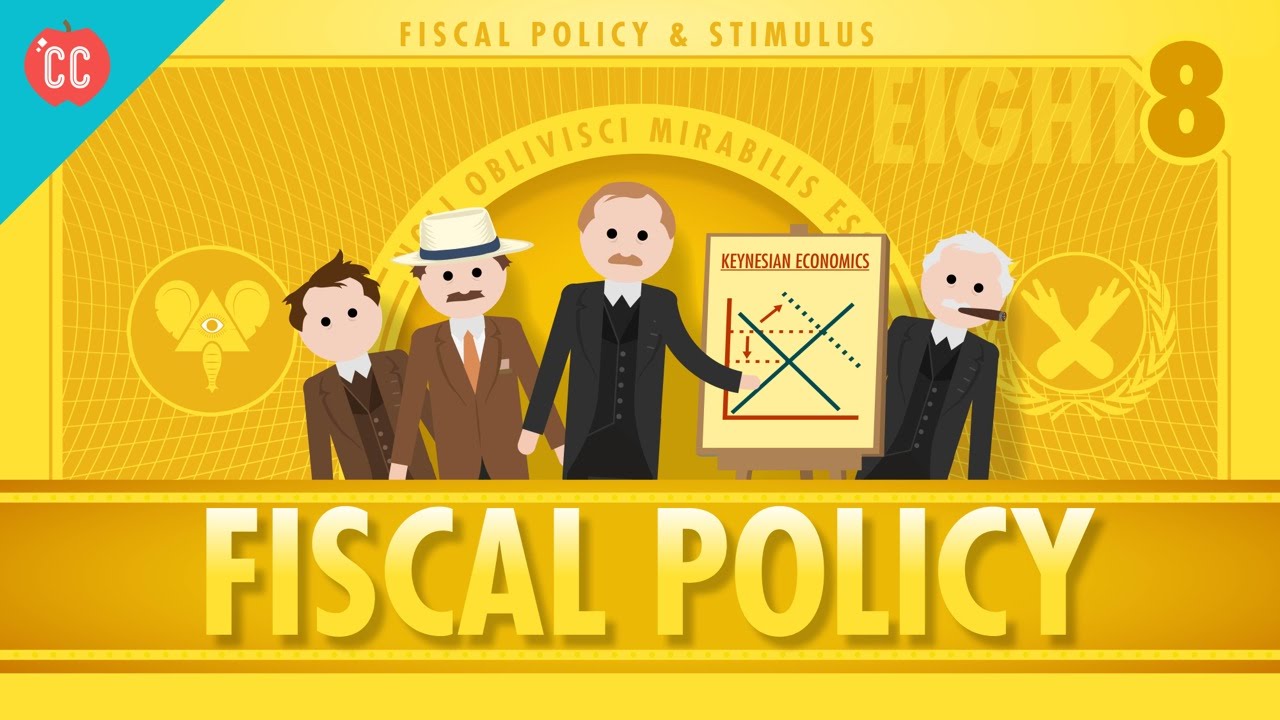
In which Jacob and Adriene teach you about the evils of fiscal policy and stimulus. Well, maybe the policies aren't evil, but there is an evil lair involved. In this episode we learn how government use taxes and spending influence the economy. Sometimes the government gives, and sometimes it takes. And the giving and the taking can have a profound effect on how economies behave.
Crash Course is on Patreon! You can support us directly by signing up at http://www.patreon.com/crashcourse
Thanks to the following Patrons for their generous monthly contributions that help keep Crash Course free for everyone forever:
Mark , Elliot Beter, Moritz Schmidt, Jeffrey Thompson, Ian Dundore, Jacob Ash, Jessica Wode, Today I Found Out, Christy Huddleston, James Craver, Chris Peters, SR Foxley, Steve Marshall, Simun Niclasen, Eric Kitchen, Robert Kunz, Avi Yashchin, Jason A Saslow, Jan Schmid, Daniel Baulig, Christian , Anna-Ester Volozh
Want to find Crash Course elsewhere on the internet?
Facebook - http://www.facebook.com/YouTubeCrashCourse
Twitter - http://www.twitter.com/TheCrashCourse
Tumblr - http://thecrashcourse.tumblr.com
Support Crash Course on Patreon: http://patreon.com/crashcourse
CC Kids: http://www.youtube.com/crashcoursekids

This week we are wrapping up our overview of sociology’s core frameworks and founding theorists with a look Max Weber and his understanding of the modern world. We’ll explore rationalization and the transition from traditional to modern society. We’ll also discuss bureaucracy, legitimacy, and social stratification in the modern state. Finally, we’ll see why Weber was so worried about the modern world.
Crash Course is made with Adobe Creative Cloud. Get a free trial here: https://www.adobe.com/creativecloud.html
***
Crash Course is on Patreon! You can support us directly by signing up at http://www.patreon.com/crashcourse
Thanks to the following Patrons for their generous monthly contributions that help keep Crash Course free for everyone forever:
Mark, Les Aker, Bob Kunz, Mark Austin, William McGraw, Jeffrey Thompson, Ruth Perez, Jason A Saslow, Eric Prestemon, Malcolm Callis, Steve Marshall, Advait Shinde, Rachel Bright, Ian Dundore, Tim Curwick, Ken Penttinen, Dominic Dos Santos, Caleb Weeks, Frantic Gonzalez, Kathrin Janßen, Nathan Taylor, Yana Leonor, Andrei Krishkevich, Brian Thomas Gossett, Chris Peters, Kathy & Tim Philip, Mayumi Maeda, Eric Kitchen, SR Foxley, Tom Trval, Andrea Bareis, Moritz Schmidt, Jessica Wode, Daniel Baulig, Jirat
--
Want to find Crash Course elsewhere on the internet?
Facebook - http://www.facebook.com/YouTubeCrashCourse
Twitter - http://www.twitter.com/TheCrashCourse
Tumblr - http://thecrashcourse.tumblr.com
Support Crash Course on Patreon: http://patreon.com/crashcourse
CC Kids: http://www.youtube.com/crashcoursekids

Take the 2017 PBS Digital Studios Survey: http://surveymonkey.com/r/pbsds2017. Today we're going to talk about a fundamental part of all modern computers. The thing that basically everything else uses - the Arithmetic and Logic Unit (or the ALU). The ALU may not have to most exciting name, but it is the mathematical brain of a computer and is responsible for all the calculations your computer does! And it's actually not that complicated. So today we're going to use the binary and logic gates we learned in previous episodes to build one from scratch, and then we'll use our newly minted ALU when we construct the heart of a computer, the CPU, in episode 7.
*CORRECTION*
We got our wires crossed with the Intel 4004, which we discuss later. The 74181 was introduced by Texas Instruments in 1970 but appeared in technical manuals around 1969. The design of the 74181, like most of the 74xx/74xxx series, was an open design which was manufactured by many other companies - Fairchild was one such manufacturer. They produced a chip, the Fairchild 9341, which was pin-for-pin compatible with the 74181.
Fairchild was the first to prototype an ALU, building the Fairchild 4711 in 1968 - a one-off device not optimized for scale manufacturing. In 1969, Signetics came out with the 8260, which they marketed in a very limited sense (it was attached, AFAICT, to one particular computer, the Data General SUPERNOVA). TI follows afterwards (March 1970) with the 74181, coupled with the 9341 from Fairchild. The 74181 became the standard number for this part, and was available from many manufacturers (back in those days, chip makers cross-licensed designs all over the place in order to provide assurance that their part could be sourced from multiple manufacturers).
Produced in collaboration with PBS Digital Studios: http://youtube.com/pbsdigitalstudios
The Latest from PBS Digital Studios: https://www.youtube.com/playlist?list...
We’ve got merch!
https://store.dftba.com/collections/crashcourse
Want to know more about Carrie Anne?
https://about.me/carrieannephilbin
Want to find Crash Course elsewhere on the internet?
Facebook - http://www.facebook.com/YouTubeCrashC...
Twitter - http://www.twitter.com/TheCrashCourse
Tumblr - http://thecrashcourse.tumblr.com
Support Crash Course on Patreon: http://patreon.com/crashcourse
CC Kids: http://www.youtube.com/crashcoursekids
Want to find Crash Course elsewhere on the internet?
Facebook - http://www.facebook.com/YouTubeCrashCourse
Twitter - http://www.twitter.com/TheCrashCourse
Tumblr - http://thecrashcourse.tumblr.com
Support Crash Course on Patreon: http://patreon.com/crashcourse
CC Kids: http://www.youtube.com/crashcoursekids

Hank continues our exploration of animal phyla with the more complexly organized annelida and arthropoda, and a biolography on insects.
Crash Course Biology is now available on DVD! http://dft.ba/-8css
Like CrashCourse on Facebook: http://www.facebook.com/YouTubeCrashCourse
Follow CrashCourse on Twitter: http://www.twitter.com/TheCrashCourse
References:
http://www.sciencedaily.com/re....leases/2010/07/10072
http://tlc.howstuffworks.com/h....ome/earthworm-apprec
http://annelidsf.blogspot.com/
http://www.bukisa.com/articles..../41743_amazing-facts
http://www.ehow.com/about_6292....974_interesting-crus
crashcourse, crash course, biology, complex animals, annelid, arthropod, segmentation, evolution, diversity, chordate, vertebrate, ancestor, earthworm, beetle, anatomy, synapomorphy, chaetae, shared traits, trait, plesiomorphy, worm, leech, phyla, class, insect, scorpion, butterfly, lobster, thorax, exoskeleton, chitin, jointed feet, cheliceriformes, arachnid, myriapoda, biolography, pollination, flowering plants, flight, metamorphosis, nymph, pupae, crustacea, shrimp, crab Support CrashCourse on Subbable: http://subbable.com/crashcourse

This week we introduce sociology’s three major theoretical paradigms, and some of the advantages and disadvantages of each paradigm.
Crash Course is made with Adobe Creative Cloud. Get a free trial here: https://www.adobe.com/creativecloud.html
***
Crash Course is on Patreon! You can support us directly by signing up at http://www.patreon.com/crashcourse
Thanks to the following Patrons for their generous monthly contributions that help keep Crash Course free for everyone forever:
Mark, Les Aker, Robert Kunz, William McGraw, Jeffrey Thompson, Jason A Saslow, Rizwan Kassim, Eric Prestemon, Malcolm Callis, Steve Marshall, Advait Shinde, Rachel Bright, Kyle Anderson, Ian Dundore, Tim Curwick, Ken Penttinen, Caleb Weeks, Kathrin Janßen, Nathan Taylor, Yana Leonor, Andrei Krishkevich, Brian Thomas Gossett, Chris Peters, Kathy & Tim Philip, Mayumi Maeda, Eric Kitchen, SR Foxley, Justin Zingsheim, Andrea Bareis, Moritz Schmidt, Bader AlGhamdi, Jessica Wode, Daniel Baulig, Jirat
--
Want to find Crash Course elsewhere on the internet?
Facebook - http://www.facebook.com/YouTubeCrashCourse
Twitter - http://www.twitter.com/TheCrashCourse
Tumblr - http://thecrashcourse.tumblr.com
Support Crash Course on Patreon: http://patreon.com/crashcourse
CC Kids: http://www.youtube.com/crashcoursekids

Welcome to Crash Course Statistics! In this series we're going to take a closer look at how statistics play a significant role in our everyday lives. Now this a "math" course, and there will definitely be some math, but we're going to focus on how statistics is useful and valuable to you - someone that performs AND consumes statistics all the time. Statistics are everywhere from batting averages and insurance rates to weather forecasting and smart assistants, and it's our hope that when you finish this series you'll get a better idea of the role statistics play in helping us better understand the world!
Crash Course is on Patreon! You can support us directly by signing up at http://www.patreon.com/crashcourse
Thanks to the following Patrons for their generous monthly contributions that help keep Crash Course free for everyone forever:
Mark Brouwer, Nickie Miskell Jr., Jessica Wode, Eric Prestemon, Kathrin Benoit, Tom Trval, Jason Saslow, Nathan Taylor, Divonne Holmes à Court, Brian Thomas Gossett, Khaled El Shalakany, Indika Siriwardena, Robert Kunz, SR Foxley, Sam Ferguson, Yasenia Cruz, Daniel Baulig, Eric Koslow, Caleb Weeks, Tim Curwick, Evren Türkmenoğlu, Alexander Tamas, Justin Zingsheim, D.A. Noe, Shawn Arnold, mark austin, Ruth Perez, Malcolm Callis, Ken Penttinen, Advait Shinde, Cody Carpenter, Annamaria Herrera, William McGraw, Bader AlGhamdi, Vaso, Melissa Briski, Joey Quek, Andrei Krishkevich, Rachel Bright, Alex S, Mayumi Maeda, Kathy & Tim Philip, Montather, Jirat, Eric Kitchen, Moritz Schmidt, Ian Dundore, Chris Peters, Sandra Aft, Steve Marshall
--
Want to find Crash Course elsewhere on the internet?
Facebook - http://www.facebook.com/YouTubeCrashCourse
Twitter - http://www.twitter.com/TheCrashCourse
Tumblr - http://thecrashcourse.tumblr.com
Support Crash Course on Patreon: http://patreon.com/crashcourse
CC Kids: http://www.youtube.com/crashcoursekids
This week, we're learning about sonnets, and English Literature's best-known purveyor of those fourteen-line paeans, William Shakespeare. We'll look at a few of Willy Shakes's biggest hits, including Sonnet 18, "Shall I compare thee to a summer's day," Sonnet 116, "Let me not to the marriage of true minds admit impediment," and Sonnet 130, "My mistresses's eyes are nothing like the sun." We'll talk about what makes a sonnet, a little bit about their history, and even a little bit about how reading poetry helps us understand how to be human beings.