Top Vídeos


Taken From the Album: Brothers In Arms
Recorded @ 24bit/48khz

Brian Fallon live in Munich

This is the same clip, but queued up with Dire Straights "Sultans of Swing".

A original Mix with a beautiful places around the World... Best band with the best places

Show de despedida da banda a-ha em 2010. Apresentação emocionante de uma banda excelente que marcou toda uma geração e que continuará nos corações de muitas outras.

a-ha is a Norwegian new wave band. The trio, composed of lead vocalist Morten Harket, guitarist Paul Waaktaar-Savoy and keyboardist Magne Furuholmen, formed in 1982 and left Oslo, Norway for London in order to make a career in the music business.
The origin of the name a-ha comes from the lyric of an early song. After checking dictionaries in several languages, they found out that 'a-ha' was an international way of expressing recognition, with positive connotations

The pop hit Take On Me by A-ha has proven a worldwide phenomenon since its release in 1985 and has just hit a billion views on YouTube.
Now, the Norwegian group is touring Australia and sits down to talk about how the classic keyboard riff came to be and why the 80s were a "musical playground".
Read more here: https://ab.co/37R5ynp
For more from ABC News, click here: https://ab.co/2kxYCZY
You can watch more ABC News content on iview: https://ab.co/2OB7Mk1
Subscribe to us on YouTube: http://ab.co/1svxLVE
Go deeper on our ABC News In-depth channel: https://ab.co/2lNeBn2
You can also like us on Facebook: http://facebook.com/abcnews.au
Or follow us on Instagram: http://instagram.com/abcnews_au
Or even on Twitter: http://twitter.com/abcnews

Original BBC Broadcast First Generation VHS-Rip.
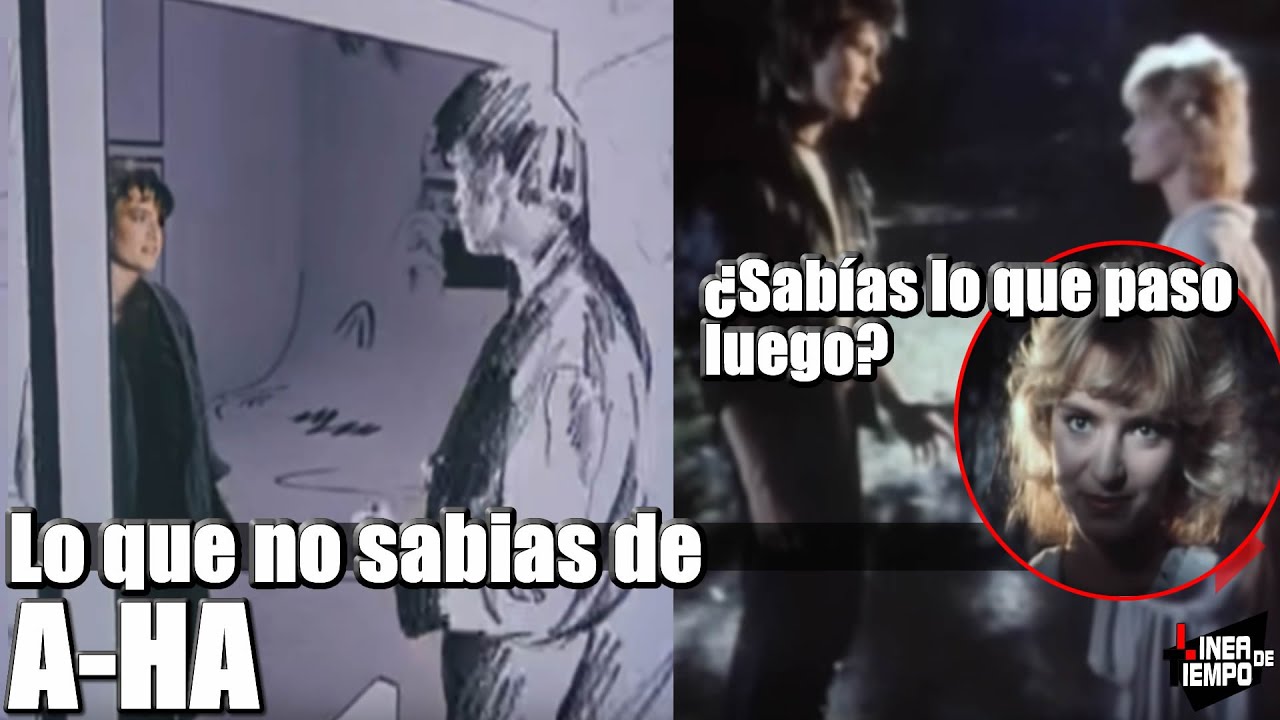
#A-ha #TakeOnMe #Biografia #LineadeTiempo
Instagram @carlosgonzaap
![a-ha - Crying in the rain [HD 720p] [Subtitulos Español / Ingles] [Vídeo oficial]](https://i.ytimg.com/vi/dNTGtAFzZ5U/maxresdefault.jpg)
https://sebastianferreyra.com/....es/clips/cryinginthe
Visitá el enlace de mi sitio web donde encontrarás la letra original, la traducción/interpretación que realicé, wallpapers, notas, el listado de videoclips realizados y además podes dejar tus comentarios, ¡Gracias por pasarte!
© Copyright Information: All music content presented in this video is property of Universal Music Group (UMG).
© Información del copyright: Todo el contenido musical presentado en este videoclip es propiedad exclusiva de Universal Music Group (UMG).
a-ha | Morten Harket | Magne Furuholmen | Paul Waaktaar Savoy | 80s | Classics | Traducción | Traducida | Interpretación | Interpretada | Letra | Lyrics | Norway | Noruega | Estados Unidos | United States of America | Take on me | Ending of a High Note | Español | Inglés | English | Spanish | Buenos Aires | Argentina | Sebastian Ferreyra | Sebaxtian1234 | sebastianferreyra.com

Uma das baladas românticas desta inesquecível banda norueguesa.Que na sua estada aqui no Brasil foi recorde de público.
A canção é uma regravação da música Crying in the Rain, feita originalmente pela dupla The Everly Brothers, em 1962. Esta versão do A-ha é a regravação mais conhecida da canção dos irmãos Everly, lançada 28 anos depois da versão original.Do álbum East of the Sun, West of the Moon, lançado em 1990.

Male jumping spiders perform courtship dances that would make Bob Fosse proud. But if they bomb, they can wind up somebody's dinner instead of their mate.
SUBSCRIBE to Deep Look! http://goo.gl/8NwXqt
DEEP LOOK is a ultra-HD (4K) short video series created by KQED San Francisco and presented by PBS Digital Studios. See the unseen at the very edge of our visible world. Get a new perspective on our place in the universe and meet extraordinary new friends. Explore big scientific mysteries by going incredibly small.
* NEW VIDEOS EVERY OTHER TUESDAY! *
During courtship, the male jumping spider performs an exuberant dance to get the female’s attention. Like a pint-sized Magic Mike working for twenties, he shimmies from side to side, waves his legs, and flaps his front appendages (called pedipalps) in her direction.
If she likes what she sees, the female may allow him to mate. But things can also go terribly wrong for these eight-legged suitors. She might decide to attack him, or even eat him for lunch. Cannibalism is the result about seven percent of the time.
These mating rituals were first described more than 100 years ago. Their study took on a new dimension, however, when scientists discovered that the males also sing when they attempt to woo their lady loves.
By rubbing together their two body segments, equipped with a comb-shaped instrument, the males create vibrations that travel through the ground. The female spiders can “hear” the male songs through ear-like slits in their legs, called sensilla.
A male spider’s coordination of the dance and the song seems to affect his reproductive success — in other words, his ability to stay alive during this risky courtship trial. But what exactly the signals mean remains mysterious to scientists.
Scientists ultimately hope to understand how a female decides whether she’s looking at a stud — or a dud.
--- Where do jumping spiders get their name?
Jumping spiders don’t spin webs to catch food. They stalk their prey like cats. They use their silk as a drag line while they hop around.
--- What do jumping spiders eat?
Jumping spiders are carnivorous and eat insects like flies, bees, and crickets.
--- Where do jumping spiders live?
A map of jumping spider habitat looks like the whole world! Tropical forests contain the greatest number, but they live just about everywhere, even the Himalayan Mountains.
---+ Read the entire article on KQED Science:
https://ww2.kqed.org/science/2....016/10/04/for-these-
---+ For more information:
Elias Lab at U.C. Berkeley: https://nature.berkeley.edu/eliaslab/
---+ More great Deep Look episodes:
This Vibrating Bumblebee Unlocks a Flower's Hidden Treasure
https://www.youtube.com/watch?v=SZrTndD1H10
The Ladybug Love-In: A Valentine's Special
https://www.youtube.com/watch?v=c-Z6xRexbIU
---+ See some great videos and documentaries from the PBS Digital Studios!
Idea Channel: Do You Pronounce it GIF or GIF?
https://www.youtube.com/watch?v=bmqy-Sp0txY
Gross Science: Are There Dead Wasps In Figs?
https://www.youtube.com/watch?v=9DQTjv_u3Vc
---+ Follow KQED Science:
KQED Science: http://www.kqed.org/science
Tumblr: http://kqedscience.tumblr.com
Twitter: https://www.twitter.com/kqedscience
---+ About KQED
KQED, an NPR and PBS affiliate in San Francisco, CA, serves Northern California and beyond with a public-supported alternative to commercial TV, Radio and web media.
Funding for Deep Look is provided in part by PBS Digital Studios and the John S. and James L. Knight Foundation. Deep Look is a project of KQED Science, which is also supported by HopeLab, the S. D. Bechtel, Jr. Foundation, the Dirk and Charlene Kabcenell Foundation, the Vadasz Family Foundation, the Gordon and Betty Moore Foundation, the Smart Family Foundation and the members of KQED.
#deeplook
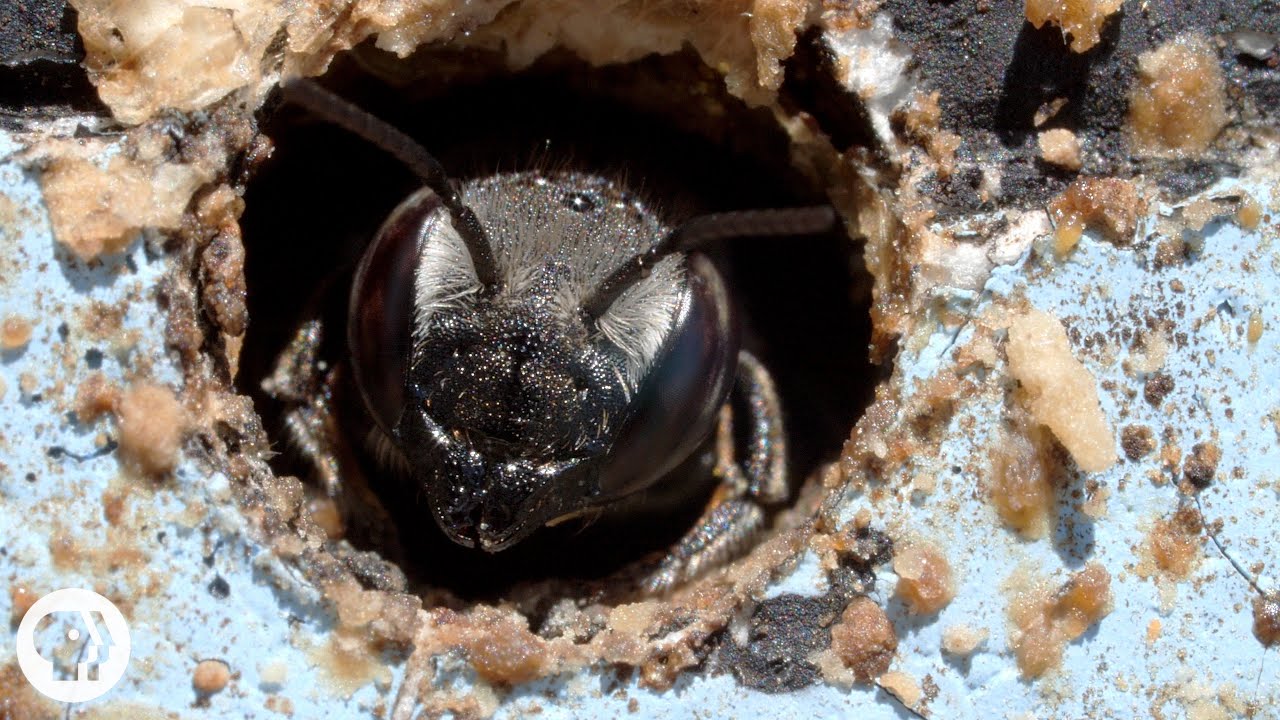
Alfalfa leafcutting bees are way better at pollinating alfalfa flowers than honeybees. They don’t mind getting thwacked in the face by the spring-loaded blooms. And that's good, because hungry cows depend on their hard work to make milk.
Join our community on Patreon! https://www.patreon.com/deeplook
Please take our annual PBSDS Survey, for a chance to win a T-shirt! https://www.pbsresearch.org/c/r/DL_YTvideo
DEEP LOOK is a ultra-HD (4K) short video series created by KQED San Francisco and presented by PBS Digital Studios. See the unseen at the very edge of our visible world. Explore big scientific mysteries by going incredibly small.
---
Sure, cows are important. But next time you eat ice cream, thank a bee.
Every summer, alfalfa leafcutting bees pollinate alfalfa in an intricate process that gets them thwacked by the flowers when they release the pollen that allows the plants to make seeds. The bees’ hard work came to fruition last week when growers in California finished harvesting the alfalfa seeds that will be grown to make nutritious hay for dairy cows.
This is how it works.
To produce alfalfa seeds, farmers let their plants grow until they bloom. They need help pollinating the tiny purple flowers, so that the female and male parts of the flower can come together and produce fertile seeds. That’s where the grayish, easygoing alfalfa leafcutting bees come in. Seed growers in California release the bees – known simply as cutters – in June and they work hard for a month.
Alfalfa’s flowers keep their reproductive organs hidden away inside a boat-shaped bottom petal called the keel petal, which is held closed by a thin membrane that creates a spring mechanism.
Cutter bees come up to the flower looking for nectar and pollen to feed on. When they land on the flower, the membrane holding the keel petal breaks and the long reproductive structure pops right up and smacks the upper petal or the bee, releasing its yellow pollen. This process is called “tripping the flower.”
When the flower is tripped, pollen falls on its female reproductive organ and fertilizes it; bees also carry pollen away on their hairy bodies and help fertilize other flowers. In a few weeks, each flower turns into a curly pod with seven to 10 seeds growing inside.
Cutters trip 80 percent of flowers they visit, compared to honeybees, which only trip about 10 percent.
---
--- What kind of a plant is alfalfa?
Alfalfa is a legume, like beans and chickpeas. Other legumes also hold their reproductive organs within a keel petal.
--- What do bees use leaves for?
Alfalfa leafcutting bees and other leafcutter bees cut leaf and petal pieces to build their nest inside a hole, such as a nook and cranny in a log. Alfalfa farmers provide bees with holes in styrofoam boards.
---+ Read the entire article on KQED Science:
https://www.kqed.org/science/1....946996/this-bee-gets
---+ Shoutout!
?Congratulations ?to the following fans for correctly identifying the bee body part coated in pollen, on our Leafcutting Bee - the scopa or scopae!
Punkonthego
GamingCuzWhyNot
Galatians 4:16
Gil AGA
Edison Lewis
---+ Thank you to our Top Patreon Supporters ($10+ per month)!
Leonhardt Wille
Justin Bull
Bill Cass
Sarah Khalida Mohamad
Daniel Weinstein
Chris B Emrick
Karen Reynolds
Tea Torvinen
David Deshpande
Daisuke Goto
Companion Cube
WhatzGames
Richard Shalumov
Elizabeth Ann Ditz
Gerardo Alfaro
Robert Amling
Shirley Washburn
Robert Warner
Supernovabetty
johanna reis
Kendall Rasmussen
Pamela Parker
Sayantan Dasgupta
Joshua Murallon Robertson
Cindy McGill
Kenia Villegas
Shelley Pearson Cranshaw
Aurora
Dean Skoglund
Silvan Wendland
Ivan Alexander
monoirre
Sonia Tanlimco
Two Box Fish
Jane Orbuch
Allen
Laurel Przybylski
Johnnyonnyful
Rick Wong
Levi Cai
Titania Juang
Nathan Wright
Carl
Michael Mieczkowski
Kyle Fisher
JanetFromAnotherPlanet
Kallie Moore
SueEllen McCann
Geidi Rodriguez
Louis O'Neill
Edwin Rivas
Jeanne Sommer
Katherine Schick
Aurora Mitchell
Cory
Ricardo Martinez
riceeater
Daisy Trevino
KW
PM Daeley
Joao Ascensao
Chris Murphy
Nicolette Ray
TierZoo
---+ Follow KQED Science and Deep Look:
Patreon: https://www.patreon.com/deeplook
Instagram: https://www.instagram.com/kqedscience/
Twitter: https://www.twitter.com/kqedscience
KQED Science on kqed.org: http://www.kqed.org/science
Facebook Watch: https://www.facebook.com/DeepLookPBS/
---+ About KQED
KQED, an NPR and PBS affiliate in San Francisco, CA, serves Northern California and beyond with a public-supported alternative to commercial TV, radio and web media.
Funding for Deep Look is provided in part by PBS Digital Studios. Deep Look is a project of KQED Science, which is also supported by the National Science Foundation, the S. D. Bechtel, Jr. Foundation, the Dirk and Charlene Kabcenell Foundation, the Vadasz Family Foundation, the Fuhs Family Foundation, Campaign 21 and the members of KQED.
#leafcutter #bees #deeplook

How does a group of animals -- or cells, for that matter -- work together when no one’s in charge? Tiny swarming robots--called Kilobots--work together to tackle tasks in the lab, but what can they teach us about the natural world?
↓ More info, videos, and sources below ↓
DEEP LOOK: a new ultra-HD (4K) short video series created by KQED San Francisco and presented by PBS Digital Studios. See the unseen at the very edge of our visible world. Get a new perspective on our place in the universe and meet extraordinary new friends. Explore big scientific mysteries by going incredibly small.
More KQED SCIENCE:
Tumblr: http://kqedscience.tumblr.com
Twitter: https://www.twitter.com/kqedscience
KQED Science: http://ww2.kqed.org/science
About Kilobots
How do you simultaneously control a thousand robots in a swarm? The question may seem like science fiction, but it’s one that has challenged real robotics engineers for decades.
In 2010, the Kilobot entered the scene. Now, engineers are programming these tiny independent robots to cooperate on group tasks. This research could one day lead to robots that can assemble themselves into machines, or provide insights into how swarming behaviors emerge in nature.
In the future, this kind of research might lead to collaborative robots that could self-assemble into a composite structure. This larger robot could work in dangerous or contaminated areas, like cleaning up oil spills or conducting search-and-rescue activities.
What is Emergent Behavior?
The universe tends towards chaos, but sometimes patterns emerge, like a flock of birds in flight. Like termites building skyscrapers out of mud, or fish schooling to avoid predators.
It’s called emergent behavior. Complex behaviors that arise from interactions between simple things. And you don’t just see it in nature.
What’s so interesting about kilobots is that individually, they’re pretty dumb.
They’re designed to be simple. A single kilobot can do maybe... three things: Respond to light. Measure a distance, sense the presence of other kilobots.
But these are swarm robots. They work together.
How do Kilobots work?
Kilobots were designed by Michael Rubenstein, a research scientist in the Self Organizing Systems Research Group at Harvard. Each robot consists of about $15 worth of parts: a microprocessor that is about as smart as a calculator, sensors for visible and infrared light, and two tiny cell-phone vibration units that allow it to move across a table. They are powered by a rechargeable lithium-ion battery, like those found in small electronics or watches.
The kilobots are programed all at once, as a group, using infrared light. Each kilobot gets the same set of instructions as the next. With just a few lines of programming, the kilobots, together, can act out complex natural processes.
The same kinds of simple instructions that kilobots use to self-assemble into shapes can make them mimic natural swarming behaviors, too. For example, kilobots can sync their flashing lights like a swarm of fireflies, differentiate similar to cells in an embryo and follow a scent trail like foraging ants.
Read the article for this video on KQED Science:
https://ww2.kqed.org/science/2....015/07/21/can-a-thou
More great DEEP LOOK episodes:
Where Are the Ants Carrying All Those Leaves?
https://www.youtube.com/watch?v=-6oKJ5FGk24
What Happens When You Put a Hummingbird in a Wind Tunnel?
https://www.youtube.com/watch?v=JyqY64ovjfY
Pygmy Seahorses: Masters of Camouflage
https://www.youtube.com/watch?v=Q3CtGoqz3ww
Related videos from the PBS Digital Studios Network!
Is Ultron Inevitable? | It’s Okay to Be Smart
https://www.youtube.com/watch?v=-Irmtk5QG8s
A History Of Robots | The Good Stuff
https://www.youtube.com/watch?v=TK-h4oATYSI
When Will We Worry About the Well-Being of Robots? | Idea Channel https://www.youtube.com/watch?v=FLieeAUQWMs
Funding for Deep Look is provided in part by PBS Digital Studios and the John S. and James L. Knight Foundation. Deep Look is a project of KQED Science, which is supported by HopeLab, The David B. Gold Foundation; S. D. Bechtel, Jr. Foundation; The Dirk and Charlene Kabcenell Foundation; The Vadasz Family Foundation; Smart Family Foundation and the members of KQED.
#deeplook
Support Deep Look on Patreon!! https://www.patreon.com/deeplook
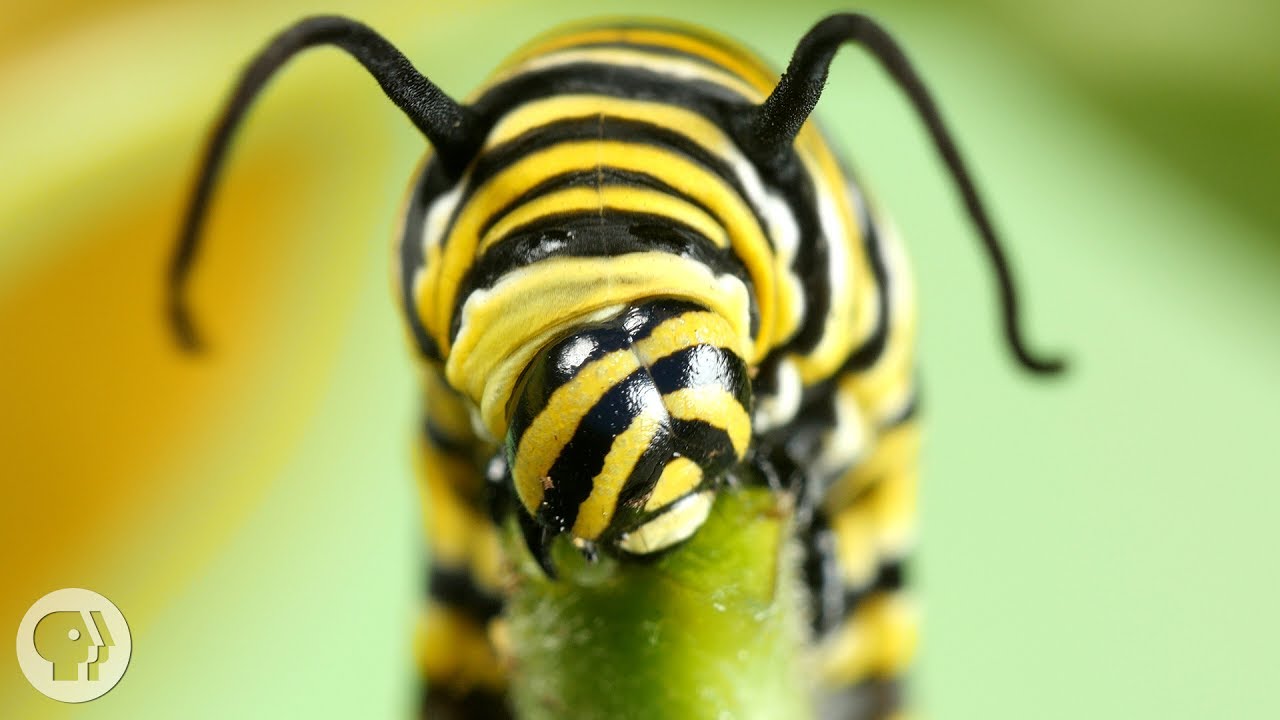
Because it's hoarding protein. Not just for itself, but for the butterfly it will become and every egg that butterfly will lay. And it's about to lose its mouth... as it wriggles out of its skin during metamorphosis.
DEEP LOOK is a ultra-HD (4K) short video series created by KQED San Francisco and presented by PBS Digital Studios. See the unseen at the very edge of our visible world. Get a new perspective on our place in the universe and meet extraordinary new friends. Explore big scientific mysteries by going incredibly small.
* NEW VIDEOS EVERY OTHER TUESDAY! *
That caterpillar in your backyard is chewing through your best leaves for a good reason.
“Caterpillars have to store up incredible reserves of proteins,” said Carol Boggs, an ecologist at the University of South Carolina. “Nectar doesn’t have much protein. Most of the protein that goes to making eggs has to come from larval feeding.”
Caterpillars are the larval stage of a butterfly. Their complete transformation to pupa and then to butterfly is a strategy called holometaboly. Humans are in the minority among animals in that we don’t go through these very distinct, almost separate, lives. We start out as a smaller version of ourselves and grow bigger.
But from an evolutionary point of view, the way butterflies transform make sense.
“You have a larva that is an eating machine,” said Boggs. “It’s very well-suited to that. Then you’re turning it into a reproduction machine, the butterfly.”
Once it becomes a butterfly it will lose its mouth, grow a straw in its place and go on a liquid diet of sugary nectar and rotten fruit juices. Its main job will be to mate and lay eggs. Those eggs started to develop while it was a pupa, using protein that the caterpillar stored by gorging on leaves. We think of leaves as carbohydrates, but the nitrogen they contain makes them more than one quarter protein, said Boggs.
-- What are the stages of a butterfly?
Insects such as butterflies undergo a complete transformation, referred to by scientists as holometaboly. A holometabolous insect has a morphology in the juvenile state which is different from that in the adult and which undergoes a period of reorganization between the two, said Boggs. The four life stages are egg, larva (caterpillar), pupa (also known as chrysalis) and butterfly.
-- What if humans developed like butterflies?
“We’d go into a quiescent period when we developed different kind of eating organs and sensory organs,” said Boggs. “It would be as if we went into a pupa and developed straws as mouths and developed more elaborate morphology for smelling and developed wings. It brings up science fiction images.”
---+ Read the entire article on KQED Science:
https://ww2.kqed.org/science/2....017/07/11/why-is-the
---+ For more information:
Monarch Watch: http://www.monarchwatch.org
California Pipevine Swallowtail Project:
https://www.facebook.com/Calif....orniaPipevineSwallow
A forum organized by Tim Wong, who cares for the butterflies in the California Academy of Sciences’ rainforest exhibit. Wong’s page has beautiful photos and videos of California pipevine swallowtail butterflies at every stage – caterpillar, pupa and butterfly – and tips to create native butterfly habitat.
---+ More Great Deep Look episodes:
What Gives the Morpho Butterfly Its Magnificent Blue?
https://www.youtube.com/watch?v=29Ts7CsJDpg
This Vibrating Bumblebee Unlocks a Flower's Hidden Treasure
https://www.youtube.com/watch?v=SZrTndD1H10
Roly Polies Came From the Sea to Conquer the Earth
https://www.youtube.com/watch?v=sj8pFX9SOXE
In the Race for Life, Which Human Embryos Make It?
https://www.youtube.com/watch?v=9mv_kuwQvoc
---+ See some great videos and documentaries from the PBS Digital Studios!
PBS Eons: When Did the First Flower Bloom?
https://www.youtube.com/watch?v=13aUo5fEjNY
CrashCourse: The History of Life on Earth - Crash Course Ecology #1
https://www.youtube.com/watch?v=sjE-Pkjp3u4
---+ Follow KQED Science:
KQED Science: http://www.kqed.org/science
Tumblr: http://kqedscience.tumblr.com
Twitter: https://www.twitter.com/kqedscience
---+ About KQED
KQED, an NPR and PBS affiliate in San Francisco, CA, serves Northern California and beyond with a public-supported alternative to commercial TV, Radio and web media.
Funding for Deep Look is provided in part by PBS Digital Studios and the John S. and James L. Knight Foundation. Deep Look is a project of KQED Science, which is also supported by HopeLab, the S. D. Bechtel, Jr. Foundation, the Dirk and Charlene Kabcenell Foundation, the Vadasz Family Foundation, the Gordon and Betty Moore Foundation, the Smart Family Foundation and the members of KQED.
#deeplook #caterpillars #butterflies

Those hundreds of powerful suckers on octopus arms do more than just stick. They actually smell and taste. This contributes to a massive amount of information for the octopus’s brain to process, so octopuses depend on their eight arms for help. (And no, it's not 'octopi.')
To keep up with Amy Standen, subscribe to her podcast The Leap - a podcast about people making dramatic, risky changes:
https://ww2.kqed.org/news/programs/the-leap/
DEEP LOOK is a ultra-HD (4K) short video series created by KQED San Francisco and presented by PBS Digital Studios. Explore big scientific mysteries by going incredibly small.
SUBSCRIBE to Deep Look! http://goo.gl/8NwXqt
* NEW VIDEOS EVERY OTHER TUESDAY! *
Everyone knows that an octopus has eight arms. And similar to our arms it uses them to grab things and move around. But that’s where the similarities end. Hundreds of suckers on each octopus arm give them abilities people can only dream about.
“The suckers are hands that also smell and taste,” said Rich Ross, senior biologist and octopus aquarist at the California Academy of Sciences.
Suckers are “very similar to our taste buds, from what little we know about them,” said University of North Carolina, Chapel Hill, cephalopod biologist William Kier.
If these tasting, smelling suckers make you think of a human hand with a tongue and a nose stuck to it, that’s a good start. It all stems from the unique challenges an octopus faces as a result of having a flexible, soft body.
“This animal has no protection and is a wonderful meal because it’s all muscle,” said Kier.
So the octopus has adapted over time. It has about 500 million neurons (dogs have around 600 million), the cells that allow it to process and communicate information. And these neurons are distributed to make the most of its eight arms. An octopus’ central brain – located between its eyes – doesn’t control its every move. Instead, two thirds of the animal’s neurons are in its arms.
“It’s more efficient to put the nervous cells in the arm,” said neurobiologist Binyamin Hochner, of Hebrew University, in Jerusalem. “The arm is a brain of its own.”
This enables octopus arms to operate somewhat independently from the animal’s central brain. The central brain tells the arms in what direction and how fast to move, but the instructions on how to reach are embedded in each arm.
Octopuses have also evolved mechanisms that allow their muscles to move without the use of a skeleton. This same muscle arrangement enables elephant trunks and mammals’ tongues to unfurl.
“The arrangement of the muscle in your tongue is similar to the arrangement in the octopus arm,” said Kier.
In an octopus arm, muscles are arranged in different directions. When one octopus muscle contracts, it’s able to stretch out again because other muscles oriented in a different direction offer resistance – just as the bones in vertebrate bodies do. This skeleton of muscle, called a muscular hydrostat, is how an octopus gets its suckers to attach to different surfaces.
--- How many suction cups does an octopus have on each arm?
It depends on the species. Giant Pacific octopuses have up to 240 suckers on each arm.
--- Do octopuses have arms or tentacles?
Octopuses have arms, not tentacles. “The term ‘tentacle’ is used for lots of fleshy protuberances in invertebrates,” said Kier. “It just happens that the eight in octopuses are called arms.”
--- Can octopuses regrow a severed arm?
Yes!
---+ Read the entire article on KQED Science:
https://ww2.kqed.org/science/2....017/02/14/if-your-ha
---+ For more information:
The octopus research group at the Hebrew University of Jerusalem: https://www.youtube.com/watch?v=gN81dtxilhE
---+ More Great Deep Look episodes:
You're Not Hallucinating. That's Just Squid Skin.
https://www.youtube.com/watch?v=0wtLrlIKvJE
Watch These Frustrated Squirrels Go Nuts!
https://www.youtube.com/watch?v=ZUjQtJGaSpk
---+ See some great videos and documentaries from the PBS Digital Studios!
It’s Okay To Be Smart: Is This A NEW SPECIES?!
https://www.youtube.com/watch?v=asZ8MYdDXNc
BrainCraft: Your Brain in Numbers
https://www.youtube.com/watch?v=FFcbnf07QZ4
---+ Follow KQED Science:
KQED Science: http://www.kqed.org/science
Tumblr: http://kqedscience.tumblr.com
Twitter: https://www.twitter.com/kqedscience
---+ About KQED
KQED, an NPR and PBS affiliate in San Francisco, CA, serves Northern California and beyond with a public-supported alternative to commercial TV, Radio and web media.
Funding for Deep Look is provided in part by PBS Digital Studios and the John S. and James L. Knight Foundation. Deep Look is a project of KQED Science, which is also supported by HopeLab, the S. D. Bechtel, Jr. Foundation, the Dirk and Charlene Kabcenell Foundation, the Vadasz Family Foundation, the Gordon and Betty Moore Foundation, the Smart Family Foundation and the members of KQED.
#deeplook

La escalera de San José: un misterio que nadie ha podido explicar
Tekton es un canal de noticias católicas nacido en Barcelona (España), puedes encontrar noticias relacionadas con la Iglesia Católica, y recursos de otro tipo como vidas de Santos, el Evangelio del día, y otras muchas cosas más. No dudes en entrar y ver el contenido que sin duda te gustará, nuestra web es http://www.tekton.info

Conoce la historia de San Chárbel y los listones de colores
Tekton es un canal de youtube católico nacido en Barcelona (España), puedes encontrar noticias relacionadas con la Iglesia Católica, y recursos de otro tipo como formación católica, oraciones, música católica, vídeos del Papa Francisco, curiosidades, vidas de Santos, el Evangelio del día, y otras muchas cosas más. No dudes en entrar y ver el contenido que sin duda te gustará
Web: http://www.tekton.info
Facebook: https://www.facebook.com/productoratekton/
Twitter: https://twitter.com/productoratekto?s=09
Instagram: https://www.instagram.com/productoratekton/
Google+: https://plus.google.com/u/1/+T....ektonTekton?hl=es-41
Hacer un donativo: https://www.tekton.info/hacer-caridad/
#Tekton
#TektonCentroTelevisivo
#TektonYouTube
#CanalCatolicoYouTube

Como murió la Virgen María. Su último día antes de subir al cielo
TEKTON NECESITA TU APOYO PARA CONTINUAR CON SU LABOR APOSTÓLICA Y CARITATIVA, SI PUEDES HACERNOS UN DONATIVO TIENES DOS FORMAS:
HAZTE PATROCINADOR: https://www.patreon.com/CTtekton
DONATIVO A TRAVÉS DE LA WEB: https://www.tekton.info/hacer-caridad/
OTRAS REDES SOCIALES
Web: https://www.tekton.info/
San José de tekton: https://www.youtube.com/channe....l/UCEy0tevPx3RayM5PA
Instagram Tekton: https://www.instagram.com/prod....uctoratekton/?hl=es-
Instagram Marcos: https://www.instagram.com/marcosveraperez/?hl=es
Twitter: https://twitter.com/productoratekto
Twitter Marcos: https://twitter.com/marcosveraprez1?lang=es
Tekton es un canal de youtube católico nacido en Barcelona (España), puedes encontrar noticias relacionadas con la Iglesia Católica, y recursos de otro tipo como formación católica, oraciones, música católica, vídeos del Papa Francisco, curiosidades, vidas de Santos, el Evangelio del día, y otras muchas cosas más. No dudes en entrar y ver el contenido que sin duda te gustará
Instagram de Marcos Vera: https://www.instagram.com/marcosveraperez/
Twitter de Marcos Vera: https://twitter.com/MarcosVeraPrez1
Twitter de Jesus Sellas: https://twitter.com/JesusSellas
Hacer un donativo: https://www.tekton.info/hacer-caridad/
Tienda de merchandising de Tekton: https://teespring.com/stores/t....ekton-centro-televis
Web: http://www.tekton.info
Facebook: https://www.facebook.com/productoratekton/
Twitter: https://twitter.com/productoratekto?s=09
Instagram: https://www.instagram.com/productoratekton/
Google+: https://plus.google.com/u/1/+T....ektonTekton?hl=es-41
#Tekton
#TektonCentroTelevisivo
#TektonYouTube
#CanalCatolicoYouTube