Top Vídeos
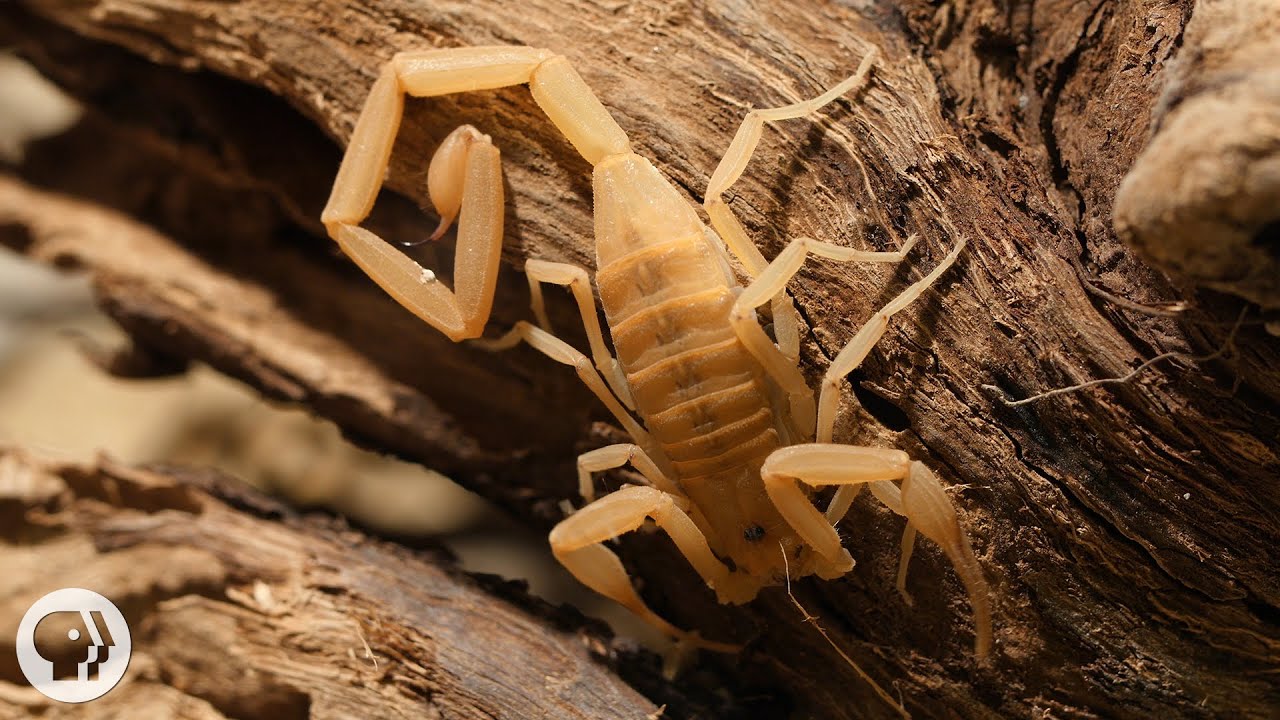
There's a chemical arms race going on in the Sonoran Desert between a highly venomous scorpion and a particularly ferocious mouse. The outcome of their battle may one day change the way doctors treat pain in people.
SUBSCRIBE to Deep Look! http://goo.gl/8NwXqt
DEEP LOOK: a new ultra-HD (4K) short video series created by KQED San Francisco and presented by PBS Digital Studios. See the unseen at the very edge of our visible world. Get a new perspective on our place in the universe and meet extraordinary new friends. Explore big scientific mysteries by going incredibly small.
Commonly found in the Sonoran Desert, the Arizona bark scorpion (Centruroides sculpturatus) is the most dangerous scorpion in the continental United States. According to Keith Boesen, Director of the Arizona Poison & Drug Information Center, about 15,000 Americans report being stung by scorpions every year in the U.S. The worst stings, about 200 annually, are attributed to this one species. Its sting can cause sharp pain along with tingling, swelling, numbness, dizziness, shortness of breath, muscular convulsions, involuntary eye movements, coughing and vomiting. Children under two years old are especially vulnerable. Since 2000, three human deaths have been attributed to the Arizona bark scorpion in the United States, all within Arizona.
But there is one unlikely creature that appears unimpressed. While it may not look the part, the Southern grasshopper mouse (Onychomys torridus) is an extremely capable hunter. It fearlessly stalks and devours any beetles or grasshoppers that have the misfortune to cross its path. But this mouse has a particular taste for scorpions.
The scorpion venom contains neurotoxins that target sodium and potassium ion channels, proteins embedded within the surface of the nerve and muscle cells that play an important role in regulating the sensation of pain. Activating these channels sends signals down the nerves to the brain. That’s what causes the excruciating pain that human victims have described as the feeling like getting jabbed with a hot needle. Others compare the pain to an electric shock. But the grasshopper mouse has an entirely different reaction when stung.
Within the mouse, a special protein in one of the sodium ion channels binds to the scorpion’s neurotoxin. Once bound, the neurotoxin is unable to activate the sodium ion channel and send the pain signal. Instead it has the entirely opposite effect. It shuts down the channel, keeping it from sending any signals, which has a numbing effect for the mouse.
--- How many species of scorpion are there?
There are almost 2,000 scorpion species, but only 30 or 40 have strong enough poison to kill a person.
--- Are scorpions insects?
Scorpions are members of the class Arachnida and are closely related to spiders, mites, and ticks.
--- Where do Arizona bark scorpions live?
Commonly found in the Sonoran Desert, the Arizona bark scorpion (Centruroides sculpturatus) is the most dangerous scorpion in the continental United States. The Arizona bark scorpion’s preference for hanging to the underside of objects makes dangerous encounters with humans more likely.
Read the entire article on KQED Science:
http://ww2.kqed.org/science/20....16/03/08/stinging-sc
For more information:
Michigan State University Venom Evolution: http://venomevolution.zoology.msu.edu/
Institute for Biodiversity Science and Sustainability at the California Academy of Sciences: http://www.calacademy.org/scientists
More great Deep Look episodes:
What Happens When You Zap Coral With The World's Most Powerful X-ray Laser?
https://youtu.be/aXmCU6IYnsA
These 'Resurrection Plants' Spring Back to Life in Seconds
https://youtu.be/eoFGKlZMo2g
See some great videos and documentaries from the PBS Digital Studios!
It's Okay to Be Smart: Your Salad Is Trying To Kill You
https://youtu.be/8Ofgj2KDbfk
It's Okay to Be Smart: The Oldest Living Things In The World
https://youtu.be/jgspUYDwnzQ
For more content from KQED Science:
KQED Science: http://www.kqed.org/science
Tumblr: http://kqedscience.tumblr.com
Twitter: https://www.twitter.com/kqedscience
Funding for Deep Look is provided in part by PBS Digital Studios and the John S. and James L. Knight Foundation. Deep Look is a project of KQED Science, which is also supported by HopeLab, the David B. Gold Foundation, the S. D. Bechtel, Jr. Foundation, the Dirk and Charlene Kabcenell Foundation, the Vadasz Family Foundation, the Gordon and Betty Moore Foundation, the Smart Family Foundation and the members of KQED.
#deeplook
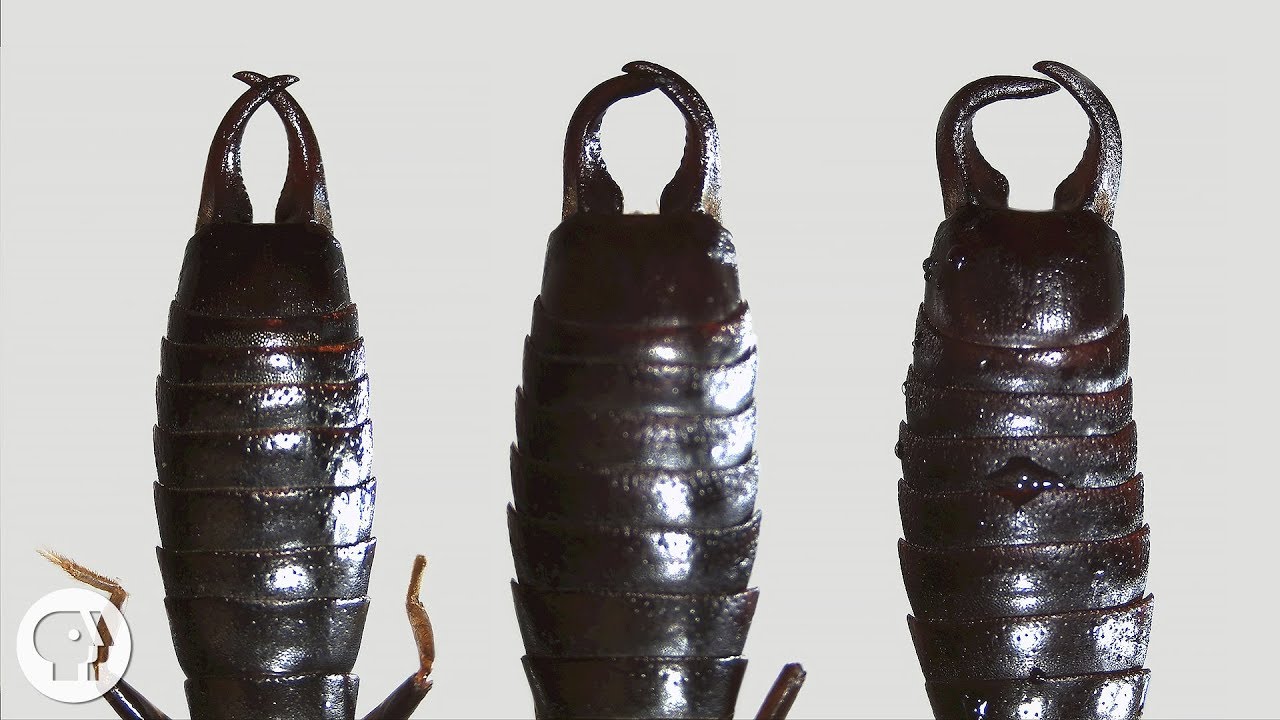
Earwigs are equipped with some pretty imposing pincers on their rear, and they're not afraid to use them. But when it comes to these appendages, size isn't everything.
You can learn more about CuriosityStream at https://curiositystream.com/deeplook.
SUBSCRIBE to Deep Look! http://goo.gl/8NwXqt
DEEP LOOK is a ultra-HD (4K) short video series created by KQED San Francisco and presented by PBS Digital Studios. See the unseen at the very edge of our visible world. Explore big scientific mysteries by going incredibly small.
Many animals seem to show a preference for symmetry in a potential mate. It can be a clue that the mate has the genes necessary to develop properly and thrive in an environment full of stresses and dangers.
But in some critters buck the trend. Like the earwig, a diminutive insect found on every continent except Antarctica.
Andrew ZInk, an associate professor of biology at San Francisco State University, has been looking at how symmetry affects earwigs success when it comes to social interactions.
He’s studying maritime earwigs, a larger and more powerful cousin to the common European earwig you might find in your backyard. Both creatures bear fearsome looking pincers on their backsides. And they aren’t afraid to use them to defend themselves. Zink knows all about that.
--- Do earwigs climb into your ear?
The quick answer is no. Earwigs are not interested in climbing into your ear to lay their eggs or otherwise. They’re no more likely than any other bug to accidentally find its way into you ear. The name earwig come from the old english words for ear and insect. It may have been named after the shape of the common European earwig’s wings, which when extended resemble a human ear.
--- Do earwigs pinch people?
Earwigs will use their pincers to defend themselves, but the pinch is typically not strong enough to be considered dangerous.
--- Do earwigs fly?
Male common European earwigs have wings and can fly to disperse and find mates. Females do not have wings or fly. Neither male nor female maritime earwigs have wings or fly.
--- What do earwigs eat?
Most earwigs are scavengers and omnivores. In addition to scavenging and eating plants, the common European earwigs also hunts small prey like aphids. Maritime earwigs are carnivorous hunting smaller arthropods like sand hoppers.
---+ Read the entire article on KQED Science:
https://ww2.kqed.org/science/2....018/06/26/what-do-ea
---+ For more information:
Biologists probe asymmetric warfare between earwigs
https://news.sfsu.edu/biologis....ts-probe-asymmetric-
Asymmetric Forceps Increase Fighting Success among Males of Similar size in the Maritime Earwig
https://onlinelibrary.wiley.co....m/doi/abs/10.1111/j.
Sexual selection by the seashore: the roles of body size and weaponry in mate choice and competition in the maritime earwig (Anisolabis maritima)
http://viyengar.clasit.org/wp-....content/uploads/2017
---+ More Great Deep Look episodes:
Watch These Cunning Snails Stab and Swallow Fish Whole | Deep Look
https://www.youtube.com/watch?v=jYMjLgPFSso
This Is Why Water Striders Make Terrible Lifeguards | Deep Look
https://www.youtube.com/watch?v=E2unnSK7WTE&t=19s
Take Two Leeches and Call Me in the Morning | Deep Look
https://www.youtube.com/watch?v=O-0SFWPLaII
---+ See some great videos and documentaries from PBS Digital Studios!
What the World’s Cutest Animal Can Teach Us About Saving Ourselves | Hot Mess
https://www.youtube.com/watch?v=IF8ym4g2SCU
The Deadpool Salamander | It's Okay To Be Smart
https://www.youtube.com/watch?v=uGutfyDOmu0
Why Do We Eat Artificial Flavors? | Origin Of Everything
https://www.youtube.com/watch?v=iNaJ31EV13U
---+ Follow KQED Science:
KQED Science: http://www.kqed.org/science
Tumblr: http://kqedscience.tumblr.com
Twitter: https://www.twitter.com/kqedscience
---+ About KQED
KQED, an NPR and PBS affiliate in San Francisco, CA, serves Northern California and beyond with a public-supported alternative to commercial TV, Radio and web media.
Funding for Deep Look is provided in part by PBS Digital Studios. Deep Look is a project of KQED Science, which is supported by the Templeton Religion Trust and the Templeton World Charity Foundation, the S. D. Bechtel, Jr. Foundation, the Dirk and Charlene Kabcenell Foundation, the Vadasz Family Foundation, the Gordon and Betty Moore Foundation, the Fuhs Family Foundation Fund and the members of KQED.
#deeplook #earwig #pincers

Please follow us on Patreon! https://www.patreon.com/deeplook
Take the PBSDS survey: https://to.pbs.org/2018YTSurvey
CORRECTION, 9/26/2018: This episode of Deep Look contains an error in the scientific name of the house centipede. It is Scutigera coleoptrata, not coleoptera. We regret the error. The viewers who caught the mistake will receive a free Deep Look T-shirt, and our gratitude. Thanks for keeping tabs on us!
Voracious, venomous and hella leggy, house centipedes are masterful predators with a knack for fancy footwork. But not all their legs are made for walking, they put some to work in other surprising ways.
SUBSCRIBE to Deep Look! http://goo.gl/8NwXqt
Recognizable for their striking (some might say, repulsive) starburst-like shape, house centipedes have far fewer than the 100 legs their name suggests. They’re born with a modest eight, a count that grows to 30 as they reach adulthood.
If 30 legs sound like more than one critter really needs – perhaps it is. Over the last 450 million years or so, when centipedes split off from other arthropods, evolution has turned some of those walking limbs into other useful and versatile tools.
When it hunts, for example, the house centipede uses its legs as a rope to restrain prey in a tactic called “lassoing.” The tip of each leg is so finely segmented and flexible that it can coil around its victim to prevent escape.
The centipede’s venom-injecting fangs, called forciples, are also modified legs. Though shorter and thicker than the walking limbs, they are multi-jointed , which makes them far more dexterous than the fangs of insects and spiders, which hinge in only one plane.
Because of this dexterity, the centipede’s forciples not only inject venom, but also hold prey in place while the centipede feeds. Then they take a turn as a grooming tool. The centipede passes its legs through the forciples to clean and lubricate their sensory hairs.
Scientists have long noticed that because of their length and the fact that the centipede holds them aloft when it walks, these back legs give the appearance of a second pair antennae. The house centipede looks like it has two heads.
In evolution, when an animal imitates itself, it’s called automimicry. Automimicry occurs in some fish, birds and butterflies, and usually serves to divert predators.
New research suggests that’s not the whole story with the house centipede. Electron microscopy conducted on the centipede’s legs has revealed as many sensory hairs, or sensilla, on them as on the antennae.
The presence of so many sensory hairs suggest the centipede’s long back legs are not merely dummies used in a defensive ploy, but serve a special function, possibly in mate selection. During courtship, both the male and female house centipede slowly raise and lower their antennae and back legs, followed by mutual tapping and probing.
--- Are house centipedes dangerous?
Though they do have venom, house centipedes don’t typically bite humans.
--- Where do house centipedes live?
House centipedes live anywhere where the humidity hovers around 90 percent. That means the moist places in the house: garages, bathrooms, basements. Sometimes their presence can indicate of a leaky roof or pipe.
--- Do house centipedes have 100 legs?
No. An adult house centipede has 30. Only one group of centipedes, called the soil centipedes, actually have a hundred legs or more.
---+ Read the entire article on KQED Science:
https://ww2.kqed.org/science/2....018/09/25/the-house-
---+ For more information:
Visit the centipede page of the Natural History Museum, London:
http://www.nhm.ac.uk/our-scien....ce/our-work/origins-
---+ More Great Deep Look episodes:
How Kittens Go From Clueless to Cute
https://www.youtube.com/watch?v=o1xRlkNwQy8
This Adorable Sea Slug is a Sneaky Little Thief
https://www.youtube.com/watch?v=KLVfWKxtfow
---+ See some great videos and documentaries from the PBS Digital Studios!
Origin of Everything: Why Do People Have Pets?
https://www.youtube.com/watch?v=k2nW7_2VUMc
Hot Mess: What if Carbon Emissions Stopped Tomorrow?
https://www.youtube.com/watch?v=A4kX9xKGeEw
---+ Follow KQED Science:
KQED Science: http://www.kqed.org/science
Tumblr: http://kqedscience.tumblr.com
Twitter: https://www.twitter.com/kqedscience
---+ About KQED
KQED, an NPR and PBS affiliate in San Francisco, CA, serves Northern California and beyond with a public-supported alternative to commercial TV, Radio and web media.
Funding for Deep Look is provided in part by PBS Digital Studios. Deep Look is a project of KQED Science, which is supported by the Templeton Religion Trust and the Templeton World Charity Foundation, the S. D. Bechtel, Jr. Foundation, the Dirk and Charlene Kabcenell Foundation, the Vadasz Family Foundation, the Gordon and Betty Moore Foundation, the Fuhs Family Foundation Fund and the members of KQED.
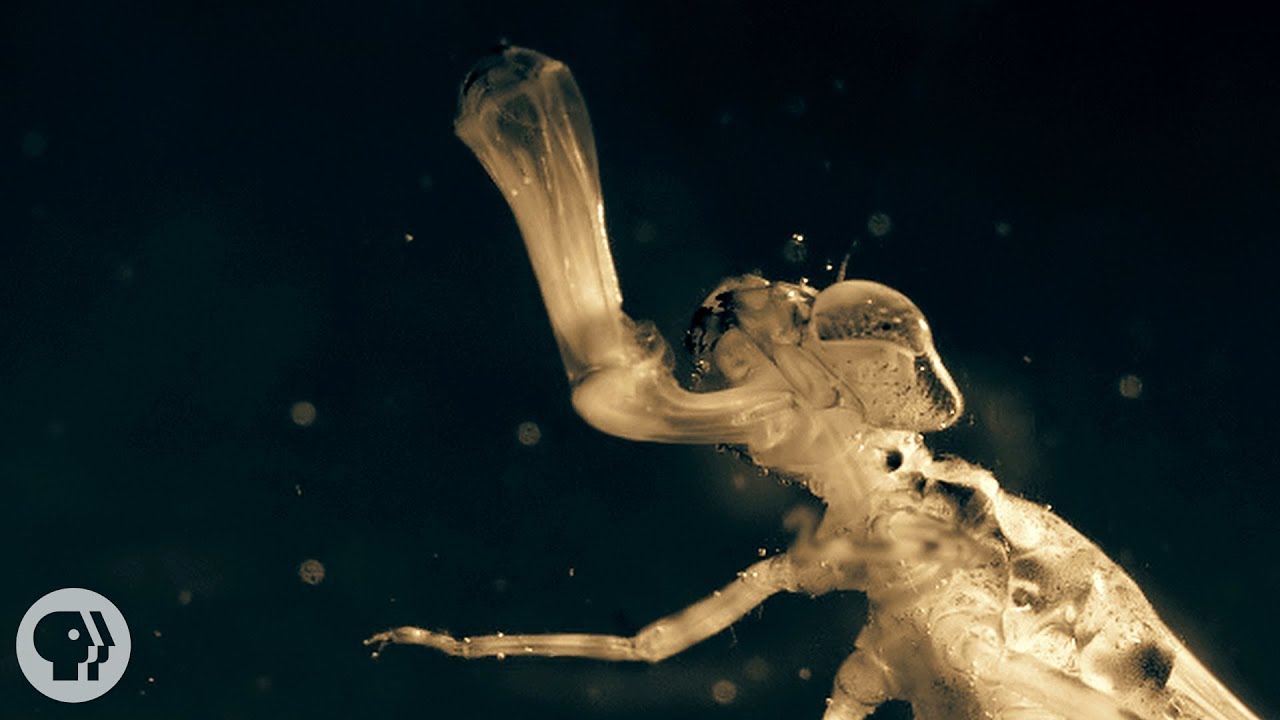
Dragonflies might rule the skies, but their babies grow up underwater in a larva-eat-larva world. Luckily for them, they have a killer lip that snatches prey, Alien-style, at lightning speed.
SUBSCRIBE to Deep Look! http://goo.gl/8NwXqt
DEEP LOOK: a new ultra-HD (4K) short video series created by KQED San Francisco and presented by PBS Digital Studios. See the unseen at the very edge of our visible world. Get a new perspective on our place in the universe and meet extraordinary new friends. Explore big scientific mysteries by going incredibly small.
* NEW VIDEOS EVERY OTHER TUESDAY! *
If adult dragonflies are known to be precise hunters, capable of turning on a dime and using their almost-360-degree vision to nab mosquitoes and flies in midair, their dragon-looking babies are even more fearsome.
Dragonflies and damselflies lay their eggs in water. After they hatch, their larvae, also known as nymphs, spend months or years underwater growing wings on their backs.
Without those versatile four wings that adults use to chase down prey, nymphs rely on a mouthpart they shoot out. It’s like a long, hinged arm that they keep folded under their head and it’s eerily similar to the snapping tongue-like protuberance the alien shoots out at Ripley in the sci-fi movie Aliens.
A nymph’s eyesight is almost as precise as an adult dragonfly’s and when they spot something they want to eat, they extrude this mouthpart, called a labium, to engulf, grab, or impale their next meal and draw it back to their mouth. Only dragonfly and damselfly nymphs have this special mouthpart.
“It’s like a built-in spear gun,” said Kathy Biggs, the author of guides to the dragonflies of California and the greater Southwest.
With their labium, nymphs can catch mosquito larvae, worms and even small fish and tadpoles.
“It’s obviously an adaptation to be a predator underwater, where it’s not easy to trap things,” said Dennis Paulson, a dragonfly biologist retired from the University of Puget Sound.
Also known among biologists as a “killer lip,” the labium comes in two versions. There’s the spork-shaped labium that scoops up prey, and a flat one with a pair of pincers on the end that can grab or impale aquatic insects.
-- How many years have dragonflies been around?
Dragonflies have been around for 320 million years, said Ed Jarzembowski, who studies fossil dragonflies at the Nanjing Institute of Geology and Paleontology. That means they were here before the dinosaurs.
-- How big did dragonflies used to be?
Prehistoric dragonflies had a wingspan of 0.7 meters (almost 28 inches). That’s the wingspan of a small hawk today.
---+ Read the entire article on KQED Science:
https://ww2.kqed.org/science/2....017/09/12/a-baby-dra
---+ For more information:
This web site, run by Kathy and David Biggs, has photos and descriptions of California dragonflies and damselflies and information on building a pond to attract the insects to your backyard: http://bigsnest.members.sonic.net/Pond/dragons/
The book "A Dazzle of Dragonflies," by Forrest Mitchell and James Lasswell, has good information on dragonfly nymphs.
---+ More great Deep Look episodes:
Why Is The Very Hungry Caterpillar So Dang Hungry?
https://www.youtube.com/watch?v=el_lPd2oFV4
This Mushroom Starts Killing You Before You Even Realize It
https://www.youtube.com/watch?v=bl9aCH2QaQY&t=57s
Daddy Longlegs Risk Life ... and Especially Limb ... to Survive
https://www.youtube.com/watch?v=tjDmH8zhp6o
This Is Why Water Striders Make Terrible Lifeguards
https://www.youtube.com/watch?v=E2unnSK7WTE
---+ See some great videos and documentaries from PBS Digital Studios!
PBS Eons: The Biggest Thing That Ever Flew
https://www.youtube.com/watch?v=scAp-fncp64
PBS Infinite Series: A Breakthrough in Higher Dimensional Spheres
https://www.youtube.com/watch?v=ciM6wigZK0w
---+ Follow KQED Science:
KQED Science: http://www.kqed.org/science
Tumblr: http://kqedscience.tumblr.com
Twitter: https://www.twitter.com/kqedscience
---+ About KQED
KQED, an NPR and PBS affiliate based in San Francisco, serves the people of Northern California and beyond with a public-supported alternative to commercial media. Home to one of the most listened-to public radio stations in the nation, one of the highest-rated public television services and an award-winning education program, KQED is also a leader and innovator in interactive media and technology, taking people of all ages on journeys of exploration – exposing them to new people, places and ideas.
Funding for Deep Look is provided in part by PBS Digital Studios and the John S. and James L. Knight Foundation. Deep Look is a project of KQED Science, which is supported by HopeLab, The David B. Gold Foundation; S. D. Bechtel, Jr. Foundation; The Dirk and Charlene Kabcenell Foundation; The Vadasz Family Foundation; Smart Family Foundation and the members of KQED.
#deeplook #dragonflies #dragonflynymph

Male jumping spiders perform courtship dances that would make Bob Fosse proud. But if they bomb, they can wind up somebody's dinner instead of their mate.
SUBSCRIBE to Deep Look! http://goo.gl/8NwXqt
DEEP LOOK is a ultra-HD (4K) short video series created by KQED San Francisco and presented by PBS Digital Studios. See the unseen at the very edge of our visible world. Get a new perspective on our place in the universe and meet extraordinary new friends. Explore big scientific mysteries by going incredibly small.
* NEW VIDEOS EVERY OTHER TUESDAY! *
During courtship, the male jumping spider performs an exuberant dance to get the female’s attention. Like a pint-sized Magic Mike working for twenties, he shimmies from side to side, waves his legs, and flaps his front appendages (called pedipalps) in her direction.
If she likes what she sees, the female may allow him to mate. But things can also go terribly wrong for these eight-legged suitors. She might decide to attack him, or even eat him for lunch. Cannibalism is the result about seven percent of the time.
These mating rituals were first described more than 100 years ago. Their study took on a new dimension, however, when scientists discovered that the males also sing when they attempt to woo their lady loves.
By rubbing together their two body segments, equipped with a comb-shaped instrument, the males create vibrations that travel through the ground. The female spiders can “hear” the male songs through ear-like slits in their legs, called sensilla.
A male spider’s coordination of the dance and the song seems to affect his reproductive success — in other words, his ability to stay alive during this risky courtship trial. But what exactly the signals mean remains mysterious to scientists.
Scientists ultimately hope to understand how a female decides whether she’s looking at a stud — or a dud.
--- Where do jumping spiders get their name?
Jumping spiders don’t spin webs to catch food. They stalk their prey like cats. They use their silk as a drag line while they hop around.
--- What do jumping spiders eat?
Jumping spiders are carnivorous and eat insects like flies, bees, and crickets.
--- Where do jumping spiders live?
A map of jumping spider habitat looks like the whole world! Tropical forests contain the greatest number, but they live just about everywhere, even the Himalayan Mountains.
---+ Read the entire article on KQED Science:
https://ww2.kqed.org/science/2....016/10/04/for-these-
---+ For more information:
Elias Lab at U.C. Berkeley: https://nature.berkeley.edu/eliaslab/
---+ More great Deep Look episodes:
This Vibrating Bumblebee Unlocks a Flower's Hidden Treasure
https://www.youtube.com/watch?v=SZrTndD1H10
The Ladybug Love-In: A Valentine's Special
https://www.youtube.com/watch?v=c-Z6xRexbIU
---+ See some great videos and documentaries from the PBS Digital Studios!
Idea Channel: Do You Pronounce it GIF or GIF?
https://www.youtube.com/watch?v=bmqy-Sp0txY
Gross Science: Are There Dead Wasps In Figs?
https://www.youtube.com/watch?v=9DQTjv_u3Vc
---+ Follow KQED Science:
KQED Science: http://www.kqed.org/science
Tumblr: http://kqedscience.tumblr.com
Twitter: https://www.twitter.com/kqedscience
---+ About KQED
KQED, an NPR and PBS affiliate in San Francisco, CA, serves Northern California and beyond with a public-supported alternative to commercial TV, Radio and web media.
Funding for Deep Look is provided in part by PBS Digital Studios and the John S. and James L. Knight Foundation. Deep Look is a project of KQED Science, which is also supported by HopeLab, the S. D. Bechtel, Jr. Foundation, the Dirk and Charlene Kabcenell Foundation, the Vadasz Family Foundation, the Gordon and Betty Moore Foundation, the Smart Family Foundation and the members of KQED.
#deeplook
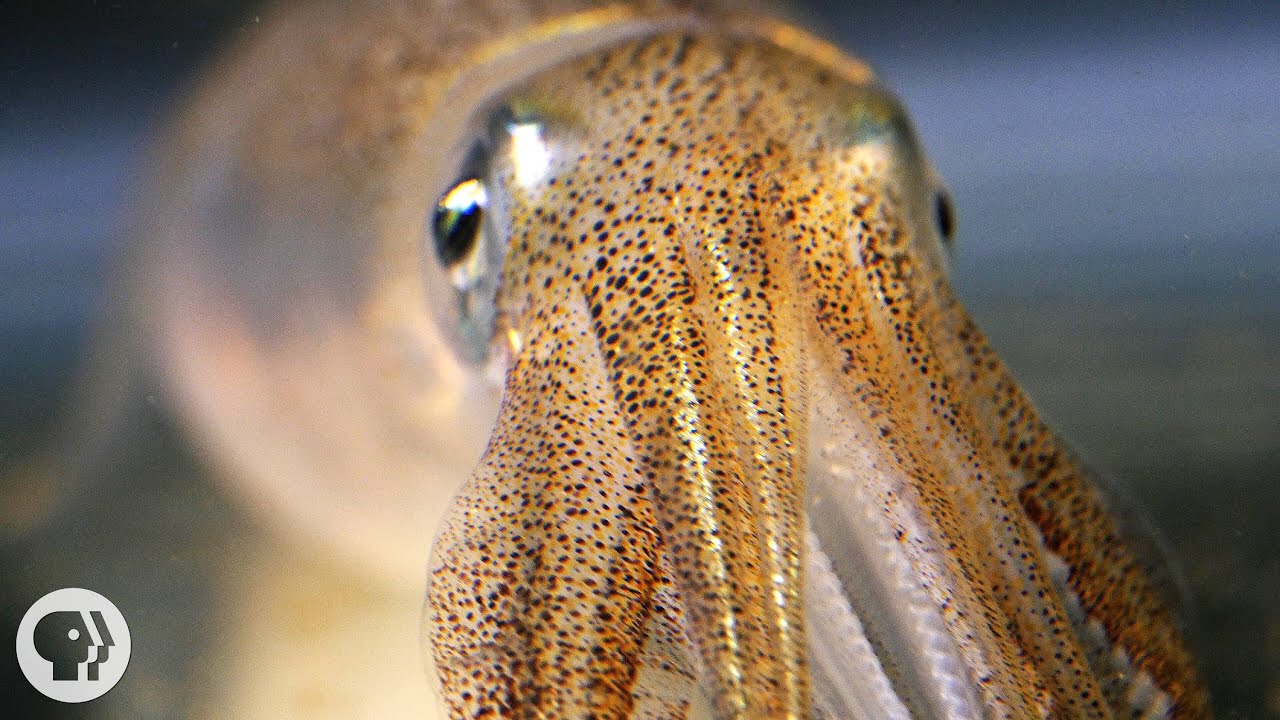
Octopuses and cuttlefish are masters of underwater camouflage, blending in seamlessly against a rock or coral. But squid have to hide in the open ocean, mimicking the subtle interplay of light, water, and waves. How do they do it? (And it is NOT OCTOPI)
SUBSCRIBE to Deep Look! http://goo.gl/8NwXqt
DEEP LOOK is a ultra-HD (4K) short video series created by KQED San Francisco and presented by PBS Digital Studios. Explore big scientific mysteries by going incredibly small.
* NEW VIDEOS EVERY OTHER TUESDAY! *
--- How do squid change color?
For an animal with such a humble name, market squid have a spectacularly hypnotic appearance. Streaks and waves of color flicker and radiate across their skin. Other creatures may posses the ability to change color, but squid and their relatives are without equal when it comes to controlling their appearance and new research may illuminate how they do it.
To control the color of their skin, cephalopods use tiny organs in their skin called chromatophores. Each tiny chromatophore is basically a sac filled with pigment. Minute muscles tug on the sac, spreading it wide and exposing the colored pigment to any light hitting the skin. When the muscles relax, the colored areas shrink back into tiny spots.
--- Why do squid change color?
Octopuses, cuttlefish and squid belong to a class of animals referred to as cephalopods. These animals, widely regarded as the most intelligent of the invertebrates, use their color change abilities for both camouflage and communication. Their ability to hide is critical to their survival since, with the exception of the nautiluses, these squishy and often delicious animals live without the protection of protective external shells.
But squid often live in the open ocean. How do you blend in when there's nothing -- except water -- to blend into? They do it by changing the way light bounces off their their skin -- actually adjust how iridescent their skin is using light reflecting cells called iridophores. They can mimic the way sunlight filters down from the surface. Hide in plain sight.
Iridophores make structural color, which means they reflect certain wavelengths of light because of their shape. Most familiar instances of structural color in nature (peacock feathers, mother of pearl) are constant–they may shimmer when you change your viewing angle, but they don't shift from pink to blue.
--- Read the article for this video on KQED Science:
http://ww2.kqed.org/science/20....15/09/08/youre-not-h
--- More great DEEP LOOK episodes:
What Gives the Morpho Butterfly Its Magnificent Blue?
https://www.youtube.com/watch?v=29Ts7CsJDpg
Nature's Mood Rings: How Chameleons Really Change Color
https://www.youtube.com/watch?v=Kp9W-_W8rCM
Pygmy Seahorses: Masters of Camouflage
https://www.youtube.com/watch?v=Q3CtGoqz3ww
--- Related videos from the PBS Digital Studios Network!
Cuttlefish: Tentacles In Disguise - It’s Okay to Be Smart
https://www.youtube.com/watch?v=lcwfTOg5rnc
Why Neuroscientists Love Kinky Sea Slugs - Gross Science
https://www.youtube.com/watch?v=QGHiyWjjhHY
The Psychology of Colour, Emotion and Online Shopping - YouTube
https://www.youtube.com/watch?v=THTKv6dT8rU
--- More KQED SCIENCE:
Tumblr: http://kqedscience.tumblr.com
Twitter: https://www.twitter.com/kqedscience
KQED Science: http://ww2.kqed.org/science
Funding for Deep Look is provided in part by PBS Digital Studios and the John S. and James L. Knight Foundation. Deep Look is a project of KQED Science, which is supported by HopeLab, The David B. Gold Foundation; S. D. Bechtel, Jr. Foundation; The Dirk and Charlene Kabcenell Foundation; The Vadasz Family Foundation; Smart Family Foundation and the members of KQED.
#deeplook #squid #octopus
Support Deep Look on Patreon!! https://www.patreon.com/deeplook
(FYI - This episode is a *bit* more bloody that usual – especially a little after the 2-minute mark. Just letting you know in case flesh wounds aren’t your thing)
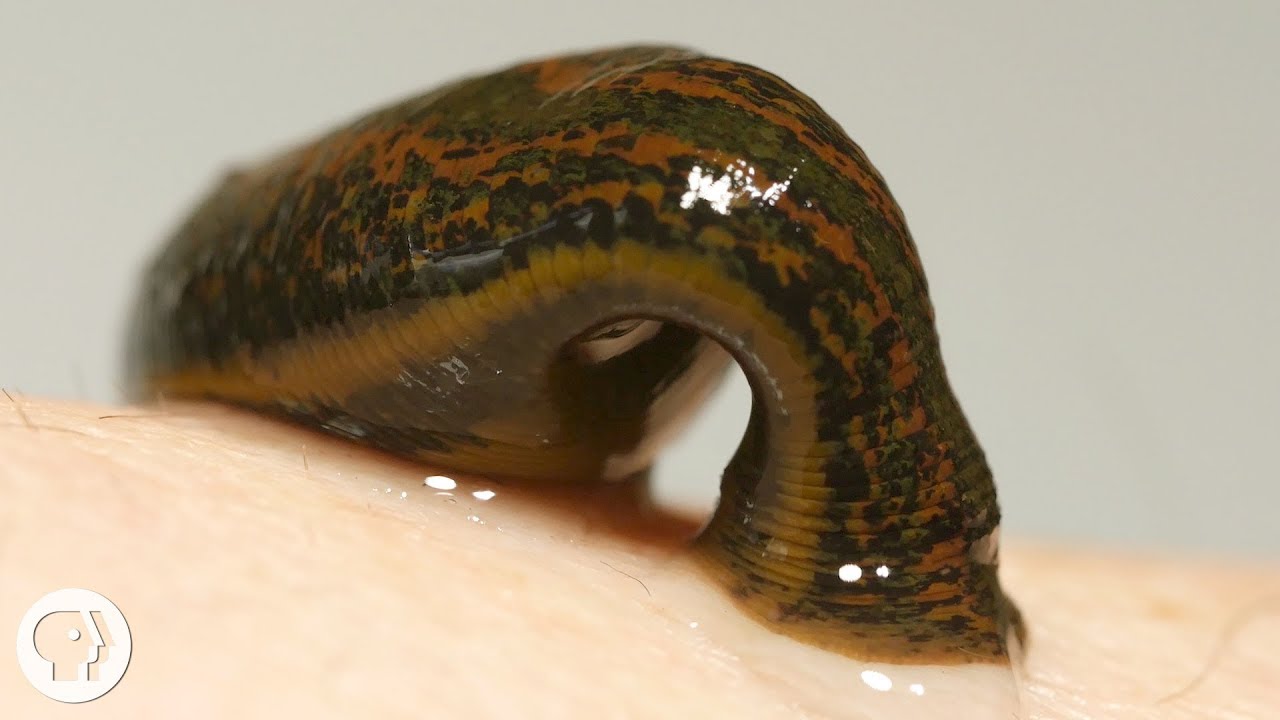
The same blood-sucking leeches feared by hikers and swimmers are making a comeback... in hospitals. Once used for questionable treatments, leeches now help doctors complete complex surgeries to reattach severed body parts.
SUBSCRIBE to Deep Look! http://goo.gl/8NwXqt
DEEP LOOK: a new ultra-HD (4K) short video series created by KQED San Francisco and presented by PBS Digital Studios. See the unseen at the very edge of our visible world. Explore big scientific mysteries by going incredibly small.
Leeches get a bad rap—but they might not deserve it. Yes, they’re creepy crawly blood-suckers. And they can instill an almost primal sense of disgust and revulsion. Humphrey Bogart’s character in the 1951 film The African Queen even went so far as to call them “filthy little devils.”
But the humble leech is making a comeback. Contrary to the typical, derogatory definition of a human “leech,” this critter is increasingly playing a key role as a sidekick for scientists and doctors, simply by being its bloodthirsty self.
Distant cousins of the earthworm, most leech species are parasites that feed on the blood of animals and humans alike. They are often found in freshwater and navigate either by swimming or by inching themselves along, using two suckers—one at each end of their body—to anchor themselves.
Upon reaching an unsuspecting host, a leech will surreptitiously attach itself and begin to feed. It uses a triangular set of three teeth to cut in, and secretes a suite of chemicals to thin the blood and numb the skin so its presence goes undetected.
---+ Read the entire article on KQED Science: https://www.kqed.org/science/1....921659/take-two-leec
---+ For more information:
David Weisblat at UC Berkeley studies leeches development and evolution
https://mcb.berkeley.edu/labs/....weisblat/research.ht
Biologists recently reported that leeches in that region can provide a valuable snapshot of which animals are present in a particular area
https://www.tandfonline.com/doi/abs/10.1080/14772000.2018.1433729?journalCode=tsab20&
---+ More Great Deep Look episodes:
Why the Male Black Widow is a Real Home Wrecker | Deep Look
https://www.youtube.com/watch?v=NpJNeGqExrc
For Pacific Mole Crabs It's Dig or Die | Deep Look
https://www.youtube.com/watch?v=tfoYD8pAsMw
Praying Mantis Love is Waaay Weirder Than You Think | Deep Look
https://www.youtube.com/watch?v=NHf47gI8w04&t=83s
---+ See some great videos and documentaries from the PBS Digital Studios! Above the Noise:
Cow Burps Are Warming the Planet | Reactions
https://www.youtube.com/watch?v=MnRFUSGz_ZM
What a Dinosaur Looks Like Under a Microscope | Eons
https://www.youtube.com/watch?v=4rvgiDXc12k
Hawking Radiation | Space Time
https://www.youtube.com/watch?v=qPKj0YnKANw
---+ Follow KQED Science:
KQED Science: http://www.kqed.org/science
Tumblr: http://kqedscience.tumblr.com
Twitter: https://www.twitter.com/kqedscience
---+ About KQED KQED, an NPR and PBS affiliate in San Francisco, CA, serves Northern California and beyond with a public-supported alternative to commercial TV, Radio and web media.
Funding for Deep Look is provided in part by PBS Digital Studios. Deep Look is a project of KQED Science, which is supported by the S. D. Bechtel, Jr. Foundation, the Dirk and Charlene Kabcenell Foundation, the Vadasz Family Foundation, the Gordon and Betty Moore Foundation, the Fuhs Family Foundation Fund and the members of KQED.
#deeplook

When predators attack, daddy longlegs deliberately release their limbs to escape. They can drop up to three and still get by just fine.
SUBSCRIBE to Deep Look! http://goo.gl/8NwXqt
DEEP LOOK: a new ultra-HD (4K) short video series created by KQED San Francisco and presented by PBS Digital Studios. See the unseen at the very edge of our visible world. Get a new perspective on our place in the universe and meet extraordinary new friends. Explore big scientific mysteries by going incredibly small.
We all know it’s not nice to pull the legs off of bugs.
Daddy longlegs don’t wait for that to happen. These arachnids, related to spiders, drop them deliberately. A gentle pinch is enough to trigger an internal system that discharges the leg. Whether it hurts is up for debate, but most scientists think not, given the automatic nature of the defense mechanism.
It’s called autotomy, the voluntary release of a body part.
Two of their appendages have evolved into feelers, which leaves the other six legs for locomotion. Daddy longlegs share this trait with insects, and have what scientists call the “alternate tripod gate,” where three legs touch the ground at any given point.
That elegant stride is initially hard-hit by the loss of a leg. In the daddy longlegs’ case, the lost leg doesn’t grow back.
But they persevere: A daddy longlegs that is one, two, or even three legs short can recover a surprising degree of mobility by learning to walk differently. And given time, the daddy longlegs can regain much of its initial mobility on fewer legs.
Once these adaptations are better understood, they may have applications in the fields of robotics and prosthetic design.
--- Are daddy longlegs a type of spider?
No, though they are arachnids, as spiders are. Daddy longlegs are more closely related to scorpions.
--- How can I tell a daddy longlegs from a spider?
Daddy longlegs have one body segment (like a pea), while spiders have two (like a peanut). Also, you won’t find a daddy longlegs in a web, since they don’t make silk.
--- Can a daddy longlegs bite can kill you?
Daddy longlegs are not venomous. And despite what you’ve heard about their mouths being too small, they could bite you, but they prefer fruit.
---+ Read the entire article on KQED Science:
https://ww2.kqed.org/science/2....017/08/22/daddy-long
---+ For more information:
Visit the Elias Lab at UC Berkeley:
https://nature.berkeley.edu/eliaslab/
---+ More Great Deep Look episodes:
Stinging Scorpion vs. Pain-Defying Mouse | Deep Look
https://www.youtube.com/watch?v=w-K_YtWqMro
For These Tiny Spiders, It's Sing or Get Served | Deep Look
https://www.youtube.com/watch?v=y7qMqAgCqME
---+ See some great videos and documentaries from the PBS Digital Studios!
Gross Science: What Happens When You Get Rabies?
https://www.youtube.com/watch?v=eiUUpF1UPJc
Physics Girl: Mantis Shrimp Punch at 40,000 fps! - Cavitation Physics
https://www.youtube.com/watch?v=m78_sOEadC8
---+ Follow KQED Science:
KQED Science: http://www.kqed.org/science
Tumblr: http://kqedscience.tumblr.com
Twitter: https://www.twitter.com/kqedscience
---+ About KQED
KQED, an NPR and PBS affiliate based in San Francisco, serves the people of Northern California and beyond with a public-supported alternative to commercial media. Home to one of the most listened-to public radio station in the nation, one of the highest-rated public television services and an award-winning education program, KQED is also a leader and innovator in interactive media and technology, taking people of all ages on journeys of exploration — exposing them to new people, places and ideas.
Funding for Deep Look is provided in part by PBS Digital Studios and the John S. and James L. Knight Foundation. Deep Look is a project of KQED Science, which is supported by HopeLab, The David B. Gold Foundation; S. D. Bechtel, Jr. Foundation; The Dirk and Charlene Kabcenell Foundation; The Vadasz Family Foundation; Smart Family Foundation and the members of KQED.
#deeplook #daddylonglegs #harvestman
Check out BBC Earth on BBC online - http://www.bbc.com/earth/world
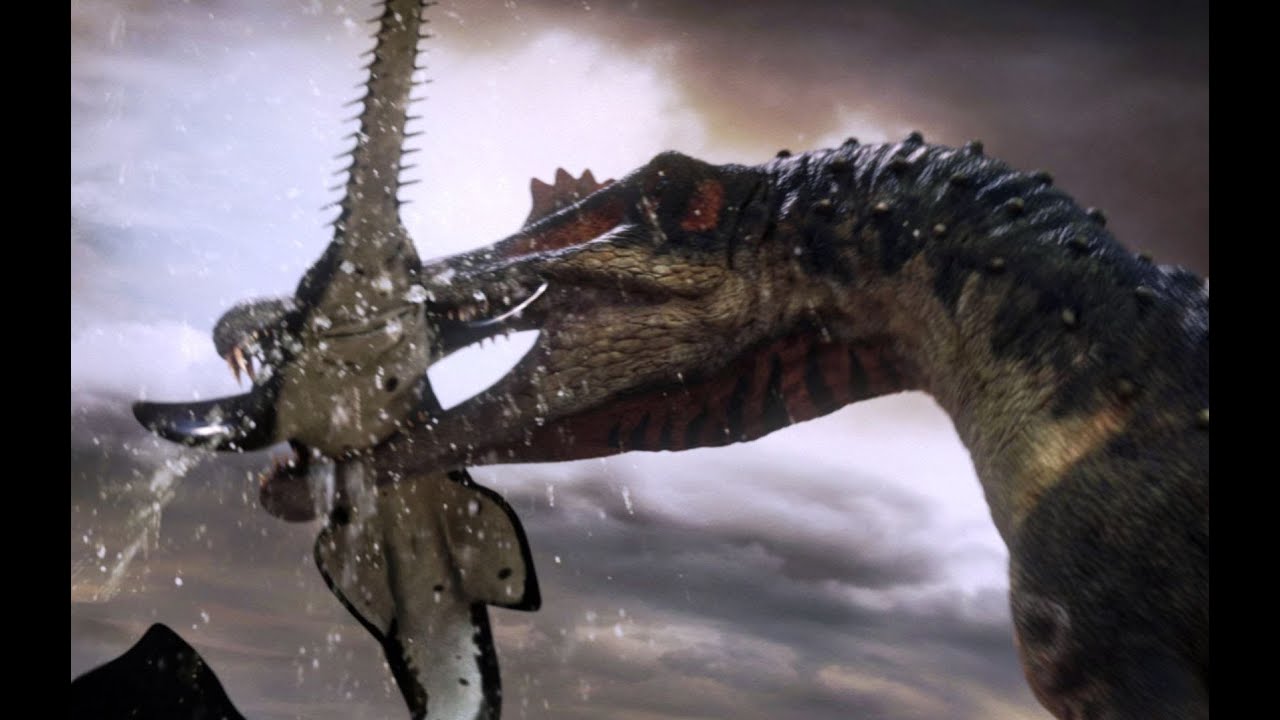
John Hurts tells the stories of the biggest, deadliest and weirdest Dinosaurs ever to walk the Earth. Massive carnivorous hunter Spinosaurus hunts the giant fresh water fish Onchopristis.
Planet Dinosaur tells the stories of the biggest, deadliest and weirdest creatures ever to walk the Earth, using the latest fossil evidence and immersive computer graphics. Narrated by John Hurt.
Visit http://www.bbcearth.com for all the latest animal news and wildlife videos
BBC Earth Facebook http://www.facebook.com/bbcearth (ex-UK only)
BBC Earth Twitter http://www.twitter.com/bbcearth
Subscribe to BBC Earth: http://bit.ly/ydxvrP
BBC Earth Channel: http://www.youtube.com/BBCEarth
Latest BBC Earth videos: http://bit.ly/y1wtbi

After precautionary checks the new born panda is reunited with mum.
Taken From Panda Babies. Subscribe: http://bit.ly/BBCEarthSub
WATCH MORE:
New on Earth: https://bit.ly/2M3La96
Oceanscapes: https://bit.ly/2Hmd2kZ
Wild Thailand: https://bit.ly/2kR7lmh
Welcome to BBC EARTH! The world is an amazing place full of stories, beauty and natural wonder. Here you'll find 50 years worth of astounding, entertaining, thought-provoking and educational natural history content. Dramatic, rare, and exclusive, nature doesn't get more exciting than this.
Want to share your views? Join our BBC Studios Voice: https://www.bbcstudiosvoice.com/register
This is a channel from BBC Studios who help fund new BBC programmes. Service information and feedback: http://bbcworldwide.com/vod-fe....edback--contact-deta

Music video by Ultravox performing Dancing With Tears In My Eyes (2009 Digital Remaster).
http://vevo.ly/hHTefK

Ultravox performing at Live Aid in front of 72,000 people in Wembley Stadium, London on the 13th July, 1985. The event was organised by Sir Bob Geldof and Midge Ure to raise funds for the Ethiopian famine disaster. Broadcast across the world via one of the largest satellite link-ups of all time, the concerts were seen by around 40% of the global population.
Remember to subscribe to stay up to date with all new releases in the channel.
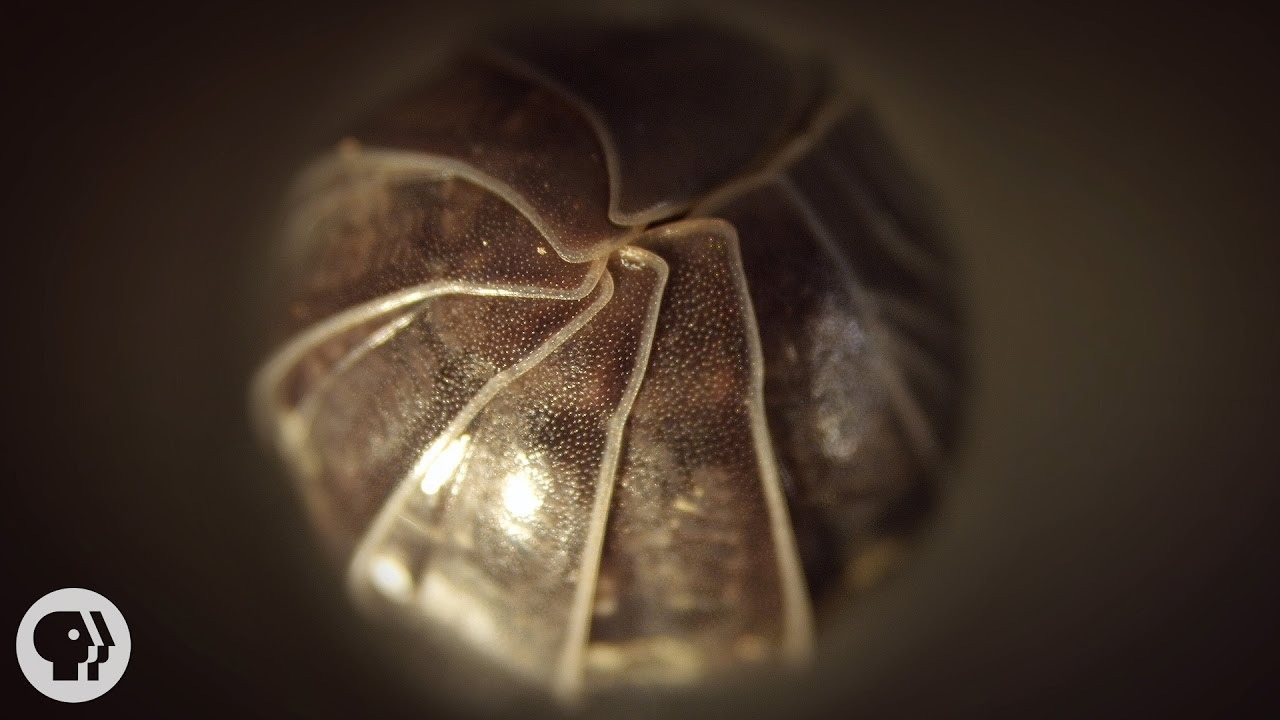
Pill bugs. Doodle bugs. Potato bugs. Wood Shrimp. Whatever you call them, there’s something less creepy about these critters than other insects. Maybe it’s because they’re not insects at all.
SUBSCRIBE to Deep Look! http://goo.gl/8NwXqt
DEEP LOOK is a ultra-HD (4K) short video series created by KQED San Francisco and presented by PBS Digital Studios. See the unseen at the very edge of our visible world. Get a new perspective on our place in the universe. Explore big scientific mysteries by going incredibly small.
* NEW VIDEOS EVERY OTHER TUESDAY! *
With winter rains, Bay Area pill bugs are out in force. Fortunately, they’re one of our most beloved “bugs.” Pill bugs. Doodle bugs. Potato bugs. Wood Shrimp. Whatever you call them, there’s something less creepy about these critters than other insects. Maybe it’s because they’re not insects at all.
Pill bugs are more closely related to a shrimp and lobsters than crickets or butterflies. Their ancestors lived in the sea, but ancient pill bugs crawled out millions of years ago to carve a life for themselves on dry land.
You can see the evidence if you take a close look at them, so that’s exactly what we did for this episode of Deep Look, an ultra-high definition wildlife video series produced by KQED and PBS DIgital Studios.
“Kids love them,” said Jonathan Wright, a professor of biology at Pomona College who studies the charismatic creepy-crawlies. After all, who hasn’t delighted as a youth in annoying a pill bug until it defensively curls up into a little armored ball?
Some adventurous foragers even eat pill bugs. Their flavor is said to resemble other crustaceans, earning pill bugs the moniker “wood shrimp”.
“I personally haven’t tasted one,” said Wright, “but I’ve spoken to people that have. They didn’t get a particularly high approval rating. Pill bugs have a lot of soil in their gut.”
They may not be ready to replace shrimp as an appetizer, but according to Wright, the evidence of the pill bug’s evolutionary lineage lies underneath its shell.
--- What are pill bugs related to?
Pill bugs are terrestrial crustaceans. They’re more closely related to marine creatures like lobsters and shrimp than crickets or other insects.
--- If pill bugs have gills, can they survive underwater?
Most pill bugs will drown within a few hours if submerged because their pleopod gills have become better at removing oxygen from air and less good at removing oxygen from water
--- Why do pill bugs roll into a ball?
Pill bugs roll into a ball to protect themselves from potential predators. They will also roll up, a process called conglobation, to keep from drying out if they don’t have access to enough moisture.
--- What do pill bugs eat?
Pill bugs mostly eat decaying plant matter but also consume fungus, algae and lichens.
---+ Read the entire article on KQED Science:
https://ww2.kqed.org/science/2....017/01/17/roly-polie
---+ For more information:
Respiratory physiology of the Oniscidea: Aerobic capacity and the significance of pleopodal lungs. Jonathan C. Wright and Kevin Ting
---+ More Great Deep Look episodes:
The Double-Crossing Ants to Whom Friendship Means Nothing
https://www.youtube.com/watch?v=fguo3HvWjb0
The Snail-Smashing, Fish-Spearing, Eye-Popping Mantis Shrimp
https://www.youtube.com/watch?v=Lm1ChtK9QDU
These Termites Turn Your House into a Palace of Poop
https://www.youtube.com/watch?v=DYPQ1Tjp0ew&t=83s
---+ See some great videos and documentaries from the PBS Digital Studios!
A Venus Flytrap Works Just Like Your Brain | Brain Craft
https://www.youtube.com/watch?v=s0prAxQTuAA
What are antibubbles? | Physics Girl
https://www.youtube.com/watch?v=w5UMyck8D64
---+ Follow KQED Science:
KQED Science: http://www.kqed.org/science
Tumblr: http://kqedscience.tumblr.com
Twitter: https://www.twitter.com/kqedscience
---+ About KQED
KQED, an NPR and PBS affiliate in San Francisco, CA, serves Northern California and beyond with a public-supported alternative to commercial TV, Radio and web media.
Funding for Deep Look is provided in part by PBS Digital Studios and the John S. and James L. Knight Foundation. Deep Look is a project of KQED Science, which is also supported by HopeLab, the S. D. Bechtel, Jr. Foundation, the Dirk and Charlene Kabcenell Foundation, the Vadasz Family Foundation, the Gordon and Betty Moore Foundation, the Smart Family Foundation and the members of KQED.
#deeplook #pillbug #isopod
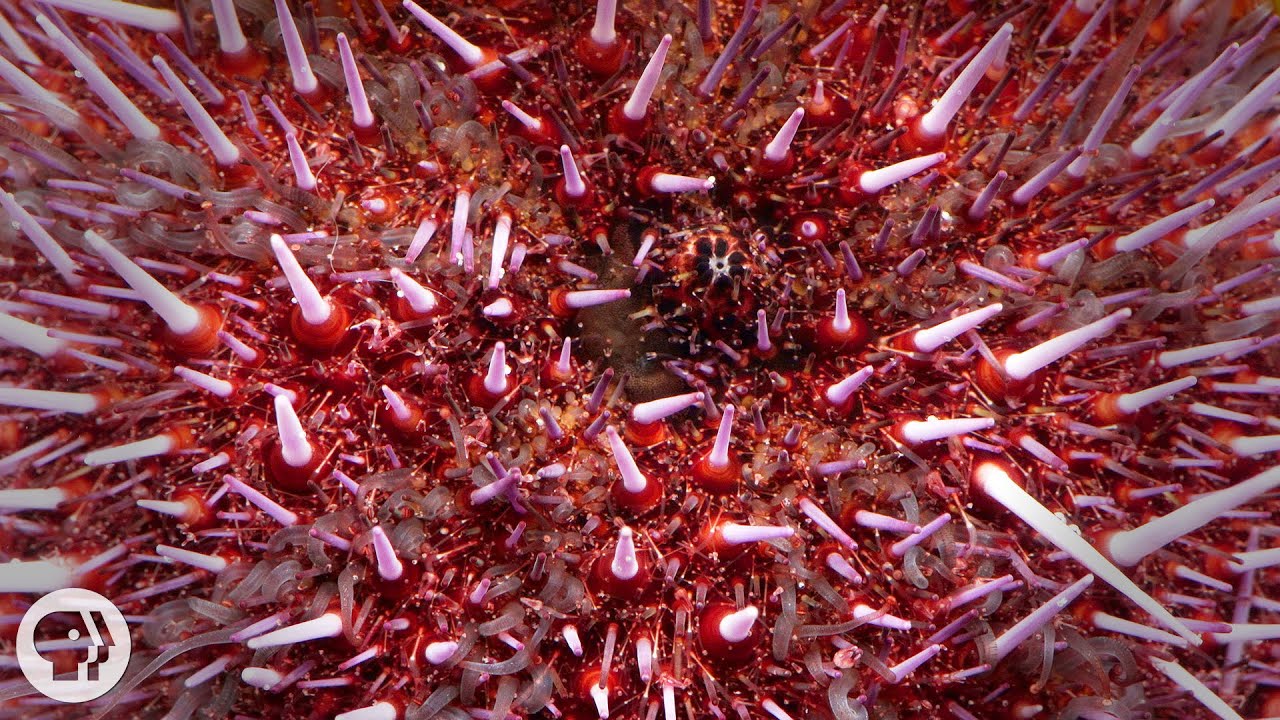
Conceived in the open sea, tiny spaceship-shaped sea urchin larvae search the vast ocean to find a home. After this incredible odyssey, they undergo one of the most remarkable transformations in nature.
SUBSCRIBE to Deep Look! http://goo.gl/8NwXqt
DEEP LOOK is a ultra-HD (4K) short video series created by KQED San Francisco and presented by PBS Digital Studios. See the unseen at the very edge of our visible world. Get a new perspective on our place in the universe. Explore big scientific mysteries by going incredibly small.
* NEW VIDEOS EVERY OTHER TUESDAY! *
Every summer, millions of people head to the coast to soak up the sun and play in the waves. But they aren’t alone. Just beyond the crashing surf, hundreds of millions of tiny sea urchin larvae are also floating around, preparing for one of the most dramatic transformations in the animal kingdom.
Scientists along the Pacific coast are investigating how these microscopic ocean drifters, which look like tiny spaceships, find their way back home to the shoreline, where they attach themselves, grow into spiny creatures and live out a slow-moving life that often exceeds 100 years.“These sorts of studies are absolutely crucial if we want to not only maintain healthy fisheries but indeed a healthy ocean,” says Jason Hodin, a research scientist at the University of Washington’s Friday Harbor Laboratories.
http://staff.washington.edu/hodin/
http://depts.washington.edu/fhl/
Sea urchins reproduce by sending clouds of eggs and sperm into the water. Millions of larvae are formed, but only a handful make it back to the shoreline to grow into adults.
--- What are sea urchins?
Sea urchins are spiny invertebrate animals. Adult sea urchins are globe-shaped and show five-point radial symmetry. They move using a system of tube feet. Sea urchins belong to the phylum Echinodermata along with their relatives the sea stars (starfish), sand dollars and sea slugs.
--- What do sea urchins eat?
Sea urchins eat algae and can reduce kelp forests to barrens if their numbers grow too high. A sea urchin’s mouth, referred to as Aristotle’s lantern, is on the underside and has five sharp teeth. The urchin uses the tube feet to move the food to its mouth.
--- How do sea urchins reproduce?
Male sea urchins release clouds of sperm and females release huge numbers of eggs directly into the ocean water. The gametes meet and the sperm fertilize the eggs. The fertilized eggs grow into free-swimming embryos which themselves develop into larvae called plutei. The plutei swim through the ocean as plankton until they drop to the seafloor and metamorphosize into the globe-shaped adult urchins.
---+ Read the entire article on KQED Science:
https://ww2.kqed.org/science/2....016/08/23/sea-urchin
---+ For more information:
Marine Larvae Video Resource
http://marinedevelopmentresource.stanford.edu/
---+ More Great Deep Look episodes:
From Drifter to Dynamo: The Story of Plankton | Deep Look
https://www.youtube.com/watch?v=jUvJ5ANH86I
Pygmy Seahorses: Masters of Camouflage | Deep Look
https://www.youtube.com/watch?v=Q3CtGoqz3ww
The Fantastic Fur of Sea Otters | Deep Look
https://www.youtube.com/watch?v=Zxqg_um1TXI
---+ See some great videos and documentaries from PBS Digital Studios!
It's Okay To Be Smart: Can Coral Reefs Survive Climate Change?
https://www.youtube.com/watch?v=P7ydNafXxJI
Gross Science: White Sand Beaches Are Made of Fish Poop
https://www.youtube.com/watch?v=1SfxgY1dIM4
---+ Follow KQED Science:
KQED Science: http://www.kqed.org/science
Tumblr: http://kqedscience.tumblr.com
Twitter: https://www.twitter.com/kqedscience
---+ About KQED
KQED, an NPR and PBS affiliate in San Francisco, CA, serves Northern California and beyond with a public-supported alternative to commercial TV, Radio and web media.
Funding for Deep Look is provided in part by PBS Digital Studios and the John S. and James L. Knight Foundation. Deep Look is a project of KQED Science, which is also supported by HopeLab, the S. D. Bechtel, Jr. Foundation, the Dirk and Charlene Kabcenell Foundation, the Vadasz Family Foundation, the Gordon and Betty Moore Foundation, the Smart Family Foundation and the members of KQED.
#deeplook #seaurchin #urchins

With the help of bowling balls, liquid nitrogen and exploding bath bombs, VFX company, Lola Post Production, helped bring the series to life using ground-breaking scientific insight and the latest graphic effects to reveal the environments that are thought to exist beyond our planet. Subscribe: http://bit.ly/BBCEarthSub
BBC Earth series The Planets takes us on a journey through the past, present and future of the eight incredible planets that orbit our Sun.
Watch more:
Planet Earth http://bit.ly/PlanetEarthPlaylist
Blue Planet http://bit.ly/BluePlanetPlaylist
Planet Earth II http://bit.ly/PlanetEarthIIPlaylist
Planet Dinosaur http://bit.ly/PlanetDinoPlaylist
Welcome to BBC EARTH! The world is an amazing place full of stories, beauty and natural wonder. Here you'll find 50 years worth of entertaining and thought-provoking natural history content.
Want to share your views with the team? Join our BBC Studios Voice: https://www.bbcstudiosvoice.com/register
This is a page from BBC Studios who help fund new BBC programmes. Service information and feedback: http://bbcworldwide.com/vod-fe....edback--contact-deta

These baboons love selfies, giving us a great opportunity to study their range of extremely complex facial expressions.
Subscribe: http://bit.ly/BBCEarthSub
Watch more videos from BBC Earth:
Planet Earth http://bit.ly/PlanetEarthPlaylist
Blue Planet http://bit.ly/BluePlanetPlaylist
Planet Earth II http://bit.ly/PlanetEarthIIPlaylist
Planet Dinosaur http://bit.ly/PlanetDinoPlaylist
The Secret Life Of Primates: Baboons
Charlotte Uhlenbroek travels to jungles and mountains to infiltrate some of the greatest wild primate groups, getting closer to them than anyone before. She unravels the complex social dynamics of gorillas, orang-utans, chimpanzees and baboons to bring viewers every detail of these magnificent animals' existence.
Welcome to BBC EARTH! Here you'll find 50 years worth of astounding, entertaining, thought-provoking and educational natural history content.
Want to share your views with the team behind BBC Earth and win prizes? Join our fan panel here: http://tinyurl.com/YouTube-BBCEarth-FanPanel
This is a channel from BBC Worldwide who help fund new BBC programmes
Service information and feedback: http://bbcworldwide.com/vod-fe....edback--contact-deta

Steve faces off with a known maneating lion.
Subscribe to BBC Earth: http://bit.ly/BBCEarthSubBBC Earth YouTube Channel: http://www.youtube.com/BBCEarth
BBC Earth Facebook http://www.facebook.com/bbcearth (ex-UK only)
BBC Earth Twitter http://www.twitter.com/bbcearth
Visit http://www.bbc.com/earth/world for all the latest animal news and wildlife videos
This is a channel from BBC Studios who help fund new BBC programmes.
Subscribe: http://bit.ly/BBCEarthSub
WATCH MORE:
New on Earth: https://bit.ly/2M3La96
Oceanscapes: https://bit.ly/2Hmd2kZ
Wild Thailand: https://bit.ly/2kR7lmh
Welcome to BBC EARTH! The world is an amazing place full of stories, beauty and natural wonder. Here you'll find 50 years worth of astounding, entertaining, thought-provoking and educational natural history content.
Want to share your views with the team behind BBC Earth and win prizes? Join our BBC Studios Voice: https://www.bbcstudiosvoice.com/register
This is a channel from BBC Worldwide who help fund new BBC programmes. Service information and feedback: http://bbcworldwide.com/vod-fe....edback--contact-deta

The Siberian Tiger is one of the most endangered species, therefore footage of it is invaluable...
Subscribe to BBC Earth: http://bit.ly/BBCEarthSubBBC Earth YouTube Channel: http://www.youtube.com/BBCEarth
BBC Earth Facebook http://www.facebook.com/bbcearth (ex-UK only)
BBC Earth Twitter http://www.twitter.com/bbcearth
Visit http://www.bbc.com/earth/world for all the latest animal news and wildlife videos
This is a channel from BBC Studios who help fund new BBC programmes.

Amazing footage of monkeys diving for lily flowers in a river populated by six foot lizards, with an appetite for primatesGreat video from BBC show Clever Monkeys. Visit http://www.bbcearth.com for all the latest animal news and wildlife videos and watch more high quality videos on the new BBC Earth YouTube channel here: http://www.youtube.com/bbcearth
Subscribe: http://bit.ly/BBCEarthSub
WATCH MORE:
New on Earth: https://bit.ly/2M3La96
Oceanscapes: https://bit.ly/2Hmd2kZ
Wild Thailand: https://bit.ly/2kR7lmh
Welcome to BBC EARTH! The world is an amazing place full of stories, beauty and natural wonder. Here you'll find 50 years worth of astounding, entertaining, thought-provoking and educational natural history content.
Want to share your views with the team behind BBC Earth and win prizes? Join our BBC Studios Voice: https://www.bbcstudiosvoice.com/register
This is a channel from BBC Worldwide who help fund new BBC programmes. Service information and feedback: http://bbcworldwide.com/vod-fe....edback--contact-deta

The team are going to examine some strange going ons between the cats on the street to see if they can translate their language and decipher what they are really up to... Taken from Cats Uncovered.
Subscribe to BBC Earth: http://bit.ly/BBCEarthSubBBC Earth YouTube Channel: http://www.youtube.com/BBCEarth
BBC Earth Facebook http://www.facebook.com/bbcearth (ex-UK only)
BBC Earth Twitter http://www.twitter.com/bbcearth
Visit http://www.bbc.com/earth/world for all the latest animal news and wildlife videos
This is a channel from BBC Studios who help fund new BBC programmes.
