Top Vídeos

Sadhguru habla sobre cómo la gente tiende a dividir Creador y creación pensando que el Creador es magnífico pero la creación es sucia. Él explica que, cualquier idea que tengamos sobre Dios en nuestra mente, es tan solo una definición formulada a partir de lo que vemos a nuestro alrededor. La fuente de la creación solo puede ser experimentada, no comprendida.
Pláticas de Sadhguru @ Programa de Ingeniería Interior, Chennai, Jun 2004
********************************************
Suscríbete a nuestro canal aquí: www.youtube.com/channel/UCJoOIj9Yu71wklP3EFzL8-A
Aprende la meditación guiada gratuita de Sadhguru
https://www.ishafoundation.org..../es/Isha-Kriya/home.
Yogui, místico y visionario, Sadhguru es un maestro espiritual con una diferencia. Una notable combinación de profundidad y pragmatismo, su vida y su trabajo sirven como recordatorio de que el yoga es una ciencia contemporánea, de vital relevancia en nuestro tiempo.
Más videos y blogs en la página
http://www.sadhguru.org
Meditación gratuita guiada por Sadhguru
https://www.ishafoundation.org..../es/Isha-Kriya/home.
Página oficial de Facebook de Sadhguru
https://www.facebook.com/sadhguru
Perfil oficial de Twitter de Sadhguru
https://twitter.com/SadhguruJV
Descarga la app de Sadhguru
http://onelink.to/sadhguru__app

"Los celos me han funcionado muy bien", confiesa una estudiante del SRCC, Delhi. Ella le pregunta a Sadhguru si hay algún problema con sentirse motivado por los celos. #UnplugWithSadhguru
http://unplugwithsadhguru.org/
**************************************************
Suscríbete a nuestro canal aquí: www.youtube.com/channel/UCJoOIj9Yu71wklP3EFzL8-A
Aprende la meditación guiada gratuita de Sadhguru
https://www.ishafoundation.org..../es/Isha-Kriya/home.
Yogui, místico y visionario, Sadhguru es un maestro espiritual con una diferencia. Una notable combinación de profundidad y pragmatismo, su vida y su trabajo sirven como recordatorio de que el yoga es una ciencia contemporánea, de vital relevancia en nuestro tiempo.
Más videos y blogs en la página
http://www.sadhguru.org
Meditación gratuita guiada por Sadhguru
https://www.ishafoundation.org..../es/Isha-Kriya/home.
Página oficial de Facebook de Sadhguru
https://www.facebook.com/sadhguru
Perfil oficial de Twitter de Sadhguru
https://twitter.com/SadhguruJV
Descarga la app de Sadhguru
http://onelink.to/sadhguru__app

Suscríbete al canal: http://smarturl.it/RomeReportsESP
Visita nuestra web: http://www.romereports.com/es
Suscríbete a nuestra newsletter: http://bit.ly/1RLUQBz
Síguenos en Facebook https://www.facebook.com/RomeReportsESP
Tras cinco meses de trabajo, expertos recuperan pinturas originales de una de 155 las salas.
---------------------
Para difusión del vídeo: sales@romereports.com
ROME REPORTS es una Agencia de Noticias para TV, internacional e independiente, especializada en la actividad del Papa, la vida del Vaticano y los debates de actualidad sobre temas sociales, culturales o religiosos. Informar sobre la Iglesia Católica requiere cercanía a las fuentes, conocimiento en profundidad de la Institución, y elevados niveles de creatividad y competencia técnica.
ROME REPORTS informa directamente al público y cubre las necesidades de las emisoras mediante noticias diarias, programas informativos semanales y documentales especializados.
---------------------
Visítanos en...
Nuestra WEB http://es.romereports.com/
FACEBOOK https://www.facebook.com/RomeReportsESP
TWITTER https://twitter.com/romereports

UPDATE 01.28.2019 - Might want to check this out - https://youtu.be/NY3Ll3mnG04. The new Zhiyun Smooth 4 is loaded with features most others are certainly going to copy. You can set any number of tracking control points and get automated focus and zoom, which is fantastic! Other features include manual exposure, focus, ISO, and white balance; 1/4" bottom mounting, filters, walking motor adjustment to take out that up and down so common to stabilizers, no touching the phone screen (everything controlled from the gimbal), on-screen gimbal and phone battery indicators, resolution control, flash control, HDR control, auto face detection and tracking, panorama, multiple exposure, long exposure, slow motion, time-lapse, motion time-lapse, controllable dolly zoom (vertigo effect), and more. The AMAZING thing is it is priced at $139! Links below.
Zhiyun Smooth 4 in Black and White
--------------------------------------------------
Amazon:
Black: https://amzn.to/2xZfw9M
White: https://amzn.to/2HyDb01
B&H:
Black: https://bhpho.to/2HBLcDc
White: https://bhpho.to/2HE8XKY
Amazon $300 Giftcard Giveaway:
--------------------------------------------------
http://bit.ly/bfmamazongiveaway
Video training courses:
--------------------------------------------------
https://www.bascifilmmakeruniversity.com
What I shoot with:
--------------------------------------------------
Amazon:
Canon 5D: https://amzn.to/2HA1zQC
Canon 50mm: https://amzn.to/2vgPcq4
Rode NTG-3: https://amzn.to/2GY9cPO
Zoom H6: https://amzn.to/2HxHcn3
Aputure Tri-8 Kit: https://amzn.to/2HyvE2U
B&H:
Canon 5D: https://bhpho.to/2GXbUoz
Canon 50mm: https://bhpho.to/2HzkoDE
Rode NTG-3: https://bhpho.to/2HxxL75
Zoom H6: https://bhpho.to/2Hz3nJx
Aputure Tri-8 Kit: https://bhpho.to/2H0IHJk
More gear at https://www.kit.com/basicfilmmaker
Outro and Music Credits
--------------------------------------------------
Outro by Kevin Anson:
http://bit.ly/EmoticonToolkktKevinAnson
Music by Premium Beat:
http://bit.ly/PremiumBeatMusic
Connect with me here:
--------------------------------------------------
http://bit.ly/BFM-YOUTUBE
http://bit.ly/BFM-FB
http://bit.ly/BFM-TWITTER
http://bit.ly/BFM-INSTAGRAM
http://bit.ly/BFM-UNIVERSITY
Copyright (c) 2018 by The Basic Filmmaker
Note that some of these links are affiliate links and help keep the channel going. Thanks for your support, as it really helps offset the costs! #basicfilmmaker #filmmaking #videos
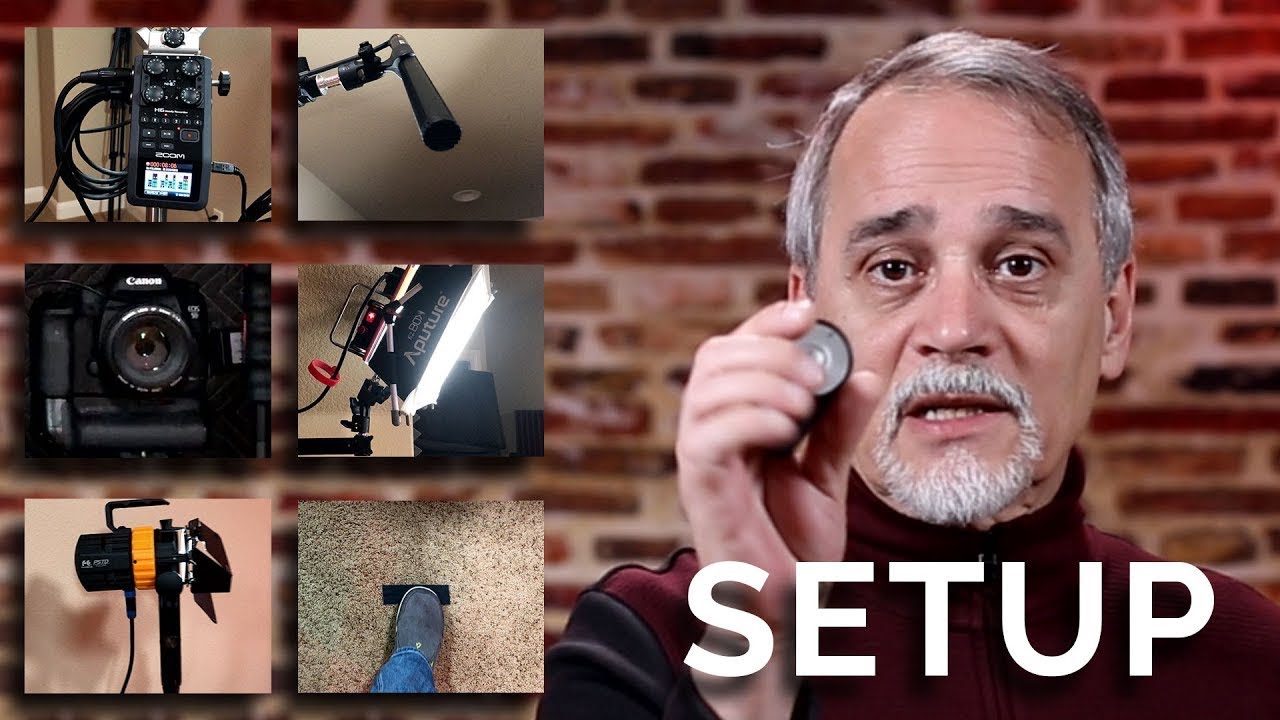
I was asked to show my YouTube studio setup and the reasoning behind it. You'll learn all sorts of tricks and tips in this one, such as lighting with glasses, backgrounds, and much more! Make sure to http://bit.ly/SubscribeToBasicFilmmaker
----------------------------------------------
LINKS MENTIONED IN VIDEO:
----------------------------------------------
CAMERA SIDE:
------------------------
Canon 5D Camera:
https://amzn.to/2HA1zQC
https://bhpho.to/2GXbUoz
Canon 50mm Lens:
https://amzn.to/2vgPcq4
https://bhpho.to/2HzkoDE
Cheap Camera Remote:
https://amzn.to/2SeO0Lf
Camera Cage:
https://amzn.to/2R8LDZ0
Aputure Monitor:
https://amzn.to/2CZRg97
IndiPro Tools Battery:
https://amzn.to/2R4ICZK
https://bhpho.to/2A9lfZv
Tripod:
https://amzn.to/2yr8ZSU
Replaced Head With:
https://amzn.to/2RaAMOy
SOUND:
------------------------
Diety Shotgun Mic:
https://amzn.to/2D11pCy
https://bhpho.to/2OqwGkf
Zoom H6 Recorder:
https://amzn.to/2D1TXXA
https://bhpho.to/2AWDfsB
SD Card:
https://amzn.to/2CZVv4n
Lapel Mic:
https://amzn.to/2R8KGzU
Headphones:
https://amzn.to/2CYEZ4E
Sandbags:
https://amzn.to/2Sdpiew
LIGHTING:
------------------------
Aputure Tri-8 3-point Light Kit:
https://amzn.to/2D4a2Mo
https://bhpho.to/2H0IHJk
Aputure L/S 1/2:
https://amzn.to/2Sb8oNn
Falcon Eyes Spotlight:
https://amzn.to/2q8dT2N
Light Stands:
https://amzn.to/2yuk9GH
Cheap Can Light:
https://amzn.to/2R9XF4q
Wall Mounting Brackets:
https://amzn.to/2CYpzxz
BACKGROUND:
------------------------
Fake Brick Tapestry:
https://amzn.to/2RcrzoZ
Backdrop Mounting Unit:
https://amzn.to/2CYFQlS
OTHER:
------------------------
Blackout Window Shades:
https://amzn.to/2PV8w2h
Clicker for Lights:
https://amzn.to/2R5tNpU
C-Stand:
https://amzn.to/2D0WWzv
Sound Blankets:
https://amzn.to/2R9Y7Qa
Colored Sounds Foam:
https://amzn.to/2R89CrC
Gaffer Tape:
https://amzn.to/2JbMQMJ
Up and Down Desk:
https://amzn.to/2q7aYap
Worktable:
https://amzn.to/2RfBEl5
Color Checker:
https://amzn.to/2PV8yXX
Smooth 4:
https://amzn.to/2Sb1tDX
SUBSCRIBE:
http://bit.ly/SubscribeToBasicFilmmaker
CAPTIONS:
https://www.rev.com/blog/coupo....n/?ref=basicfilmmake
See gear at https://www.kit.com/basicfilmmaker
----------------------------------------------
Training:
----------------------------------------------
https://www.basicfilmmakeruniversity.com
----------------------------------------------
Credits
----------------------------------------------
Outro Kevin Anson: http://bit.ly/EmoticonToolkktKevinAnson
Music by Premium Beat: http://bit.ly/PremiumBeatMusic
----------------------------------------------
Connect with me here:
----------------------------------------------
http://bit.ly/BFM-YOUTUBE
http://bit.ly/BFM-FB
http://bit.ly/BFM-TWITTER
http://bit.ly/BFM-INSTAGRAM
http://bit.ly/BFM-UNIVERSITY
----------------------------------------------
Copyright (c) 2018 Basic Filmmaker. All rights reserved.
----------------------------------------------
Note that some of these links are affiliate links and help keep the channel going. Thanks for your support, as it really helps offset the costs! #basicfilmmaker #filmmaking #videos

Before I leave for the Holidays, I just wanted to say to everyone who watches and supports my efforts - THANK YOU. You know who you are! http://bit.ly/SubscribeToBasicFilmmaker
----------------------------------------------
LINKS:
----------------------------------------------
----------------------------------------------
THE CAMERA SIDE:
----------------------------------------------
Canon 5D:
https://amzn.to/2HA1zQC
https://bhpho.to/2GXbUoz
Cheap Camera Remote:
https://amzn.to/2SeO0Lf
Camera Cage:
https://amzn.to/2R8LDZ0
Aputure Monitor:
https://amzn.to/2CZRg97
https://bhpho.to/2JgFJ5E
Pro Batteries:
https://amzn.to/2CdhL9L
https://bhpho.to/2A9lfZv
Tripod (replaced head):
https://amzn.to/2yr8ZSU
https://bhpho.to/2PpdG9E
Replaced Head With:
https://amzn.to/2RaAMOy
https://bhpho.to/2JhjUmd
Alternative Tripod:
https://amzn.to/2qdpttt
Quick Release Plates:
https://amzn.to/2qh7eTX
https://bhpho.to/2PpuNbb
----------------------------------------------
LENSES:
----------------------------------------------
Canon 50mm:
https://amzn.to/2vgPcq4
https://bhpho.to/2HzkoDE
28mm f/1.8:
https://amzn.to/2L6gwKd
https://bhpho.to/2BovVWQ
50mm f/1.4:
https://amzn.to/2vUmBoD
https://bhpho.to/2nVe6W1
85mm f/1.8:
https://amzn.to/2MWElWB
https://bhpho.to/2BmRiHY
24-70mm f2.8:
https://amzn.to/2MlJw6l
https://bhpho.to/2nLOJ8W
24-105mm f/4.0:
https://amzn.to/2PkAhRC
https://bhpho.to/2N3X2aU
70-200mm f/2.8:
https://amzn.to/2PlNKJ1
https://bhpho.to/2MGJ7Ln
----------------------------------------------
AUDIO:
----------------------------------------------
Rode NTG-3:
https://amzn.to/2GY9cPO
https://bhpho.to/2HxxL75
Deity Mic:
https://amzn.to/2xlgeKW
https://bhpho.to/2OqwGkf
Zoom H6 Recorder:
https://amzn.to/2MjiOdL
https://bhpho.to/2AWDfsB
SR VRM1 Recorder:
https://amzn.to/2KWMQjS
https://bhpho.to/2Hzr8RY
SD Card:
https://amzn.to/2CZVv4n
https://bhpho.to/2Pk7q30
Lapel Mic:
https://amzn.to/2R8KGzU
https://bhpho.to/2JkDXAA
Headphones:
https://amzn.to/2CYEZ4E
https://bhpho.to/2Pu1hBr
Sound Blankets:
https://amzn.to/2R9Y7Qa
Colored Acoustic Foam:
https://amzn.to/2R89CrC
----------------------------------------------
LIGHTING:
----------------------------------------------
Aputure Tri-8 Kit:
https://amzn.to/2HyvE2U
https://bhpho.to/2H0IHJk
Aputure L/S 1/2:
https://amzn.to/2Sb8oNn
https://bhpho.to/2JfrNZp
Pulsar Spotlight:
https://amzn.to/2q85wEr
Light Stands:
https://amzn.to/2yuk9GH
Cheap Can Light:
https://amzn.to/2R9XF4q
Wall Mounting Brackets:
https://amzn.to/2CYpzxz
C-Stand:
https://amzn.to/2D0WWzv
Sandbags:
https://amzn.to/2Sdpiew
----------------------------------------------
BACKGROUND:
----------------------------------------------
Fake Brick Tapestry:
https://amzn.to/2RcrzoZ
Backdrop Mounting Unit:
https://amzn.to/2CYFQlS
Portable Green/Blue/White/Gray Screen:
https://amzn.to/2Opnb5m
----------------------------------------------
EDITING:
----------------------------------------------
Adobe Premiere Pro:
http://bit.ly/AdobeCCFull
----------------------------------------------
OTHER:
----------------------------------------------
Mavic 2 Pro:
https://amzn.to/2yDkeqM
https://bhpho.to/2QNoGdS
Smooth 4:
https://amzn.to/2xZfw9M
https://bhpho.to/2HBLcDc
Color Checker:
http://bit.ly/X-RiteAmazon
http://bit.ly/X-RiteBandH
Teleprompter:
https://amzn.to/2pR4HzB
https://bhpho.to/2QMhvmj
Captions:
https://www.rev.com/blog/coupo....n/?ref=basicfilmmake
Blackout Window Shades:
https://amzn.to/2PV8w2h
Clicker for Lights:
https://amzn.to/2R5tNpU
Gaffer Tape:
https://amzn.to/2JbMQMJ
Up and Down Desk:
https://amzn.to/2q7aYap
Worktable:
https://amzn.to/2RfBEl5
Analyzing YouTube Videos:
VidIQ: https://vidiq.com/#_l_gc
TubeBuddy: https://www.tubebuddy.com/thebasicfilmmaker
See gear at https://www.kit.com/basicfilmmaker
----------------------------------------------
Training:
----------------------------------------------
https://www.basicfilmmakeruniversity.com
----------------------------------------------
Credits
----------------------------------------------
Bumper Kevin Anson: http://bit.ly/EmoticonToolkktKevinAnson
Music by Premium Beat: http://bit.ly/PremiumBeatMusic
----------------------------------------------
Connect with me here:
----------------------------------------------
http://bit.ly/BFM-YOUTUBE
http://bit.ly/BFM-FB
http://bit.ly/BFM-TWITTER
http://bit.ly/BFM-INSTAGRAM
http://bit.ly/BFM-UNIVERSITY
----------------------------------------------
Copyright (c) 2018 Basic Filmmaker
All rights reserved.
----------------------------------------------
Note that some of these links are affiliate links and help keep the channel going. Thanks for your support, as it really helps offset the costs! #basicfilmmaker #filmmaking #videos

By popular request, I compare a high-end ($300) lapel mic against a low-end ($18) lapel mic and of course, the $300 one is way better! Or is it?
By the way, you'll be better able to tell the difference if you watch this in HD.
THIS MAKES THE WORLD A BETTER PLACE:
Please like, comment and subscribe: http://tinyurl.com/78tf9qk
LINKS TO THE SOUND GEAR IN THIS EPISODE:
Zoom H1: http://tinyurl.com/7mu5tb2
Zoom H4n: http://tinyurl.com/8wnefkp
Audio Technica ATR-3350 Lapel Mic (Cheap!): http://tinyurl.com/8wrtg3z
Rode Lapel Mic (Not Cheap!): http://tinyurl.com/8zt9xu7
Rode MiCon-2 Connector (3.5mm Stereo): http://tinyurl.com/ctk8q9d
Rode Micon Extension Cable: http://tinyurl.com/9cs77pt
REACH THE BASIC FILMMAKER:
Facebook: http://www.facebook.com/TheBasicFilmmaker
Twitter: http://www.twitter.com/basicfilmmaker
Email: thebasicfilmmaker@gmail.com
Home: http://www.thebasicfilmmaker.com
Blog 2: http://www.thebasicfilmmaker.wordpress.com
Vimeo: http://www.vimeo.com/thebasicfilmmaker
ABOUT THE BASIC FILMMAKER:
I post videos, short films, DIY build projects you've never seen before, After Effects tutorials, and cover cameras, gear, sliders, makeup, DSLRs, cranes, jibs, dolly's, stabilizers, shoulder rigs, rail systems, green screen tutorials, and answering any question you ask about filming.
GEAR USED.
Canon DSLR and 28mm lens. Audio Technica and Rode lapel mic and Zoom H1 recorder. Edited in Premier Pro CS 6.
MUSIC, FOOTAGE AND GRAPHICS.
All music, footage and graphics are either created or licensed by me. Don't steal! It kills your brains! :)
THANKS.
To My YouTube Favs...
Video Copilot, Andrew Kramer, FreddieW, Film Riot, The Frugal Filmmaker, Knoptop, Indy Mogul and Corridor Digital for trail blazing, and, to YouTube and Vimeo for giving filmmakers a home.
Here's some gear you can check out. It's linked to my Amazon account, throws a few pennies my way, and costs you nothing. :)
CAMERAS:
Canon 550D (T2i): http://tinyurl.com/breu6bj
Canon 600D (T3i): http://tinyurl.com/c4uzyoh
Canon 650D (T4i): http://tinyurl.com/7x469u6
Canon 5D Mark II: http://tinyurl.com/8kvmxny
Canon 5D Mark III: http://tinyurl.com/9qxeajr
Canon Canon XF300 Camcorder: http://tinyurl.com/92zardq
Tripod: http://tinyurl.com/95wm3zg
STORAGE:
SanDisk Extreme 45MB/s 16GB SDHC Card: http://tinyurl.com/7wd2p5a
3 TB USB Drive: http://tinyurl.com/9xl4gk3
LENSES:
50mm Lens ("the nifty fifty"): http://tinyurl.com/7c7wsaa
28mm Lens ("the great 28"): http://tinyurl.com/6mdcfj7
40mm Lens ("pancake"): http://tinyurl.com/9k6grha
Zoom Lens: (28mm - 135mm): http://tinyurl.com/7gjt4lu
28MM/T2.1 Compact Prime CP.2 Cine Lens: http://tinyurl.com/9w2lbm8
FLUID HEADS:
Manfrotto 701HDV Pro Fluid Video Mini Head: http://tinyurl.com/95uf5bu
Manfrotto 501HDV Video Head: http://tinyurl.com/8osn6vh
Manfrotto 504HD Video Head: http://tinyurl.com/8veyxle
QUICK CONNECT CONNECTOR:
Manfrotto 577 Rapid Connect Adapter: http://tinyurl.com/8jrc26v
SHOULDER RIG:
Cinema ready Shoulder Stabilizer: http://tinyurl.com/92v6obm
SOUND:
Zoom H1: http://tinyurl.com/7mu5tb2
Zoom H4n: http://tinyurl.com/8wnefkp
Audio Technica ATR-3350 Lapel Mic (Cheap!): http://tinyurl.com/8wrtg3z
Rode Lapel Mic (Not Cheap!): http://tinyurl.com/8zt9xu7
Rode MiCon-2 Connector (3.5mm Stereo): http://tinyurl.com/ctk8q9d
Rode Micon Extension Cable: http://tinyurl.com/9cs77pt
Shure SM-58: http://tinyurl.com/86neg7k
JuicedLink (minijack - cheaper): http://tinyurl.com/7u679s7
Hosa Line Match Transformer: http://tinyurl.com/8zdc24g
HDMI MONITOR
Lilliput 7-inch: http://tinyurl.com/8eh57j3
SLIDER:
Konova Slider: http://tinyurl.com/976lgpl
GREEN/BLUE SCREENS:
Portable: http://tinyurl.com/9c9lbud
Full Studio Set With Lights: http://tinyurl.com/9bftnqo
LIGHTS:
Camera Top Mounted LED: http://tinyurl.com/9kcx9e9
CLAMPS:
Pedro Clamps: http://tinyurl.com/8wsjwf3
Mini Spring Clamps: http://tinyurl.com/9mkk6df
WHITE BALANCE:
White Balance Filter: http://tinyurl.com/7e4k3rr #basicfilmmaker #filmmaking #videos

There will be times you need to have an object follow another and not everyone has tracking capabilities. I show how to do that using ANY editor by giving myself a tattoo. Read more below and http://bit.ly/SubscribeToBasicFilmmaker
You may not have tracking capabilities, such as those in After Effects or Mocha, and might need a quick solution to a small clip where you need to, for instance, replace a sign or poster on a client video that has a moving image.
In this video, I show a SIMPLE example of how to use any video editor to add an element, photo or video, and have it follow the on-screen movement of another object.
It's quite easy, and I suggest this method for short clips in a pinch, like when the client needs it now (which is usually the case). :)
----------------------------------------------
LINKS:
----------------------------------------------
Keyframe Video: https://youtu.be/J8EdjrZ1zFw
New Course: http://bit.ly/BFUColorCourse
Training: http://bit.ly/BFM-UNIVERSITY
Subscribe: http://bit.ly/SubscribeToBasicFilmmaker
----------------------------------------------
CAMERAS:
----------------------------------------------
Canon 5D:
https://amzn.to/2HA1zQC
https://bhpho.to/2GXbUoz
----------------------------------------------
LENSES:
----------------------------------------------
Canon 50mm:
https://amzn.to/2vgPcq4
https://bhpho.to/2HzkoDE
28mm f/1.8:
https://amzn.to/2L6gwKd
https://bhpho.to/2BovVWQ
50mm f/1.4:
https://amzn.to/2vUmBoD
https://bhpho.to/2nVe6W1
85mm f/1.8:
https://amzn.to/2MWElWB
https://bhpho.to/2BmRiHY
24-70mm f2.8:
https://amzn.to/2MlJw6l
https://bhpho.to/2nLOJ8W
24-105mm f/4.0:
https://amzn.to/2PkAhRC
https://bhpho.to/2N3X2aU
70-200mm f/2.8:
https://amzn.to/2PlNKJ1
https://bhpho.to/2MGJ7Ln
----------------------------------------------
AUDIO:
----------------------------------------------
Rode NTG-3:
https://amzn.to/2GY9cPO
https://bhpho.to/2HxxL75
Deity Mic:
https://amzn.to/2xlgeKW
https://bhpho.to/2OqwGkf
Zoom H6 Recorder:
https://amzn.to/2MjiOdL
https://bhpho.to/2AWDfsB
SR VRM1 Recorder:
https://amzn.to/2KWMQjS
https://bhpho.to/2Hzr8RY
----------------------------------------------
LIGHTING:
----------------------------------------------
Aputure Tri-8 Kit:
https://amzn.to/2HyvE2U
https://bhpho.to/2H0IHJk
----------------------------------------------
EDITING:
----------------------------------------------
Adobe Pemiere Pro:
http://bit.ly/AdobeCCFull
----------------------------------------------
OTHER:
----------------------------------------------
Mavic 2 Pro:
https://amzn.to/2yDkeqM
https://bhpho.to/2QNoGdS
Smooth 4:
https://amzn.to/2xZfw9M
https://bhpho.to/2HBLcDc
Backdrop:
https://amzn.to/2Opnb5m
Color Checker:
http://bit.ly/X-RiteAmazon
http://bit.ly/X-RiteBandH
Teleprompter:
https://amzn.to/2pR4HzB
https://bhpho.to/2QMhvmj
Pro Batteries:
https://amzn.to/2CdhL9L
https://bhpho.to/2A9lfZv
Wall Mount Brackets:
https://amzn.to/2CJu0w4
Captions:
https://www.rev.com/blog/coupo....n/?ref=basicfilmmake
See gear at https://www.kit.com/basicfilmmaker
----------------------------------------------
Training:
----------------------------------------------
https://www.basicfilmmakeruniversity.com
----------------------------------------------
Credits
----------------------------------------------
Outro Kevin Anson: http://bit.ly/EmoticonToolkktKevinAnson
Music by Premium Beat: http://bit.ly/PremiumBeatMusic
----------------------------------------------
Connect with me here:
----------------------------------------------
http://bit.ly/BFM-YOUTUBE
http://bit.ly/BFM-FB
http://bit.ly/BFM-TWITTER
http://bit.ly/BFM-INSTAGRAM
http://bit.ly/BFM-UNIVERSITY
----------------------------------------------
Copyright (c) 2018 Basic Filmmaker
All rights reserved.
----------------------------------------------
Note that some of these links are affiliate links and help keep the channel going. Thanks for your support, as it really helps offset the costs! #basicfilmmaker #filmmaking #videos

I share some stats from the channel, last year's ad revenue, ask for your help in making this channel a success while conducting an experiment (cavia porcellus). You in? Share this link wherever you can. http://bit.ly/BFM-SUBSCRIBE
Cavia porcellus = Guinea Pig
ALL MY GEAR IS LISTED HERE:
By popular request...
▶ http://bit.ly/BFM-AMAZON
▶ http://bit.ly/BFM-KIT
BASIC FILMMAKER UNIVERSITY:
Get smarter. Learn on my free and paid courses.
▶ http://bit.ly/BFM-UNIVERSITY
ALL MUSIC USED IN THIS VIDEO IS HERE:
With few exceptions, I use Premium Beat for my music needs. They have some of the highest quality music I've found, and a huge library. I get nothing for recommending them.
▶ http://bit.ly/PremiumBeatMusic
CONNECT WITH ME HERE:
I've responded to over 20,000 comments, emails, and social media posts. Don be shy...let me know you're our there. :)
http://bit.ly/BFM-YOUTUBE
http://bit.ly/BFM-SUBSCRIBE
http://bit.ly/BFM-UNIVERSITY
http://bit.ly/BFM-TWITTER
http://bit.ly/BFM-FB
http://bit.ly/BFM-INSTAGRAM
http://bit.ly/BFM-WEB
http://bit.ly/BFM-GPLUS
http://bit.ly/BFM-AMAZON
http://bit.ly/BFM-KIT
http://bit.ly/BFM-PINTEREST
http://bit.ly/BFM-TUMBLR
http://bit.ly/BFM-STUMBLE
http://bit.ly/BFM-VIMEO
http://bit.ly/BFM-DMOTION
Copyright (c) 2018 by Basic Filmmaker
What I shoot my episodes with:
----------------------------------------
Amazon:
Canon 5D: https://amzn.to/2HA1zQC
Canon 50mm: https://amzn.to/2vgPcq4
Rode NTG-3: https://amzn.to/2GY9cPO
Zoom H6: https://amzn.to/2HxHcn3
B&H:
Canon 5D: https://bhpho.to/2GXbUoz
Canon 50mm: https://bhpho.to/2HzkoDE
Rode NTG-3: https://bhpho.to/2HxxL75
Zoom H6: https://bhpho.to/2Hz3nJx
---------------------------------------- #basicfilmmaker #filmmaking #videos

Tracklist Below:
Spotify: https://open.spotify.com/album..../5WwQof0lJpHZQcu7baW
Physicale sale: http://brilliantclassics.com/a....rticles/s/satie-pian
iTunes: https://itunes.apple.com/album..../satie-piano-music/i
00:00:00 3 Sarabandes (1887): No. 1
00:05:33 3 Sarabandes (1887): No. 2
00:10:33 3 Sarabandes (1887): No. 3
00:14:47 3 Gymnopédies (1889): No. 1: Lent et douloureux
00:18:27 3 Gymnopédies (1889): No. 2: Lent et triste
00:21:45 3 Gymnopédies (1889): No. 3: Lent et grave
00:24:37 Gnossiennes 1-3 (1890): No. 1
00:28:45 Gnossiennes 1-3 (1890): No. 2
00:30:45 Gnossiennes 1-3 (1890): No. 3
00:34:11 Gnossiennes 4-6 (1889-1897): No. 4
00:37:02 Gnossiennes 4-6 (1889-1897): No. 5
00:39:53 Gnossiennes 4-6 (1889-1897): No. 6
00:41:26 2 Préludes du Nazaréen (1892): No. 1, assez lent
00:46:09 2 Préludes du Nazaréen (1892): No. 2, assez lent
00:49:15 Prélude de la porte, Héroique du Ciel (1894)
00:53:00 2 Pièces Froides (1897): No. 1: Airs a faire fuir: D’une manière très particulaire
00:55:59 2 Pièces Froides (1897): No. 1: Airs a faire fuir: Modestemente
00:57:42 2 Pièces Froides (1897): No. 1: Airs a faire fuir: S’inviter
01:00:44 2 Pièces Froides (1897): No. 2: Danses de travers: En y regardent à deux fois
01:01:38 2 Pièces Froides (1897): No. 2: Danses de travers: Passer
01:02:25 2 Pièces Froides (1897): No. 2: Danses de travers: Encore
01:03:47 Petite ouverture à danser (1900)
01:05:18 Poudre d'Or, valse (1902)
01:09:53 Le Piccadilly (1904)
01:11:24 Véritables préludes flasques (1912): Sévere reprimande
01:12:07 3 Véritables préludes flasques (1912): Seul a la maison
01:13:16 3 Véritables préludes flasques (1912): On jou
01:14:02 Chapitres tournés en tous sens (1913): Celui qui parle trop
01:15:05 Chapitres tournés en tous sens (1913): Le porteur de grosses pierres
01:17:22 Chapitres tournés en tous sens (1913): Regrets des enfermés
01:18:58 3 Descriptions automatiques (1913): Sur un vaisseau
01:20:31 3 Descriptions automatiques (1913): Sur une lanterne
01:22:22 3 Descriptions automatiques (1913): Sur un casque
01:23:18 Embryons desséchés (1913): D’Holothurie
01:25:30 Embryons desséchés (1913): d’Edriopthalma
01:27:30 Embryons desséchés (1913): de Podophthalma
01:29:14 Heures séculaires et instantanées (1914): Obstacles venimeux
01:30:55 Heures séculaires et instantanées (1914): Crépuscule matinal (de midi)
01:32:09 Heures séculaires et instantanées (1914): Affolements grantiques
01:33:04 Sports et divertissements (1914): Choral inappétissant
01:33:52 Sports et divertissements (1914): La balançoire
01:34:32 Sports et divertissements (1914): La chasse
01:34:50 Sports et divertissements (1914): Le comédie italienne
01:35:25 Sports et divertissements (1914): Le réveil de la mariée
01:35:52 Sports et divertissements (1914): Colin-Maillard
01:36:28 Sports et divertissements (1914): La pêche
01:37:09 Sports et divertissements (1914): Le yachting
01:38:01 Sports et divertissements (1914): Le bain de mer
01:38:31 Sports et divertissements (1914): Le carnaval
01:38:58 Sports et divertissements (1914): Le golf
01:39:30 Sports et divertissements (1914): Le pieuvre
01:39:57 Sports et divertissements (1914): Les courses
01:40:19 Sports et divertissements (1914): Les quatre-coins
01:40:58 Sports et divertissements (1914): Le pique-nique
01:41:22 Sports et divertissements (1914): Le waterchute
01:41:59 Sports et divertissements (1914): Le tango
01:43:04 Sports et divertissements (1914): Le traineau
01:43:27 Sports et divertissements (1914): Le flirt
01:44:01 Sports et divertissements (1914): Le feu d’artifice
01:44:24 Sports et divertissements (1914): Le tennis
01:45:00 3 Valses distinguées du précieux dégoute (1914): Sa taille
01:45:54 3 Valses distinguées du précieux dégoute (1914): Son bincole
01:47:14 3 Valses distinguées du précieux dégoute (1914): Ses jambes
01:48:08 Avant-dernières pensées (1915): Idylle
01:49:21 Avant-dernières pensées (1915): Aubade
01:50:54 Avant-dernières pensées (1915): Méditation
01:51:53 Sonatine buraucratique (1917)
01:55:50 Nocturnes (1919): Doux et calme
01:58:58 Nocturnes (1919): Simplement
02:01:02 Nocturnes (1919): Un peu mouvementé
02:04:04 Nocturnes (1919): No. 4
02:06:31 Nocturnes (1919): No. 5
Artist:
Håkon Austbö (piano)

Tracklist below.
Online purchase or streaming (Spotify, iTunes, Amazon Music, Deezer, Google Play): https://brilliant-classics.lnk.to/ChopinEtudes
More Information: https://www.brilliantclassics.....com/articles/c/chopi
Brilliant Classics Spotify: https://open.spotify.com/user/....brilliantclassics?si
Brilliant Classics Facebook: https://www.facebook.com/brilliantclassics
Artist: Alessandro Deljavan (piano)
With his two books of Etudes, Frédéric Chopin threw down the gauntlet for all who would come after him. These 24 studies, and the three works published as ‘Nouvelles Etudes’ within the Méthode des Méthodes de Moscheles et Fétis – a publication including studies by Henselt, Liszt, Mendelssohn and Thalberg – probe and refine every aspect of a pianist’s technique, as one might expect from the technical and didactic implications of their title. What distinguishes them, however, from the hundreds of other similar volumes published throughout the 19th century and beyond, is the melodic genius, harmonic novelty and long-range structure that is peculiar to Chopin.
Alessandro Deljavan is a young Italian pianist whose previous recordings for Brilliant Classics include the violin sonatas of Anton Rubinstein (BC94605), played with his regular duet partner Daniela Cammarano. Perhaps more pertinently, Brilliant has also just released his new recording of Chopin’s Waltzes (BC95208). According to Fou T’Song – no mean Chopin pianist himself – Alessandro Deljavan is ‘one of the most interesting pianists I have heard in my life’. Excerpts on YouTube from his success at the 2013 Van Cliburn Competition in Fort Worth confirm the truth and promise of Fou T’Song’s acclamation. Deljavan’s approach to the Etudes is not as monuments of pianism but with a charming and sometimes surprising sense of relaxation which takes for granted the kind of formidable technique that they were designed to test. Deljavan is free with the rubato that makes this music breathe: there are many other recordings of the Etudes that set the pages on fire: this one riffles them in the breeze, tapping into the vein of aching nostalgia from which all of Chopin’s music draws. It was first made available as part of the most recent Chopin Edition from Brilliant Classics (BC94660).
Chopin Etudes are the Mount Everest for every concert pianist: the combination of technical difficulties of the highest level and a rich and complex musical content make them even today the biggest challenge a mortal pianist can meet.
Young Italian pianist Alessandro Deljavan presents a strong and highly personal interpretation: deeply poetic and passionate, backed by a superlative technical mastery.
Deljavan is one of the most remarkable pianists of his generation. “His playing is full of intensive power and contagious artistry” (Dmitri Bashkirov), “he is one of the most interesting pianists I’ve heard in my life” (Fou Ts’Ong), “he is one of the most major talents of his age” (John Perry), “Jaw-dropping virtuosity and heart-stopping eloquence” (Dallas Morning News).
00:00:00 Etudes, Op. 10: I. Etude in C Major “Waterfall”. Allegro
00:02:03 Etudes, Op. 10: II. Etude in A Minor. Allegro
00:03:35 Etudes, Op. 10: III. Etude in E Major “Tristesse”. Lento ma non troppo
00:08:01 Etudes, Op. 10: IV. Etude in C-Sharp Minor. Presto
00:10:09 Etudes, Op. 10: V. Etude in G-Flat Major “Black Keys”. Vivace
00:11:58 Etudes, Op. 10: VI. Etude in E-Flat Minor. Andante
00:15:50 Etudes, Op. 10: VII. Etude in C Major. Vivace
00:17:31 Etudes, Op. 10: VIII. Etude in F Major. Allegro
00:19:52 Etudes, Op. 10: IX. Etude in F Minor. Allegro molto agitato
00:22:25 Etudes, Op. 10: X. Etude in A-Flat Major. Vivace assai
00:24:47 Etudes, Op. 10: XI. Etude in E-Flat Major. Allegretto
00:27:17 Etudes, Op. 10: XII. Etude in C Minor “Revolutionary”. Allegro con fuoco
00:30:06 Etudes, Op. 25: I. Etude in A-Flat Major “Aeolian Harp”.Allegro sostenuto
00:32:39 Etudes, Op. 25: II. Etude in F Minor. Presto
00:34:36 Etudes, Op. 25: III. Etude in F Major. Allegro
00:36:32 Etudes, Op. 25: IV. Etude in A Minor. Agitato
00:38:17 Etudes, Op. 25: V. Etude in E Minor. Vivace
00:42:01 Etudes, Op. 25: VI. Etude in G-Sharp Minor. Allegro
00:44:17 Etudes, Op. 25: VII. Etude in C-Sharp Minor. Lento
00:50:20 Etudes, Op. 25: VIII. Etude in D-Flat Major. Vivace
00:51:33 Etudes, Op. 25: IX. Etude in G-Flat Major “Butterfly”. Allegro assai
00:52:44 Etudes, Op. 25: X. Etude in B Minor. Allegro con fuoco
00:56:55 Etudes, Op. 25: XI. Etude in A Minor “Winter Wind”. Lento
01:00:37 Etudes, Op. 25: XII. Etude in C Minor. Allegro molto con fuoco
01:03:30 3 Nouvelles études, B. 130: I. Andantino in F minor
01:06:00 3 Nouvelles études, B. 130: II. Allegretto in D-Flat Major
01:08:11 3 Nouvelles études, B. 130: III. Allegretto in A-Flat Major

Tracklist below.
Download & Streams:
https://brilliant-classics.lnk.....to/EinaudiPianoMusi
For physical sales: http://www.brilliantclassics.c....om/articles/e/einaud
When Einaudi burst onto the classical music scene some 20 years ago, critics were at first unsure how to react. What to make of a composer who has arguably broken through the boundaries of traditional classical music, forging his own path and attracting millions of fans? How to classify his soothing, peaceful, stunningly beautiful compositions? No one could have foreseen the astonishing precedent Einaudi has set, having had an important role in bringing classical music into the mainstream and at the same time asking us to forget our traditional categories and labels, and just sit back and enjoy his unique works. Pianist and composer Jeroen van Veen has long been a fan of Einaudi’s deceptively simple style. Here he has brought together a personal selection of the composer’s best works, and any listener unfamiliar with Einaudi up until now will soon see why he has garnered the enormous fame and attention he enjoys worldwide today.
Tracklist:
00:00:00 Una mattina
00:03:34 I Giorni
00:09:44 Le Onde
00:14:55 Corale
00:16:55 Canzone Popolare
00:17:51 Corale Solo
00:22:05 Questa Notte
00:27:55 Luce
00:34:53 Brothers
00:39:59 L’ultima Volta
00:44:03 Discovery at Night
00:49:16 Indaco
00:55:14 L’origine nascosta
00:58:49 Nuvole bianche
01:04:38 Nightbook
01:09:13 Two Trees
01:16:35 Walk
01:19:21 Waterways
01:23:49 Reverie
01:28:53 Oltremare
01:41:59 Giorni dispari
01:48:06 Sarabande
01:55:37 Ancora
02:08:56 Nefeli
02:14:14 Primavera
02:21:34 Bye, Bye mon amour
02:30:29 Berlin Song
Artist:
Jeroen van Veen (piano)

Online purchase or streaming (Spotify, iTunes, Amazon Music, Deezer, Google Play):
https://brilliant-classics.lnk.to/satieslow
Physical purchase:
http://www.brilliantclassics.c....om/articles/s/satie-
Composer: Erik Satie
Artist: Jeroen van Veen (piano)
“Open your head”, “light as an egg” and “from the top of your back teeth”: such phrases are only to be found in the scores of the eccentric Erik Satie, a composer born into a generation where ‘only more could be more’ – the post-Wagnerian age of richly furnished, intense music full of emotional layering. Expelled from the Paris Conservatoire for being its ‘laziest student’, Satie rebelled strongly against the musical climate in which he grew up, instead choosing to adopt a voice that did away with what he considered to be pretentious behaviour and which instead drew on irony through the use of free association, subtle dissonances and unexpected asides.
Such a stance – that music requires no extra layering, no showing-off, in order to touch its audience – ultimately resulted in ethereal-sounding compositions that are slow and solemn by nature. Pianist Jeroen van Veen has therefore taken it upon himself to exploit the concept of time in relation to the composer’s works, stretching the durations of some of the Frenchman’s most frequently performed pieces – including the Gymnopédies (a made-up word, incidentally) – to the max, and then going the extra mile: from slower to slowest, giving each note and each chord the chance to be absorbed fully. The result is that less actually becomes more; that duration is no longer of relevance, because the presence of sound is enough. Such music forces us to think outside the box, and ‘maybe this is exactly what makes Satie’s works timeless,’ says van Veen, who presents the listener with a unique take on one of music history’s most fascinating characters.
00:00:00 Gymnopédie No. 1. Lent et douloureux (1888)
00:05:44 Gymnopédie No. 2. Lent et triste (1895)
00:10:16 Gymnopédie No. 3. Lent et grave (1888)
00:14:30 Gnossiennes Nos. 1-3: Gnossienne No. 1 (1890)
00:20:58 Gnossiennes Nos. 1-3: Gnossienne No. 2 (1890)
00:24:17 Gnossiennes Nos. 1-3: Gnossienne No. 3 (1890)
00:29:08 Gnossiennes Nos. 4-6: Gnossienne No. 4 (1891)
00:33:58 Gnossiennes Nos. 4-6: Gnossienne No. 5 (1889)
00:39:02 Gnossiennes Nos. 4-6: Gnossienne No. 6 (1897)
00:42:50 Petite ouverture à danser (1897)
00:46:10 Pièces froides: II: Danses de travers. No. 1, En y regardant à deux fois (1897)
00:50:23 Pièces froides: II: Danses de travers. No. 2, Passer (1897)
00:53:50 Pièces froides: II: Danses de travers. No. 3, Encore (1897)
00:59:35 Gymnopédie No. 1. Lent et douloureux, 1896 tuning

Online purchase or streaming (Spotify, iTunes, Amazon Music, Deezer, Google Play): https://VA.lnk.to/ChopinFavPiano
Physical purchase: http://www.brilliantclassics.c....om/articles/c/chopin
Facebook page: https://www.facebook.com/brilliantclassics/
Composer: Frédéric Chopin
Artists: Alwin Bär, Folke Nauta, Pieter van Winkel, Martijn van den Hoek, Paolo Giacometti (pianos)
A CD filled with short characteristic pieces by Frédéric Chopin. Played by several Dutch pianists, including International Franz Liszt Piano Competition winner Martijn van den Hoek and Alwin Bär.
00:00:00 Berceuse in D-Flat Major, Op. 57
00:05:06 Polonaise in A-Flat Major, Op. 53, “Heroic”
00:12:07 Nocturne in E-Flat Major, Op. 9 No. 2
00:16:22 Waltz in D-Flat Major, Op. 64 No. 1, “Minute Waltz”
00:18:06 Waltz in C-Sharp Minor, Op. 64 No. 2
00:21:45 Ballade No. 3 in A-Flat Major, Op. 47
00:29:06 Souvenir de Paganini
00:33:21 Fantasie-Impromptu in C-Sharp Minor, Op. 66
00:38:29 Etude in E Major, Op. 10 No. 3
00:42:30 Scherzo No. 2 in B-Flat Minor, Op. 31
00:52:19 Prelude in D-Flat Major, Op. 28 No. 15, “Raindrop”
00:57:32 Etude in C Minor, Op. 10 No. 12, “Revolutionary”
01:00:16 Nocturne in B-Flat Minor, Op. 9 No. 1
01:05:41 Barcarolle in F-Sharp Major, Op. 60

Tracklist below.
Online purchase or streaming (Spotify, iTunes, Amazon Music, Deezer, Google Play): https://brilliant-classics.lnk.....to/BeethovenPianoTr
More Information: https://www.brilliantclassics.....com/articles/b/beeth
Brilliant Classics Spotify: https://open.spotify.com/user/....brilliantclassics?si
Brilliant Classics Facebook: https://www.facebook.com/brilliantclassics
Artist:
François Dumont (piano)
Laurent Le Flécher (violin)
Virginie Constant (cello)
Trio Élégiaque
00:00:00 Piano Trio in G Major, Op. 1 No. 2: I. Adagio – Allegro vivace
00:12:05 Piano Trio in G Major, Op. 1 No. 2: II. Largo con espressione
00:21:57 Piano Trio in G Major, Op. 1 No. 2: III. Scherzo. Allegro
00:25:40 Piano Trio in G Major, Op. 1 No. 2: IV. Finale. Presto
00:33:30 Piano Trio in D Major, Op. 70 No. 1 “Ghost”: I. Allegro vivace
00:43:58 Piano Trio in D Major, Op. 70 No. 1 “Ghost”: II. Largo assai ed espressivo
00:55:02 Piano Trio in D Major, Op. 70 No. 1 “Ghost”: III. Presto
01:03:28 Piano Trio in E-Flat Major, WoO 38: I. Allegro moderato
01:07:36 Piano Trio in E-Flat Major, WoO 38: II. Scherzo. Allegro ma non troppo
01:12:01 Piano Trio in E-Flat Major, WoO 38: III. Rondo. Allegretto
01:17:05 Piano Trio in C Minor, Op. 1 No. 3: I. Allegro con brio
01:26:22 Piano Trio in C Minor, Op. 1 No. 3: II. Andante cantabile con variazioni
01:33:26 Piano Trio in C Minor, Op. 1 No. 3: III. Menuetto. Quasi allegro – Trio
01:36:54 Piano Trio in C Minor, Op. 1 No. 3: IV. Finale. Prestissimo
01:44:43 Piano Trio in E-Flat Major, Op. 70 No. 2: I. Poco sostenuto – Allegro ma non troppo
01:55:04 Piano Trio in E-Flat Major, Op. 70 No. 2: II. Allegretto
02:00:01 Piano Trio in E-Flat Major, Op. 70 No. 2: III. Allegretto ma non troppo
02:04:47 Piano Trio in E-Flat Major, Op. 70 No. 2: IV. Finale. Allegro
02:12:39 Piano Trio in E-Flat Major, Op. 44: 14 Variations on an Original Theme: Tema. Andante con variazioni
02:25:22 Piano Trio in E-Flat Major, Op. 1 No. 1: I. Allegro
02:35:00 Piano Trio in E-Flat Major, Op. 1 No. 1: II. Adagio cantabile
02:42:02 Piano Trio in E-Flat Major, Op. 1 No. 1: III. Scherzo. Allegro assai
02:46:56 Piano Trio in E-Flat Major, Op. 1 No. 1: IV. Finale. Presto
02:54:23 Piano Trio in D Major, After Symphony No. 2, Op. 36: I. Adagio – Allegro con brio
03:06:37 Piano Trio in D Major, After Symphony No. 2, Op. 36: II. Larghetto quasi andante
03:17:33 Piano Trio in D Major, After Symphony No. 2, Op. 36: III. Scherzo
03:21:14 Piano Trio in D Major, After Symphony No. 2, Op. 36: IV. Allegro molto
03:27:54 Triosatz in E-Flat Major, Op. Posth. (Allegretto)
03:31:18 Piano Trio in B-Flat Major, Op. 97 “Archduke”: I. Allegro moderato03:44:09 Piano Trio in B-Flat Major, Op. 97 “Archduke”: II. Scherzo. Allegro
03:50:29 Piano Trio in B-Flat Major, Op. 97 “Archduke”: III. Andante cantabile, ma però con moto – Poco più adagio
04:02:27 Piano Trio in B-Flat Major, Op. 97 “Archduke”: IV. Allegro moderato
04:09:26 Piano Trio in B-Flat Major WoO39 (Allegretto)
04:15:39 Piano Trio in E-Flat Major, Op. 63, After String Quintet, Op. 4: I. Allegro con brio
04:23:43 Piano Trio in E-Flat Major, Op. 63, After String Quintet, Op. 4: II. Andante
03:30:23 Piano Trio in E-Flat Major, Op. 63, After String Quintet, Op. 4: III. Menuetto – Trio
04:36:36 Piano Trio in E-Flat Major, Op. 63, After String Quintet, Op. 4: IV. Finale. Presto
04:42:32 Piano Trio in B-Flat Major, Op. 11 “Gassenhauer”: I. Allegro con brio
04:51:23 Piano Trio in B-Flat Major, Op. 11 “Gassenhauer”: II. Adagio
04:56:30 Piano Trio in B-Flat Major, Op. 11 “Gassenhauer”: III. Tema. Pria ch'io l'impegno allegretto con variazioni
05:03:15 Piano Trio in G Major, Op. 121a “Ich bin der Schneider Kakadu” (Introduzione. Adagio assai – Tema. Allegretto con variazioni)
05:19:19 Piano Trio in E-Flat Major, Op. 38, After the Septet, Op. 20: I. Adagio – Allegro con brio
05:26:38 Piano Trio in E-Flat Major, Op. 38, After the Septet, Op. 20: II. Adagio cantabile
05:34:54 Piano Trio in E-Flat Major, Op. 38, After the Septet, Op. 20: III. Tempo di menuetto
05:37:54 Piano Trio in E-Flat Major, Op. 38, After the Septet, Op. 20: IV. Andante con variazioni
05:44:44 Piano Trio in E-Flat Major, Op. 38, After the Septet, Op. 20: V. Scherzo. Allegro molto e vivace
05:48:01 Piano Trio in E-Flat Major, Op. 38, After the Septet, Op. 20: VI. Andante con moto alla marcia – Presto

Online Purchase/Streaming: https://VA.lnk.to/Top50nocturnes
Facebook page: https://www.facebook.com/brilliantclassics/
A moonlit summer night, an open window, the intoxicating sounds of a piano playing the dreamlike melodies of a Chopin Nocturne: this is the atmosphere of this selection of the most beautiful Noctunres and other night pieces written for piano by the great masters Chopin, Schumann (Des Abends), Tchaikovsky (Barcarolle), Debussy (Clair de Lune), Beethoven (Mondschein Sonata), Liszt (Liebestraum) and many others.
Frédéric Chopin:
00:00:00 Nocturnes, Op. 48: No. 1 in C Minor. Lento by Earl Wild
00:05:42 Nocturne in C-Sharp Minor, B. 49 by Earl Wild
00:09:35 Nocturnes, Op. 15: No. 2 in F-Sharp Major by Earl Wild
00:13:11 Nocturnes, Op. 32: No. 1 in B Major by Earl Wild
00:18:06 Nocturne in E Minor, Op. 72, No. 1 by Earl Wild
00:21:46 Nocturnes, Op. 62: No. 2 in E Major by Earl Wild
00:27:06 Nocturnes, Op. 9: No. 3 in B Major by Earl Wild
00:32:43 Nocturnes, Op. 37: No. 2 in G Major. Andantino by Earl Wild
00:38:09 Nocturnes, Op. 32: No. 2 in A-Flat Major by Earl Wild
00:43:44 Nocturnes, Op. 27: No. 2 in D-Flat Major. Lento sostenuto by Earl Wild
00:49:05 Nocturnes, Op. 9: No. 1 in B-Flat Minor. Larghetto by Earl Wild
00:54:28 Nocturnes, Op. 15: No. 3 in G Minor by Earl Wild
00:59:02 Nocturnes, Op. 48: No. 2 in F-Sharp Minor. Andantino by Earl Wild
01:06:11 Nocturnes, Op. 62: No. 1 in B Major by Earl Wild
01:12:30 Nocturnes, Op. 9: No. 2 in E-Flat Major by Earl Wild
01:16:42 Nocturnes, Op. 55: No. 1 in F Minor by Earl Wild
01:21:25 Nocturnes, Op. 55: No. 2 in E-Flat Major. Lento sostenuto by Earl Wild
01:25:40 Nocturnes, Op. 27: No. 1 in C-Sharp Minor by Earl Wild
01:30:16 Nocturnes, Op. 15: No. 1 in F Major by Earl Wild
01:34:38 Nocturnes, Op. 37: No. 11 in G Minor by Earl Wild
01:42:21 Nocturne No. 21 in C Minor, Op. Posth. by Earl Wild
01:45:30 Franz Liszt -Liebesträume, S. 541: No. 3 in A-Flat Major by Pieter van Winkel
01:50:06 Ludwig van Beethoven - I. Adagio sostenuto by Pieter van Winkel
01:55:46 Robert Schumann - No. 1, Des Abends in D-Flat Major by Pieter van Winkel
01:59:11 Claude Debussy - Reverie, L. 68 by Pieter van Winkel
02:02:55 Robert Schumann - No. 2, Romance in F-Sharp Major by Pieter van Winkel
02:06:18 Franz Liszt - No. 3, Lento placido in D-Flat Major by Pieter van Winkel
02:09:23 Claude Debussy - No. 3, Clair de lune by Pieter van Winkel
02:14:23 Robert Schumann - No. 7, Träumerei by Pieter van Winkel
02:17:34 Frédéric Chopin - Berceuse in D-Flat Major, Op. 57 by Alwin Bär
02:22:37 Edvard Hagerup Grieg - No. 1, Cradle Song by Håkon Austbö
02:24:54 Erik Satie - No. 1, Lent et douloureux in D Major by Håkon Austbö
02:28:33 Erik Satie - Gnossiennes: 5. Modéré by Håkon Austbö
02:31:25 Charles Henri Valentin Alkan - Nocturne, Op. 22 by Alan Weiss
02:37:50 Robert Schumann - No. 5, In der Nacht in F Minor by Klára Würtz
02:41:38 Robert Schumann - No. 12, Kind im Einschlummern by Klára Würtz
02:43:48 Piotr Ilyich Tchaikovsky - No. 10, October. Autumn Song in D Minor. Andante doloroso e molto cantabile by Alexander Warenberg
02:47:13 Maurice Ravel - Pavane pour une infante défunte in G Major, M. 19 by Michelangelo Carbonara
02:53:37 Robert Schumann - No. 7, Vogel als Prophet by Klára Würtz
02:56:28 Piotr Ilyich Tchaikovsky - No. 6, June. Barcarolle in G Minor. Andante cantabile by Alexander Warenberg
03:00:11 Camille Pleyel - Nocturne alla Field in B-Flat Major, Op. 52 by Bart van Oort
03:04:53 Friedrich Wilhelm Michael Kalkbrenner - No. 1 in A-Flat Major "Les soupirs de la harpe eolienne" by Bart van Oort
03:09:04 Friedrich Wilhelm Michael Kalkbrenner - No. 2 in F Major (A trois mains) by Bart van Oort & Agnieszka Chabowska
03:13:08 Clara Schumann - No. 2, Nocturne in F Major by Bart van Oort
03:18:17 Louis Lefèbure-Wély - Nocturne in D-Flat Major by Bart van Oort
03:23:30 Edmond Weber - Nocturne in D-Flat Major, Op. 1 by Bart van Oort
03:27:18 Charles Henri Valentin Alkan - Notturnino innamorato in F-Sharp Minor, Op. 63 No. 43 by Bart van Oort
03:29:27 Michael Glinka - Nocturne in E-Flat Major by Bart van Oort
03:35:12 Maria Szymanowska - La Murmure. Nocturne in A-Flat Major by Bart van Oort
03:38:15 Ignacy Feliks Dobrzynski - No. 1 in G Minor by Bart van Oort
Tracklist below.
Download on iTunes: https://itunes.apple.com/album..../cage-piano-works/id
For physical sales: http://brilliantclassics.com/a....rticles/c/cage-piano
Listen via Spotify: https://open.spotify.com/album..../48ZmMUIaqPml6GnOQYJ
John Cage (1912–92) is regarded as one of the most influential and controversial composers of the 20th century.
It is not only his music that this reputation is based on – his ideas were revolutionary, and he cast doubt on the supremacy of European art, and music when it was unchallenged and such views were considered heretic.
Cage rejected the status held by harmony, instrumentation, and even the development of music from one point to another. He disconnected harmony from rhythm to liberate western music from its hitherto privileged hierarchies – iconoclastic stuff for 1940s America!
Cage studied with Schoenberg in Los Angeles, and although he adopted the 12-tone technique he abandoned Schoenberg’s expressionist style.
Cage was also influenced the maverick composer – Erik Satie. Satie had also ridiculed the musical establishment, and Cage arranged Satie’s longest work Socrate (a monodrama for piano and voice) for two pianos. It is worth mentioning that Cage’s favourite Satie composition was Vexations, a short work for piano, with instructions that it may be performed 840 times without pause or change.
00:00:00 Three Easy Pieces (1933): Round
00:01:54 Three Easy Pieces (1933): Duo
00:02:36 Three Easy Pieces (1933): infinite CaNon
00:03:11 Three Easy Pieces (1933): Quest
00:04:01 Metamorphosis (1938): Metamorphosis I
00:06:17 Metamorphosis (1938): Metamorphosis II
00:08:54 Metamorphosis (1938): Metamorphosis III
00:13:59 Metamorphosis (1938): Metamorphosis IV
00:15:13 Metamorphosis (1938): Metamorphosis V
00:17:43 Jazz study (1942)
00:20:20 Tripled paced (first version, 1943): Tripled paced - 1a versione I
00:21:16 Tripled paced (first version, 1943): Tripled paced - 1a versione II
00:22:07 Tripled paced (first version, 1943): Tripled paced - 1a versione III
00:22:43 Ad lib
00:25:46 Soliloquy
00:28:21 Ophelia
00:34:45 Two pieces (1946): Two pieces I
00:38:22 Two pieces (1946): Two pieces II
00:42:07 in A landscape
00:50:08 Dream
00:56:24 Suite for toy Piano - versione per Pianoforte - I
00:57:42 Suite for toy Piano - versione per Pianoforte - II
00:59:09 Suite for toy Piano - versione per Pianoforte - III
01:00:20 Suite for toy Piano - versione per Pianoforte - IV
01:01:52 Suite for toy Piano - versione per Pianoforte - V
01:02:47 Seven Haiku I
01:03:00 Seven Haiku II
01:03:11 Seven Haiku III
01:03:34 Seven Haiku IV
01:03:50 Seven Haiku V
01:04:14 Seven Haiku vi
01:04:32 Seven Haiku viI
01:04:52 For M.C. and D.T.
01:05:40 Waiting
01:09:21 Socrate (1918) Drame symphonique en trois parties Transcription for two pianos by Cage (1944–1968): I Portrait de Socrate (Le Banquet)
01:15:47 Socrate (1918) Drame symphonique en trois parties Transcription for two pianos by Cage (1944–1968): II Bords de l'Iliussus (Phèdre)
01:22:39 Socrate (1918) Drame symphonique en trois parties Transcription for two pianos by Cage (1944–1968): III Morte de Socrate (Phédon)
01:38:23 Cheap imitation (1969) I
01:44:26 Cheap imitation (1969) II
01:53:28 Cheap imitation (1969) III
02:09:39 Etudes Boreales I (Piano)
02:15:13 Etudes Boreales II (Piano)
02:20:44 Etudes Boreales III (Piano)
02:26:22 Etudes Boreales IV (Piano)
02:32:04 Etudes Boreales I (cello)
02:37:32 Etudes Boreales II (cello)
02:43:12 Etudes Boreales III (cello)
02:48:41 Etudes Boreales IV (cello)
02:54:22 Etudes Boreales I (cello & Piano)
03:00:07 Etudes Boreales II (cello & Piano)
03:05:51 Etudes Boreales III (cello & Piano)
03:11:30 Etudes Boreales IV (cello & Piano)

Listen to a selection of beautiful minimal piano music, made by Brilliant Classics. Perfect for studying, or just to relax. For more information go to www.brilliantclassics.com.
Tracklist:
1) 0:00:00 – Divenire: No. 9, Fly – Ludovico Einaudi
2) 0:04:51 – Minimal Preludes, Book III: Prelude No. 25 in A Minor – Jeroen van Veen
3) 0:13:49 – Comptine d’un autre été: L’après midi – Yann Tiersen
4) 0:16:09 – Canto Ostinato, Pt. 1: Section 69 – Simeon Ten Holt
5) 0:20:20 – Canto Ostinato, Pt. 1: Theme I, Section 74 – Semeon Ten Holt
6) 0:25:32 – Canto Ostinato, Pt. 1: Section 78 – Simeon Ten Holt
7) 0:28:49 – The Promise – Michael Nyman
8) 0:31:56 – Una Mattina: No. 1, Una mattina – Ludovico Einaudi
9) 0:35:18 – Comptine d‘été No. 3 – Yann Tiersen
10) 0:37:51 – The Heart Asks Pleasure First I – Michael Nyman
11) 0:42:08 – Divenire: No. 6, Primavera – Ludovico Einaudi
12) 0:49:32 – Le Onde: No. 2, Le Onde – Ludovico Einaudi
13) 0:54:50 – Mad Rush – Philip Glass
14) 1:10:03 – Una Mattina: No. 10, Nuvole bianche – Ludovico Einaudi
15) 1:15:51 – Metamorphosis III (Arranged for Two Pianos by Jeroen Van Veen) – Philip Glass
16) 1:21:52 – I Giorni: No. 6, I giorni – Ludovico Einaudi
17) 1:28:16 – The Poet Acts – Philip Glass
18) 1:31:52 – 4 Mains – Wim Mertens
19) 1:35:25 – Incanto No. 3 for Two Pianos – Jeroen van Veen
20) 1:52:16 – Lost And Found – Michael Nyman
21) 1:55:31 – La valse d’Amélie – Yann Tiersen
22) 1:58:15 – Kiss the Rain – Yiruma
23) 2:02:11 – Metamorphosis II (Arranged for Two Pianos by Jeroen Van Veen) – Philip Glass
24) 2:09:39 – All Imperfect Things – Michael Nyman
25) 2:13:21 – Metamorphosis: Metamorphosis One – Philip Glass
26) 2:20:25 – Yellow Room – Yiruma
27) 2:24:18 – River Flows in You – Yiruma
28) 2:27:49 – Beloved – Yiruma
29) 2:32:28 – Incantatie IV, Pt. 1: Tableau I, Section 1-26
30) 3:00:14 – Kiss the Rain – Yiruma
Online purchase or streaming (Spotify, iTunes, Amazon Music, Deezer, Google Play): https://brilliant-classics.lnk.to/overtures1
Physical purchase: http://www.brilliantclassics.c....om/articles/t/telema
Facebook page: https://www.facebook.com/brilliantclassics/
Composer: Georg Philipp Telemann
Artists: Collegium Instrumentale Brugense, Patrick Peire (conductor)
Georg Philipp Telemann (1681–1767) was one of the most prolific composers of the 18th century; although the largest part of his compositional activities were devoted to vocal music, he wrote a substantial number of overtures, which this splendid 8-disc collection is dedicated to.
Although Telemann chose the title of ‘Overtures’, this was somewhat interchangeable with the genre of the Suite in his era. Each work opens with a three-part French overture, and this is followed by a series of varied, shorter pieces – encompassing everything from dances (drawn from the French tradition and beyond), fugues, chaconnes, passacailles, musical portraits, folk dances and evocations of scenes and characters.
In these eight discs, Collegium Instrumentale Brugense and Patrick Peire’s three separate volumes of Telemann Overtures have been collected together for the first time, creating a box set that is set apart by its breadth. Its overview of 33 Overtures illuminates Telemann’s hugely inventive approach to instrumentation, while revealing the wealth of subjects that he sought inspiration in. The ‘Alster Overtüre’, for example, named after the Alster river in Germany, features a ‘Concert of Frogs and Crows’, while another Overture is inspired by Cervantes’ Don Quixote.
A generous selection of 33 Overtures (or Orchestral Suites) by Georg Philipp Telemann, formerly issued separately, now collected in one 8-CD set. This collection contains CD 5 and 6 out of 8 discs.
CD1: TWV55: D18, G10 ‘Burlesque de Quixotte’, c2 & D4
CD2: TWV55: F11 ‘Alster’, B5 ‘Volker’,d2 & B7
CD3: TWV55: a4, A4, D23 & G4 ‘Des Nations anciens et modernes’
CD4: TWV55: D22 ‘Ouverture jointes d’une Suite tragi-comique’, e7, h4, e3 & c4
-CD5: TWV55: d3, F4, B11 ‘La Bourse’ & Es1
-CD6: TWV55: C6, f1, B8 ‘Burlesque’ & g9
CD7: TWV55: D17, A2, a2 & e8 ‘l’Omphale’
CD8: TWV55: F16 ‘Pour S.A.S. Monseigheur Le Landgrave de Darmstadt’, g2 ‘La Changeante’, G7 & D13 ‘La Gaillarde’
Tracklist can be found in the comment section below!

Streaming & Download: https://brilliant-classics.lnk.....to/ChopinCompletePi
Physical sale: https://www.brilliantclassics.....com/articles/c/chopi
Brilliant classics Spotify: https://brilliant-classics.lnk.to/Spotify
Brilliant classics Facebook: https://www.facebook.com/brilliantclassics
Wolfram Schmitt-Leonardy has gradually built a distinguished catalogue of recordings over the years on Brilliant Classics, and each new release from this German pianist tends to be welcomed in effusive terms by the international press. His accounts of Chopin have met with particular praise. A 2CD set of the Ballades, Impromptus and Preludes (BC95210) was celebrated by Classics Today as achieving ‘a fusion of impassioned ardour and classical textual rigour… the best of Schmitt‐Leonardy’s Chopin adds up to a stimulating and compelling listening journey well worth travelling, even if you’ve heard these works hundreds of times.’
Individual discs of Mendelssohn (BC93975), Schumann (BC93136) and Brahms (BC92512) have likewise attracted admiring comments. According to Gramophone, ‘Wolfram Schmitt-Leonardy’s superb technical and musical command holds unflagging interest throughout the [Brahms] variation sets, which easily hold their own among the top versions available.’
With these new recordings, made in 2011 and 2015, Schmitt-Leonardy returns to Chopin, and to ‘his wildest children’ according to Schumann: a comment which has been much parsed for its implications of structural incoherence as well as indomitable passion. In truth, Chopin’s struggle with the larger, multi-movement form has by no means failed, but rather resulted in a more accurate and elaborated mosaic of interrelations, coherencies and references, which cannot be discerned by casual listening or glancing at the scores. Chopin’s ability to balance these elements comes from neatly hidden formal concessions and the use of several compositional tools found in the music of Bach; combined, these aspects award Chopin’s sonatas continuity.
Even if the First Sonata is the work of a student, it nonetheless demonstrates some of those Bachian connections and a lyric poise which would come to full bloom in the Second. This work is centred around the grave Funeral March which has become perhaps Chopin’s best-known individual piece. Bachian principles of counterpoint and polyphony are even more richly satisfied by the final sonata of the trilogy, at least until the grand and sweeping passion of its concluding Rondo.
00:00:00 Piano Sonata No. 1 in C Minor, Op. 4: I. Allegro maestoso
00:09:52 Piano Sonata No. 1 in C Minor, Op. 4: II. Menuetto
00:14:35 Piano Sonata No. 1 in C Minor, Op. 4: III. Larghetto
00:18:23 Piano Sonata No. 1 in C Minor, Op. 4: IV. Finale. Presto
00:25:04 Piano Sonata No. 2 in B-Flat Minor, Op. 35: I. Grave - Doppio movimento
00:33:22 Piano Sonata No. 2 in B-Flat Minor, Op. 35: II. Scherzo
00:40:39 Piano Sonata No. 2 in B-Flat Minor, Op. 35: III. Marche funèbre. Lento
00:50:03 Piano Sonata No. 2 in B-Flat Minor, Op. 35: IV. Finale. Presto
00:51:40 Piano Sonata No. 3 in B Minor, Op. 58: I. Allegro maestoso
01:01:05 Piano Sonata No. 3 in B Minor, Op. 58: II. Scherzo. Molto vivace
01:03:59 Piano Sonata No. 3 in B Minor, Op. 58: III. Largo
01:13:25 Piano Sonata No. 3 in B Minor, Op. 58: IV. Finale. Presto non tanto